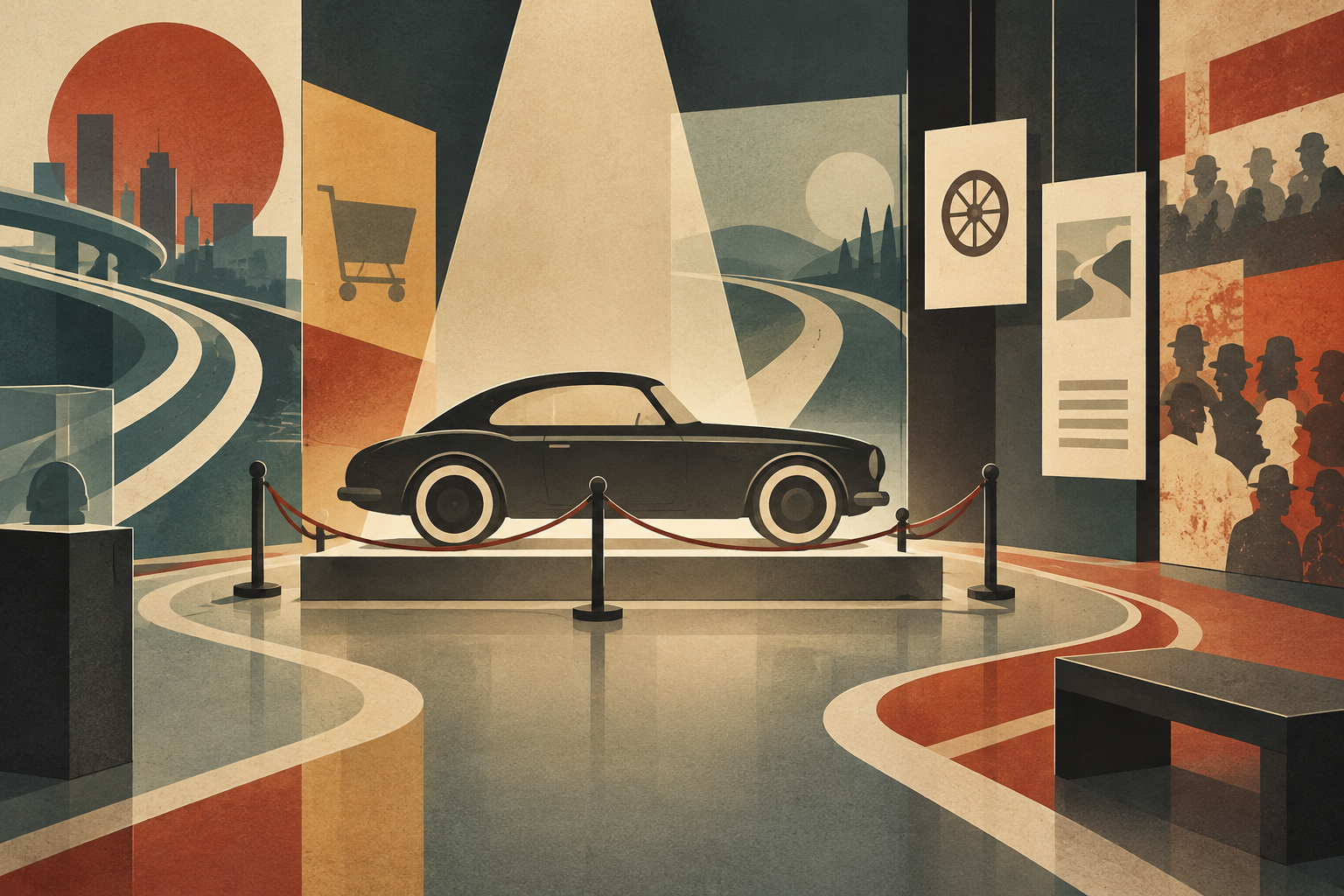
A displayed car seems to offer a simple answer: here is the object, its shape and materials visible. Yet a museum changes the question. The issue is no longer how the car moves, but what it can tell us about technology, consumption and social life. An academic study of the automobile as an exhibition object describes it as a consumer good with considerable influence on society from the twentieth century to the present, and examines its educational potential in museums. That approach makes the vehicle more than an isolated artefact, but it does not justify assigning it a particular history without object-specific documentation.
From everyday use to display
An exhibition removes the car from ordinary use. That distance can make it legible in a new way: visitors can observe it, compare it and ask where it belongs in material culture. Physical presence alone, however, cannot reconstruct a vehicle’s life. The available sources identify no models and provide no production dates, performance figures or individual histories. Claims about a particular example would therefore require further evidence, such as catalogue documentation or records linked to the object.
The distinction matters because museum narratives bring together two planes that should remain clear. One consists of verifiable facts about the exhibit; the other interprets what the car might represent. Interpretation can be rigorous without pretending to be a technical record. Conversely, a list of specifications cannot by itself explain the social relationships that give an object meaning.
Consumption and social influence
The cited study places the automobile’s social influence across a span from the twentieth century to the present. That framing makes it possible to consider the car as part of consumer culture, rather than merely as a technical solution. But the available summary does not explain how that influence was distributed, which groups experienced it or how it varied across places. Those nuances should not be filled in with a general narrative presented as though it were documented for every context.
A museum, in this respect, can pose questions rather than close the story. What patterns of consumption can the automobile help us examine? What ideas about mobility emerge when it is compared with other forms of transport? The sources support interest in these dimensions, but provide no evidence to answer such questions for a specific brand, model or community.
A vehicle as a place of encounter
The UNESCO text on the myth of the automobile offers a concrete but limited cultural image: it mentions teenagers going to gathering places in cars or on motorcycles, which also serve to get around. The observation connects vehicles with movement and sociability. It does not describe a universal experience, nor show that young people in every period used vehicles in the same way. It does suggest that mobility can be part of collective life and of the settings where relationships form.
In a gallery, that reference can shift the focus. The automobile appears not only as a machine, but as something tied to journeys, meetings and social use. To develop that interpretation around a particular exhibit would require information about its provenance and context. The UNESCO mention offers a line of inquiry, not the biography of a displayed vehicle.
The museum’s educational role
The study of the automobile’s educational potential explicitly places learning within its scope. An exhibition can organise questions and connect a consumer object to broader themes. The supplied evidence, however, describes no activities, teaching methods or learning outcomes. It would be inaccurate to attribute a specific educational practice to the study based only on its title and summary.
The curatorial challenge is nevertheless clear: teach visitors how to look. A museum can distinguish what it knows about an object from what it proposes to interpret. This transparency does not weaken the account; it allows the public to see which claims rest on documentation and which function as open cultural questions.
A museum needs limits, too
A separate study of the National Museum of Transport outlines conceptual directions for a state museum devoted to transport and public works. The available summary does not detail those directions or support claims about a specific exhibition design. Its presence broadens the frame: a car may belong within a history of transport, but the sources do not say how it should be related to other vehicles or infrastructure.
That limit is useful. It prevents a general reflection from turning into an invented description of a collection, and reminds us that an object’s facts need to be checked individually. The evidence supports treating the automobile as a consumer object, a potential educational resource and a symbol associated with mobility and gathering. It does not establish which particular vehicle embodies these dimensions or what technical characteristics it has.
What a car can tell us
On entering a museum, a car remains a material object, but its meaning no longer depends only on how it works. It can open a conversation about consumption, education, movement and sociability, provided the exhibition separates documented facts from interpretation. The practical conclusion is also a caution: before telling the story of an individual vehicle, identify it and consult its records. Without that work, the exhibit raises cultural questions; it does not, by itself, supply verifiable historical answers.
- Decade
- 2000s
- Region
- Global
- Level
- Introduction
- Entities
- Museum
Sources and references
- Todo listo para la Noche de los Museos - Prensa Cbaprensa.cba.gov.ar · 2026-10-15
- Desarrollo y conservación del patrimonio cultural-natural en el contexto neoliberal y nuevas tecnologíasdoi.org · 2026-10-15
- el caso del Museo Nacional del Transporte Mikel Asensio ...core.ac.uk · 2026-10-15
- El automóvil como objeto expositivo y su potencial didácticowww.tdx.cat · 2026-10-15
- El Mito del automóvilunesdoc.unesco.org · 2026-10-15