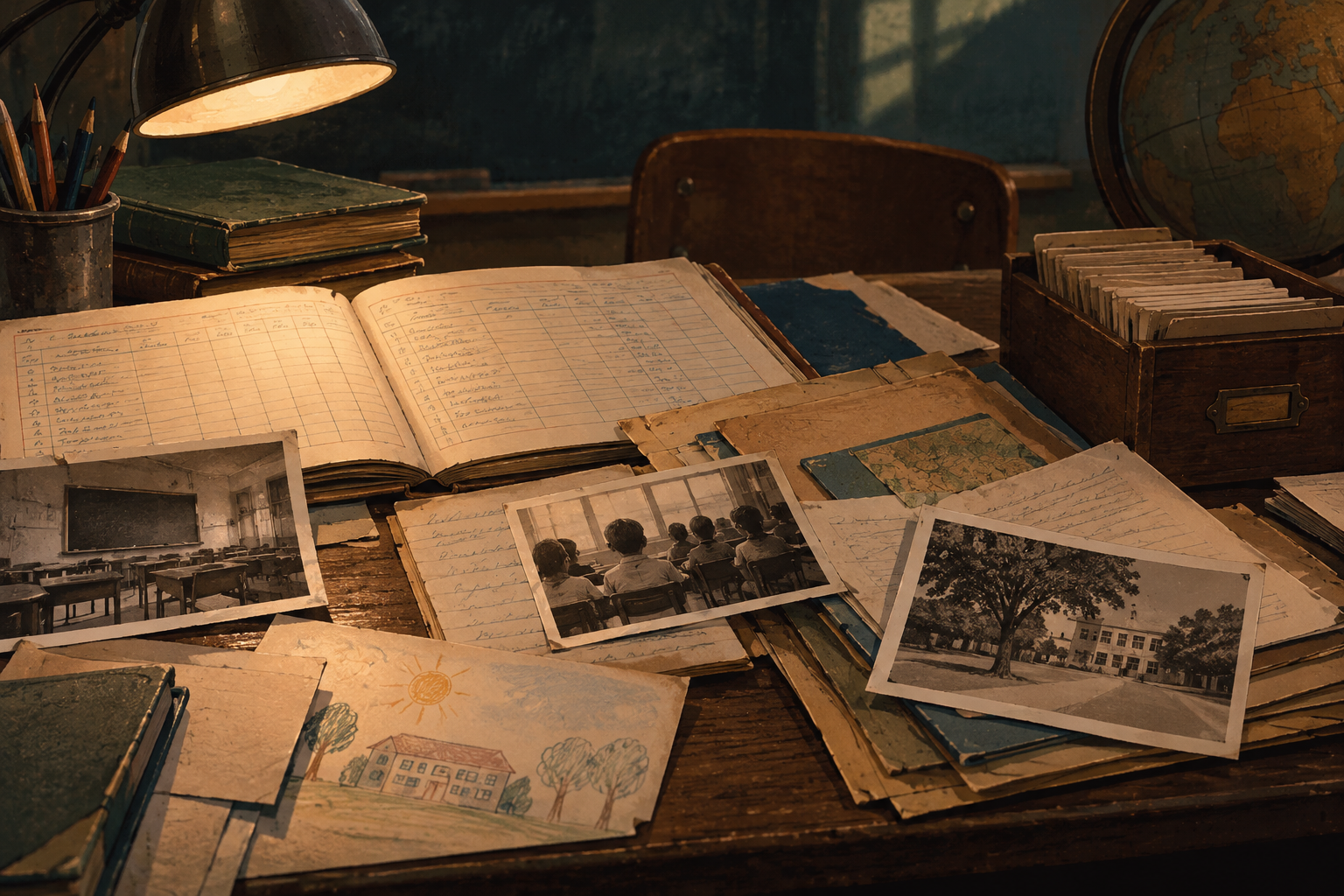
School often appears in history as an institution: a framework for teaching, organizing knowledge and transmitting rules. It is also a place where part of everyday life unfolds. Looking at it from this angle shifts attention towards the practices, objects and relationships that make a school space recognizable. Documents, images and testimony can help reconstruct that setting. None offers a complete portrait on its own; each provides a partial view shaped by the conditions in which it was produced and preserved.
That caution does not diminish the value of sources. It makes it possible to ask more precisely what kind of knowledge each trace can provide. A document may record a decision or an activity; an image fixes a selected scene; testimony conveys memory from a personal perspective. Read together, they can broaden the field of view, but they do not erase their own limits or turn one person’s experience into everyone’s.
School as a lived place
I. Macera’s 2011 article proposes a subjective, everyday route for thinking about how school is composed as a place. The formulation discourages treating the school environment as a neutral container. A place takes on meaning through uses, habits and memories, although the available evidence does not describe a particular school in detail or allow a specific scene to be reconstructed. What it does support is a perspective: studying school also means attending to how it is lived and represented.
This shift matters because institutional histories can push daily life into the background. The question is no longer limited to what was taught or how a school was organized. It also asks which activities and relationships become visible in the sources, and which remain outside them. An everyday-life approach opens questions; it does not answer them in advance.
Sources do not speak for themselves
Documents, images and testimony are not transparent windows onto the past. Their reach depends on who produced them, for what purpose, and on the conditions that allowed them to survive. Research on documentary heritage and school archives offers a framework for considering both the educational use of these materials and the decisions involved in selecting and interpreting them. The available references point to this field, but do not support attributing more specific findings to those studies.
It is therefore useful to distinguish a source from the interpretation built from it. The fact that an archive preserves a document shows that the document survived; by itself, it does not show that it represents every activity or voice in the school environment. Likewise, the absence of a record does not automatically prove that a practice did not exist. It may mean, among other things, that it was not documented or that the material was not preserved.
The image that seems representative
A teaching resource on sources from the past offers a specific example: traditional images used in schools for many years gave prominent space to street vending. This observation makes it possible to examine how visual selection can influence what is presented as everyday or representative. A repeated image becomes familiar, but familiarity does not guarantee that it describes the experiences of different places or groups equally.
The example does not establish how street vending was represented in every school or who appeared in each image. Its value is narrower and methodological: it prompts questions about who selected the scene, what idea of everyday life it conveys, and which other activities may have gone unrepresented. An image is evidence of a way of representing something, not necessarily a measure of how often that thing occurred.
Between archive and experience
Documentary heritage and school archives can connect historical inquiry with concrete materials. That connection requires reading each item in context and not confusing an object or document’s presence in an archive with a complete representation of the past. The available references identify archival research and its use in teaching as topics of interest; the evidence provided, however, does not detail specific methods or findings that would support describing a particular school practice.
Testimony also needs to be read in context. It can offer memories and perspectives absent from other materials, but it should not automatically be treated as a collective voice. Comparing sources can reveal agreements, differences and silences. When there is not enough information to resolve a discrepancy, the rigorous response is to preserve it as a limit of interpretation.
What can be claimed
The evidence supports a limited point: studying school as part of everyday life requires attention to the traces available and to the conditions that made them visible. It also supports the observation that image selection shapes the construction of what seems representative, and that documentary archives can provide material for historical research and teaching.
It does not identify a school, decade or social group as the subject of a detailed reconstruction. Nor does it allow us to describe the experiences of particular students, teachers or families, or to measure the prevalence of a given practice. Keeping this boundary clear does not weaken the analysis; it prevents partial clues from becoming sweeping claims.
A history made of questions
Everyday school life is not reconstructed through a single privileged source, but by asking what each item records, from what position and with what absences. An image may prompt a question about representation, a document one about preservation, and testimony one about memory. Together, they offer ways to investigate how an educational institution also becomes a lived place.
The concrete conclusion is methodological: each trace should be read for what it can support, not for what we would like it to prove. This lets a history of school recognize the value of its documents and testimony without mistaking them for a complete account of every life that passed through it.
- Decade
- 2000s
- Region
- Global
- Level
- Introduction
- Entities
- No linked entities
Sources and references
- Reconstruir las historias de vida, de comunidad, de barrio...www.mineducacion.gov.co · 2026-10-15
- La vida cotidiana como recurso didáctico y fuente de ...dialnet.unirioja.es · 2026-10-15
- La visibilidad de lo cotidiano. Didáctica, Historia y fuentes ...revistas.usal.es · 2026-10-15
- Las fuentes como puertas de entrada al pasadowww.noveduc.com · 2026-10-15
- El uso del patrimonio documental para Educación Primaria y ...papiro.unizar.es · 2026-10-15
- Cosas de escuela: Aproximaciones a la vida cotidiana ...www.scielo.org.ar · 2026-10-15