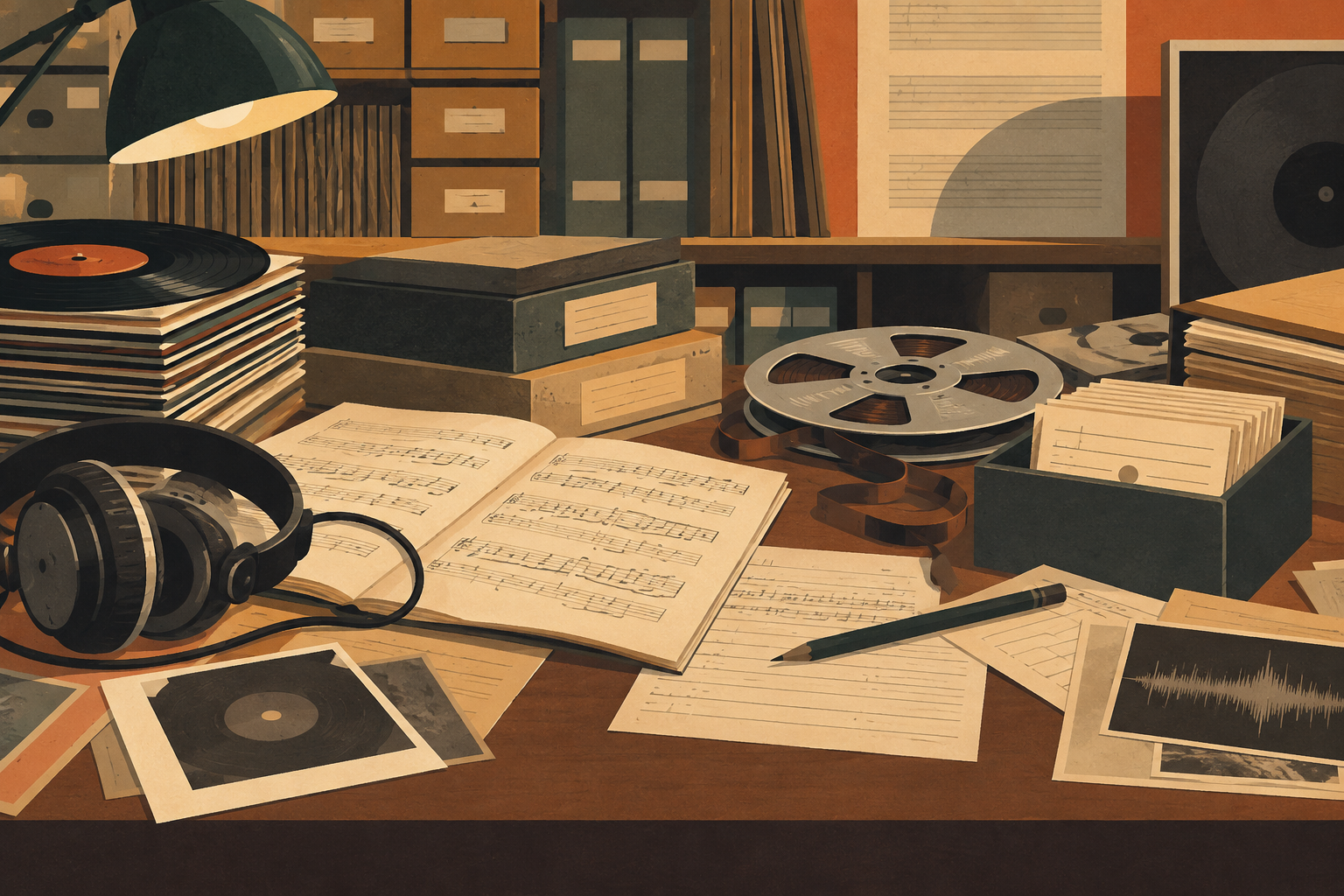
A music archive is not a collection of songs kept in one place. It may bring together scores, images, records of institutional activity and other materials documenting musical practices and institutions. The pages of El Museo Canario, the National Museum of Performing Arts and Barcelona’s Museu de la Música describe different kinds of holdings; a 2024 article also frames the challenge of finding songs in the streaming era. Together, these sources prompt a focused question: what does it mean to preserve music when the documents around it are not the music itself?
A score is a doorway, not the whole building
El Museo Canario describes a guided visit devoted to musical holdings in its archive, taking written music—particularly scores—as its starting point. This makes the score visible as a document that can be consulted, but it does not justify assuming that the entire collection consists of scores or that every preserved piece has an associated recording.
A score preserves a written form of music. It can help researchers study notation and repertoire, but it does not, by itself, contain every aspect of a particular performance. The distinction matters: a history built only from written material risks overlooking what was never recorded in that format. This is a methodological caution, not a claim about specific gaps in the collections mentioned here.
Archives also reflect institutions
The National Museum of Performing Arts’ Music Archive says that most of its musical heritage comes from the Museum-Archive of the Teatro Real, established by its director, Luis París, in 1919. The institutional page therefore offers provenance information and a precise date for understanding part of the formation of its collections. The available material does not list every document currently held in the archive or trace the history of each acquisition.
That limit is a reason to read the word “heritage” carefully. An institution’s holdings enable research into what reached it and how it is described; they do not automatically represent all musical activity in a period. Catalogues and introductory pages are guides to access, not substitutes for examining the objects or proof that anything not mentioned never existed.
Images and metadata tell stories too
Barcelona’s Museu de la Música reports that its Multimedia Archive contains more than 60,000 items documenting the museum’s collections and activities. The examples named include identification and restoration photographs. The figure and examples point to another dimension of preservation: alongside musical objects, an institution may keep images and records that help document what it holds and the work it carries out.
An identification photograph can help an object be recognised; an image connected with an intervention can provide visual documentation of that process. The brief description, however, does not explain the multimedia archive’s complete composition, cataloguing criteria or access conditions. It is therefore important to distinguish what the page states from what would need to be checked in catalogues and documentary policies.
From document to findable song
A 2024 article in the journal PH asks, in its title, “Where are the songs?” and frames the challenge of music archiving in the streaming era. Its summary mentions an event that included the presentation of a joint initiative by Subterfuge Records and Spain’s National Library. The source establishes the topic and that reference to the event; the available excerpt does not describe the initiative or its results in detail.
The article’s question points to a practical difference between preserving a document and being able to locate a song. In a digital-distribution environment, finding a work may depend on how it is identified and linked to its records. This broad interpretation helps explain the issue, but the supplied sources do not specify technical formats, protocols, particular catalogues or the scope of the initiative mentioned. It would be unwise to present those details as facts documented here.
Gathering and preserving require a method
A 2005 academic paper on the organisation of music archives argues, in the available excerpt, that music matters to cultural identity and that this heritage needs to be gathered and preserved appropriately. That formulation focuses attention on work that often remains outside the act of listening: deciding what to collect and how to preserve it so it can be consulted.
The Ministry of Culture document titled “Music Through Time” offers another general point: music plays a part in private celebrations, public events and historical events. Read alongside the museum pages, it encourages us to consider how a music archive can document more than one dimension: written repertoires, institutional collections, images and activities. It does not, however, justify attributing all these kinds of material to any single collection.
What these sources allow us to say
The sources offer a limited picture, not a comprehensive inventory of Spanish music archives. One museum highlights scores and musical holdings; another notes the main provenance of its heritage; a third gives the size of its multimedia archive and mentions photographs. A recent article frames the challenge of songs in streaming, while an earlier academic text stresses organisation and preservation.
The editorial conclusion is straightforward: preserving music means attending both to works and to the documents that describe, contextualise and make them findable. But each medium answers different questions. A score is not a performance; an image is not a substitute for the object; a web description is not a full catalogue. To understand what has been preserved, we should first identify the document in front of us and what it can actually demonstrate.
That caution does not diminish the value of archives. It makes our approach more precise. Rather than imagining a complete collection, we can follow verifiable clues: which institution holds the material, what kinds of material it describes, what activity it documents and what questions remain open. Musical history then appears not as an intact sound inside a box, but as an inquiry built from evidence of different kinds.
- Decade
- Contemporary
- Region
- Spain
- Level
- Introduction
- Entities
- Museum, Museo Nacional de Artes Escénicas
Sources and references
- “Los Sonidos del Archivo”, una visita para conocer el ...www.elmuseocanario.com · 2026-09-29
- Archivo Musical - Museo Nacional de Artes Escénicasmuseodeartesescenicas.inaem.gob.es · 2026-09-29
- EDR | Museu de la Músicaajuntament.barcelona.cat · 2026-09-29
- la organización de archivos musicales marco conceptual ...agora.edu.es · 2026-09-29
- ¿Dónde están las canciones? El reto del archivo musical en la ...www.iaph.es · 2026-09-29
- La Música en el Tiempowww.cultura.gob.es · 2026-09-29