A heritage that does not fit inside a cartridge
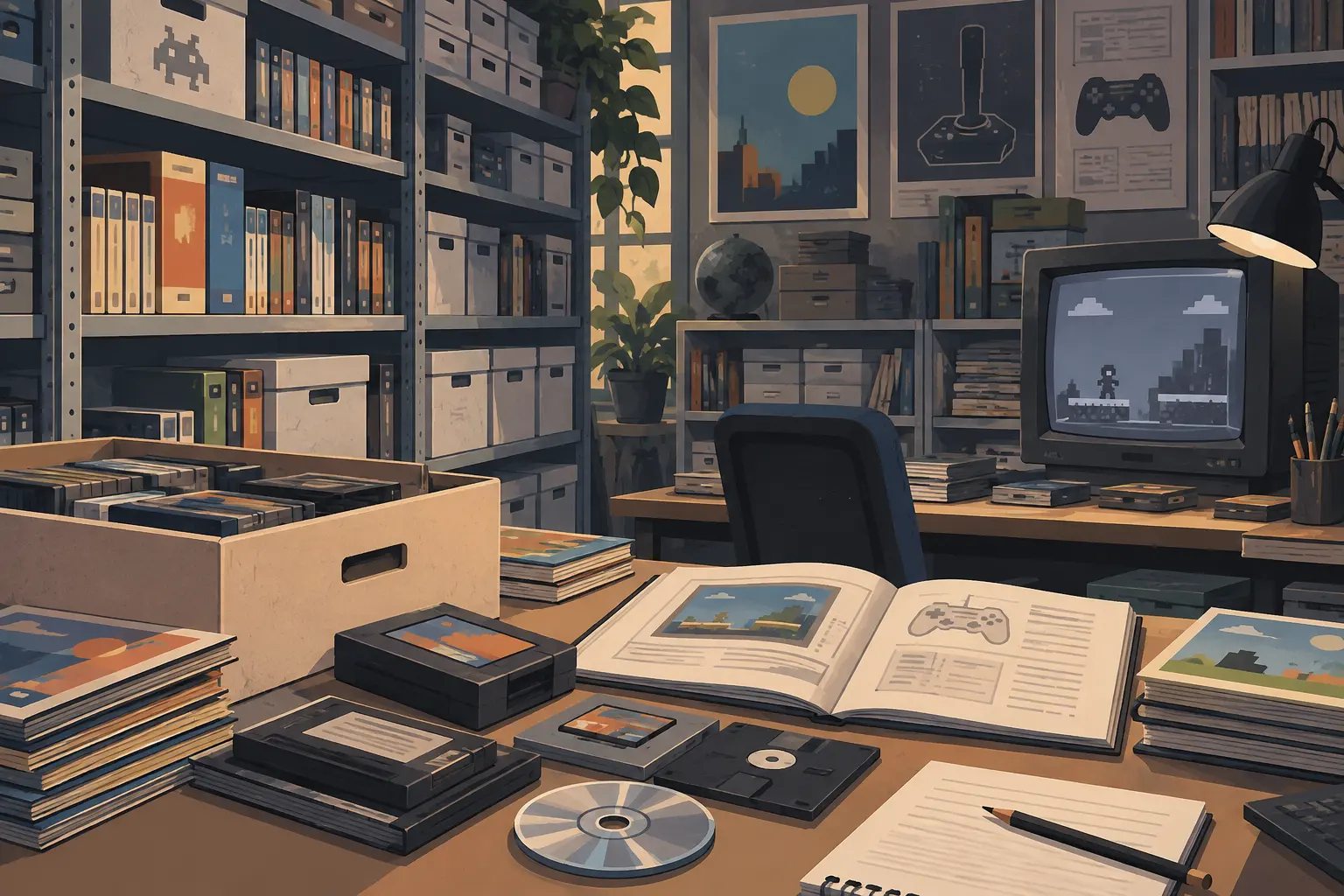
Video-game preservation can sound like a simple task: keep a console and its games so that they continue to exist. The work of Spanish museums and archival projects points to a broader reality. Video games have depended on machines, software, firmware, documentation, advertising, publications and audiovisual material. If one element disappears, playing may not become impossible, but an essential part of how a game was made, circulated and understood can be lost.
The Museo del Videojuego says it began work in 2000 to gather, organize and preserve information and materials related to video games and computing, building an archive to help understand their technological, cultural and social development. Over time, the project expanded from cataloguing games and systems to include magazines, manuals, catalogues, advertising, documentation, photographs, recordings and other related materials. The museum describes its work as cataloguing elements connected to the industry, recovering publications and records, and connecting objects and documents to reconstruct the context in which they were created, used and circulated. It presents its digital archive as a growing project and aims to make the material it has gathered available for consultation, comparison and study. That breadth matters: a history reduced to famous titles leaves out the media and records that help explain the medium.
The object is not the only record
The Museo del Recreativo describes preserving, restoring, conserving and making visible materials related to games and associated technologies as part of its work. It distinguishes restoration—repair and maintenance—from preservation, which it describes as protecting and maintaining information through techniques such as reverse engineering, backups, photography, printing and digitization. It describes conservation as keeping materials in good condition and protecting them from time, temperature, humidity and other harmful factors. To make materials visible, the museum says it provides physical and digital means to consult, display and teach with materials held there, including documentation, machines, software and hardware. This is a statement of purpose; it does not mean that every item is available in both formats. A circuit board, manual, poster, magazine, guide or trade-show video can each supply different information, in addition to what a working machine can show.
The Museo del Videojuego’s digital library presents documentation and printed publications, editorial and technical materials, catalogues, manuals, maps, advertising and audiovisual materials, including advertisements, promotional videos, trailers, intros, demos, and content from CDs and DVDs. The page distinguishes categories with materials from those marked “Coming soon”: guides, books, CDs and DVDs, and fairs and events are among the latter. The description of the fairs-and-events category mentions historical material from E3, CES and the Tokyo Game Show, but because that category is marked “Coming soon,” it should not be described as an already accessible collection. Materials that are available can help reconstruct how a product was presented and what documentation circulated around it.
Hardware, software and dependencies
Video games present a particular challenge because the work and its technical setting are closely tied together. Preserving data alone does not resolve how it can be read again or how the software used to create it can be run. In his review of digital-preservation strategies, Stewart Granger identifies two problems: the fragility of digital media and the obsolescence of hardware and software. He also explains that migration—transferring data from a platform threatened by obsolescence to a newer one—can risk losing data, functionality or the original “look and feel.” Emulation offers another possibility: accessing original data or running original software on a current platform with software that emulates the original platform.
Neither approach automatically preserves every aspect of an experience. Granger explains that, beyond intellectual content, appearance and feel, interactivity, display characteristics, peripherals, speed and other features of the environment may matter. He presents emulation as a strategy that may play a role in preservation, not as a universal solution or a guarantee that every aspect will be retained: its suitability depends on the material and on what one aims to preserve. Documenting files, software, technical configuration, metadata and use context helps make these dependencies explicit.
CAMiLEON: evaluating emulation
CAMiLEON—Creative Archiving at Michigan and Leeds—was a joint project of the University of Michigan and the University of Leeds, funded by NSF and JISC. In his article “Emulation as a Digital Preservation Strategy”, Stewart Granger, the project’s UK coordinator and affiliated with the University of Leeds, presents it as an initiative to assess emulation as a digital-preservation strategy. The citation is D-Lib Magazine, volume 6, number 10, October 2000, ISSN 1082-9873 (DOI: 10.1045/october2000-granger).
The work plan Granger describes included evaluating publicly available emulators, exploring emulator development, and conducting test cases involving the Apple II and BBC Micro—including investigating the application of emulation to the BBC Doomsday Project—from both technical and user perspectives. It also envisaged user trials comparing original systems with their emulations, and a cost-benefit analysis of emulation against other digital-preservation strategies.
The article presents these activities as work the project intended to undertake; it does not demonstrate that every study was completed or that a definitive solution was found. Granger considers that emulation may have a strategic role, but writes, “I do not believe that emulation can resolve all digital preservation issues.” This is his assessment, not an experimental result demonstrated by the project. He also examines metadata, documentation, intellectual-property rights and organizational questions. The practical lesson for video-game preservation is specific: keeping a copy and a way to run it is not enough unless the required environment, the functions one hopes to retain and the limits on access are also recorded.
Selecting is also interpreting
Every collection selects what it gathers, describes and makes available. Decisions about what to catalogue, digitize or display shape what people will be able to consult in the future. Clear records of what is preserved and how it is presented are therefore useful: they help distinguish an object or document from later interpretations built around it. Nostalgic accounts may offer an entry point, but they do not replace documentation.
Preserving in order to consult and teach
Conservation can also make consultation, exhibition and teaching possible. The Museo del Recreativo says it provides physical and digital means to consult, display and teach with materials held by the museum; this is a statement of purpose, not a claim that every item is available in both formats. The Museo del Videojuego’s digital archive says it seeks to preserve, catalogue and facilitate access to documentation, publications and audiovisual materials.
Video games can also be used as means of cultural communication. Ana Ordás describes NUBLA as a console game inspired by the Thyssen-Bornemisza Museum and its works, and as an educational project with a narrative related to art history and literature. It is a specific example of an institution engaging with video games not only as objects that can be preserved, but also as a format for bringing content to an audience. It does not establish that all cultural projects work in the same way.
A layered memory
Video-game preservation cannot be reduced to accumulating boxes or retaining an executable copy. It requires attention to objects, programs, documents and contexts; making them available for consultation where possible; and recognizing the technical, legal and material limits of each strategy. Migration and emulation can address different problems, and neither guarantees that every property of an experience will be retained.
The task will remain incomplete: media and programs can become obsolete, and every collection selects. That is why it matters to preserve and describe publications, manuals, advertising, photographs, recordings and documentation as well. These layers contain a substantial part of video-game history: not only what was played, but how it was made, how it circulated and what conditions made access possible.
- Decade
- Contemporary
- Region
- Spain
- Level
- Enthusiast
- Entities
- Salón recreativo, PlayStation, Museum, Museo del Videojuego, Museo del Recreativo, Apple II
Sources and references 9
- Objetivo del Museo del Videojuego | Museo del Videojuegowww.museodelvideojuego.com · 2026-09-20
- Videojuegos para bibliotecas, archivos y museos – Ana Ordásanaordas.com · 2026-09-20
- Misión – Museo Arcade Vintagemuseoarcadevintage.com · 2026-09-20
- "Everything not saved will be lost": de museos, archivos y preservación de videojuegos - Caninowww.caninomag.es · 2026-09-20
- Fondo de Preservación | Museo del Recreativomuseodelrecreativo.es · 2026-09-20
- Descargas | Museo del Videojuegowww.museodelvideojuego.com · 2026-09-20
- Emulation as a Digital Preservation Strategy — Stewart Granger, CAMiLEON UK Project Co-ordinator, October2000 · 2026-11-15
- https://www.museodelvideojuego.com/nuestra-historia · 2026-11-15
- https://doi.org/10.1045/october2000-granger · 2026-11-15