The traces that make a history
The history of Panamanian cinema is made up of more than films. It also survives in newsreels, records of public events and the media held in institutional archives—some preserved, others at risk of loss. Following these traces reveals a history of uneven production and shows why preserving, describing and making materials available for consultation are themselves part of cultural history.
According to a historical account published by La Estrella de Panamá, the earliest known filming in the country recorded work on the Canal. The U.S. Army’s film unit made these images from 1904 onward. The same publication places the start of the cinema business around 1915 and says Robert Wilcox, based in Colón, may have been the first to distribute and exhibit films. It presents this as an attribution: the article says “some” consider him the first, rather than treating the claim as settled fact.
From newsreels to an uneven tradition
Local activity took shape in the decades that followed. La Estrella reports that Panamanian cameraman José Antonio Sosa and French laboratory technician John de Pool made the first Panamanian newsreels by hand in the 1920s and 1930s. For the 1940s and 1950s, it mentions newsreels filmed by Manuel Ricardo Sánchez Durán and the later Revista Nacional, produced by John H. Heymann and Jorge Carrasco.
These milestones do not describe an industry that expanded continuously. In statements quoted by the newspaper, filmmaker and teacher Edgar Soberón Torchía characterizes its development as spontaneous and discontinuous. Abner Benaim, meanwhile, emphasizes cinema as an expression of Panamanian culture and a dialogue with other cultures. These are the interviewees’ perspectives, not a single explanation of the sector’s development.
The distinction matters: a history marked by interruptions and limited access to surviving materials is not the same as a history without production. Films, newsreels and other records may circulate unevenly as their physical media age and their contents remain unidentified. Archives are part of the response, though their collections do not necessarily cover the country’s entire output.
GECU: preserving media and content
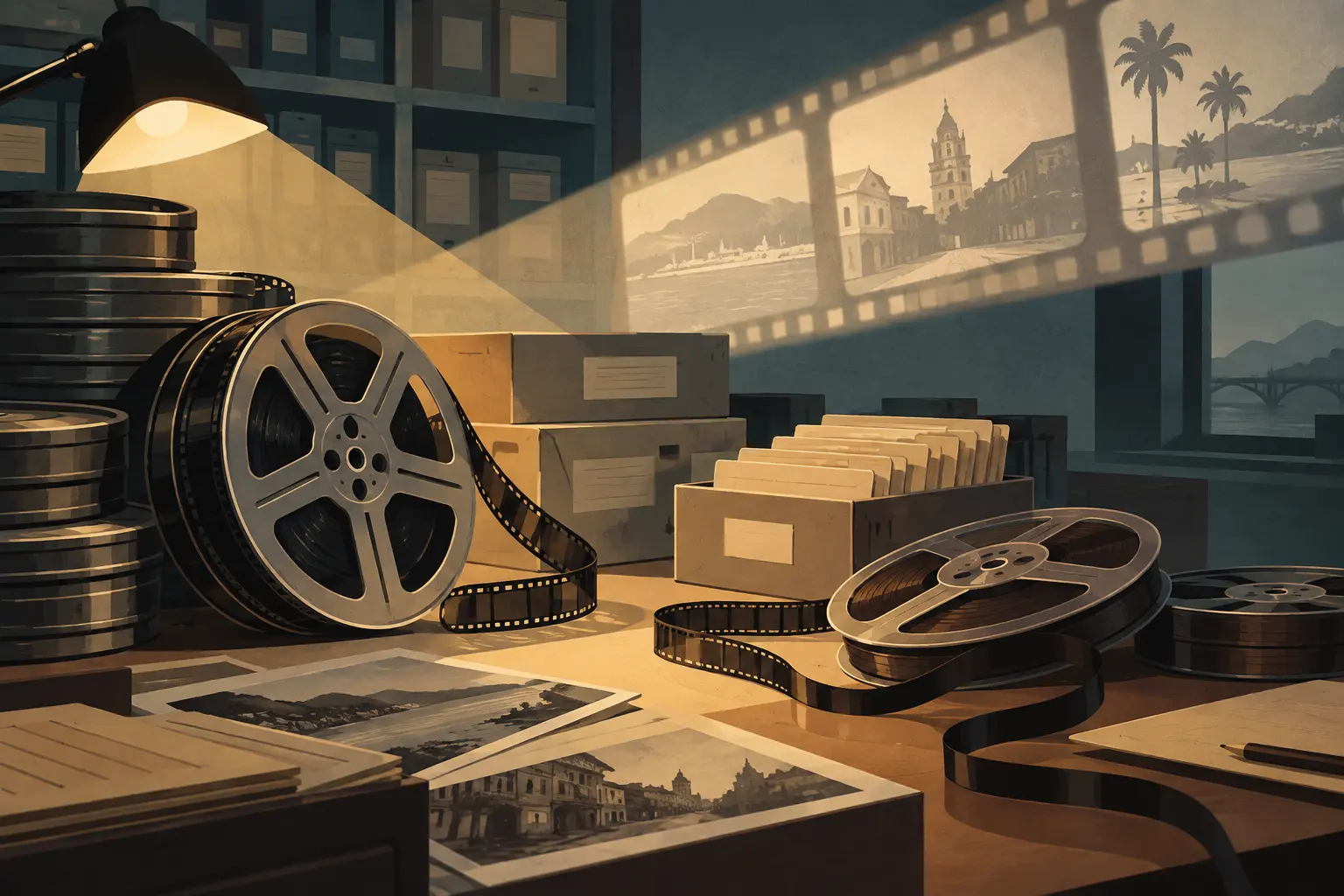
The Grupo Experimental de Cine Universitario (GECU), affiliated with the University of Panama, combines filmmaking with the preservation of a historical collection. Its Film and Audiovisual Archive describes 16 mm film, photographic negatives, slides, audio tapes and analog and digital video formats. The archive says its historical collection includes unpublished material from the 1960s, 1970s and 1980s, among it records related to the events of 9 January 1964, the Bayano hydroelectric plant and the Torrijos-Carter Treaties.
Its work includes cataloguing, documentation, conservation, repair and digitisation, as well as outreach. This combination shows why keeping a copy is not enough: the medium must be identified, its content described and conditions for consultation established. Without cataloguing, an image can survive physically yet remain difficult to find or interpret.
GECU has also described using AD-Strips to monitor chemical deterioration in 16 mm film associated with so-called vinegar syndrome. The results help identify materials requiring priority attention and guide decisions about conservation and digitisation. The archive has also said that limited space makes it difficult to separate deteriorating materials adequately. The situation illustrates the difference between holding a collection and having the conditions needed to preserve it.
Public access, consultation and rights
Panama’s National Library describes complementary work: recovering, organising, cataloguing and preserving Panamanian images and sounds scattered within and beyond the country. Its Audiovisual Centre provides on-site consultation of materials in formats including VHS, DVD, compact discs and cassettes; they cannot be borrowed. Its access rules provide for viewing and listening in designated spaces and require users to respect copyright and refrain from reproducing material without permission.
This model makes visible a tension inherent in audiovisual archives: enabling consultation while protecting both media and rights. Access does not always mean that a copy can circulate freely; it may instead take place in a reading room under conditions specific to the collection.
In July 2025, SERTV announced an agreement with the Pro National Library Foundation to make its own audiovisual productions available to the Foundation, with the aim of organising and preserving them and bringing them within reach of National Library users. The agreement also envisages cultural events, including screenings, conferences and themed programmes. It broadens the discussion from cinema to an audiovisual memory that includes television and educational and cultural content.
A memory held in different places
GECU, the National Library and SERTV have different roles and describe different collections. GECU preserves its own and gathered film and audiovisual materials; the National Library seeks to recover Panamanian records scattered across different locations; SERTV contributes its institutional archive. Neither separately nor together do they claim to represent the country’s entire output. They do show that audiovisual memory is distributed among institutions with different aims, materials and forms of access.
Preservation does not end with physically rescuing a film or digitising it. Cataloguing, documenting provenance and establishing consultation conditions make it possible to study and contextualise images again. A cinema screening, home video and archival consultation are different experiences; in the Panamanian case, what these institutions document above all is the work of turning scattered or vulnerable materials into organised, consultable collections.
Telling the history of Panamanian cinema through these traces helps avoid mistaking a lack of available copies for an absence of filmmaking. Films and newsreels are works and documents, but their place in public history also depends on less visible tasks: preserving the media, identifying their contents, clarifying conditions of use and enabling access. Through this daily work, archives keep open the possibility of looking at and studying the country’s images again.
- Decade
- 1970s
- Region
- Latin America
- Level
- Enthusiast
- Entities
- VHS, Sounds
Sources and references 5
- Colección Audiovisual - Biblioteca Nacional de Panamábinal.ac.pa · 2026-11-25
- ARCHIVO FÍLMICO AUDIOVISUAL | gecupanamawww.gecupanama.org · 2026-11-25
- SERTV Panamá | Noticias De Actualidad, Cultura Y Educaciónsertv.gob.pa · 2026-11-25
- El archivo audiovisual como patrimonio vivoupinforma.com · 2026-11-25
- El cine y el teatro panameño albergan una historia de esfuerzoswww.laestrella.com.pa · 2026-11-25