A soft toy with a social history
Textile dolls occupy a distinctive place in toy history: their material makes them easy to hold and carry, while their appearance can convey ideas about childhood and education. Pere Capellà Simó dates the beginning of the renewal of textile toys in Spain to the First World War. From then until the end of the 20th century, comfort dolls became one of the main branches of Spain’s toy industry, according to his synthesis published in Historia y Memoria de la Educación in 2022.
The significance of these toys lies in more than their manufacture or appearance. Capellà describes them as a channel for transmitting social imaginaries, where the educational values of a changing era could take root or come into conflict. Looking at a fabric doll therefore raises questions about play and the models of childhood around it, even though an individual object cannot answer them all.
From manufactured object to plaything
The term “comfort doll” emphasizes a relationship of use: the toy may accompany a child and become part of everyday experience, rather than simply being looked at. The academic source describes these dolls as warm and unbreakable; that characterization helps explain why textiles could suit a toy kept close to the body. It is not a specific instruction, however, and does not prove that every model was used in the same way.
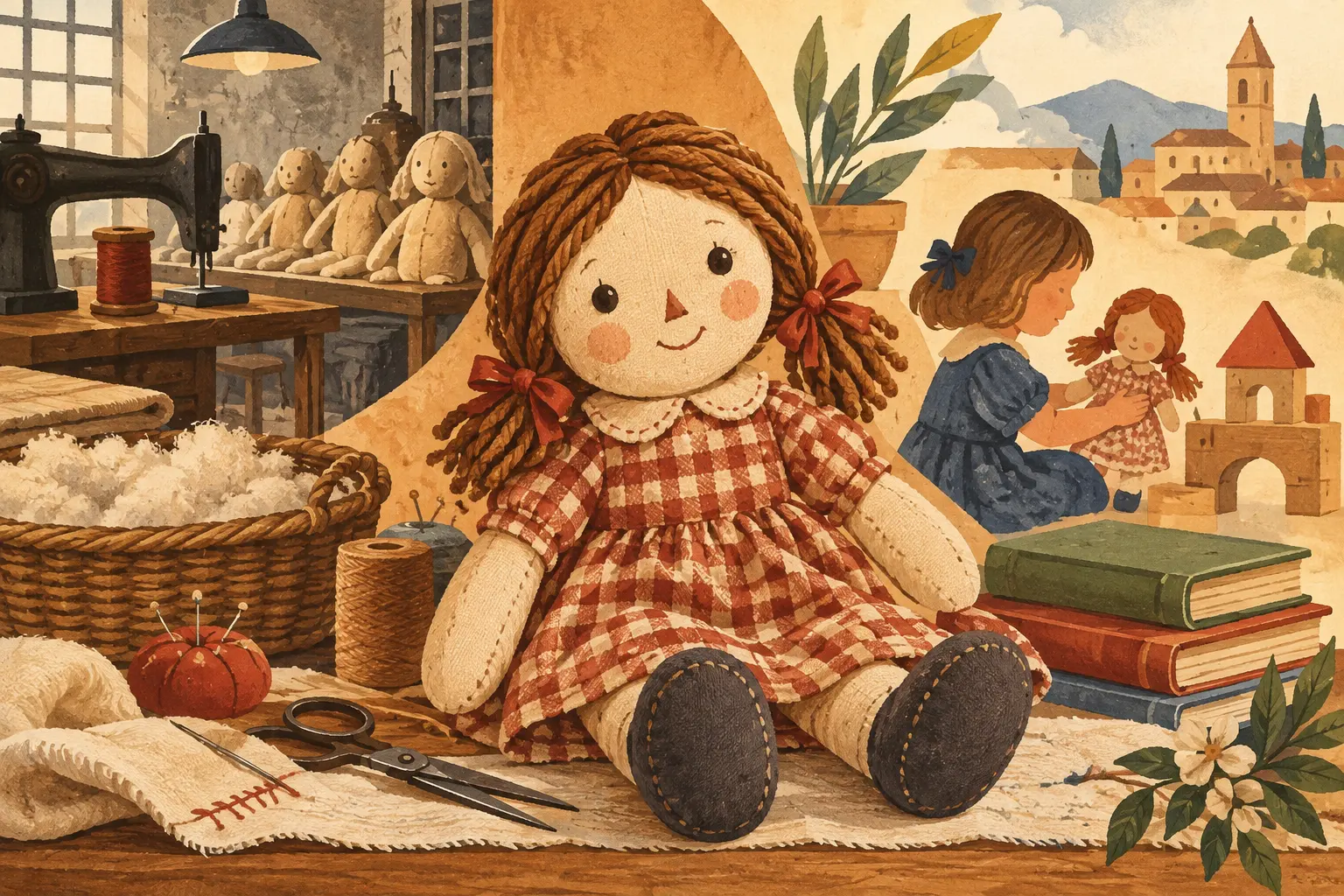
An object documented by the Virtual Museum of Human Ecology offers a material example. Made in Henche, Guadalajara, in 1984 by Margarita García Blanco, the doll is described as consisting of six cotton pieces—head, body and limbs—filled with sheep’s wool or, alternatively, straw, and decorated according to its maker’s taste. It is a particular example, not a universal pattern for Spanish fabric dolls.
The description makes several possibilities of the object visible: its sewn parts create a recognizable human form; the filling gives it volume; and its decoration allows for personal choices. The record does not preserve play instructions, so no particular activity can be attributed to this doll. It does show how a relatively simple construction could provide a figure to play with and give individual features to.
Industry, children’s culture and education
Capellà’s historical account expands the focus from school culture to children’s culture in all its variety. In this context, the textile doll is neither just an industrial product nor solely a handmade creation: it can be a plaything and, at the same time, an image reflecting social and educational ideas. The history of toys in Spain needs to be read with this coexistence in mind, rather than reduced to a simple opposition between factory and home.
The Henche doll illustrates a particular practice of making and personalizing a toy, while the academic study offers a long-term interpretation of the sector’s renewal and cultural role. These are different but complementary scales: the object reveals materials and choices of form; the synthesis places textile toys within the industry and the social imaginaries of the 20th century. Neither, by itself, justifies generalizing to a single experience shared by all children, families or manufacturers.
What instructions do—and do not—tell us
The historical value of an instruction depends on what it actually says. The sources described here do not reproduce factory instructions or printed rules for these dolls. They therefore cannot establish a prescribed sequence of play. They do, however, guide us in reading the object: its shape, texture and personal decoration invite us to consider touch, companionship and symbolic play as possible uses, not as actions proven for every example.
Reading the material object alongside its social history avoids two simplifications: assuming that a soft doll served only to comfort, or treating it as a decorative object with no place in children’s play. Between the toy industry and everyday experience there were many ways to play. The history of comfort dolls in Spain invites us to investigate precisely that variety, considering textile toys both for what they made possible and for the values and images they helped circulate.
- Decade
- 1970s
- Region
- Spain
- Level
- Enthusiast
- Entities
- Museum, Pere Capellà Simó, Muñecos de apego
Sources and references 5
- Muñecos de apego: apuntes para la historia del juguete textil en Españadialnet.unirioja.es · 2026-11-21
- Muñeca de trapo - Museo de Ecología Humanamuseoecologiahumana.org · 2026-11-21
- Resumen de Muñecos de apego: apuntes para la historia del juguete textil en España - Dialnetdialnet.unirioja.es · 2026-11-21
- Comfort Dolls: Notes for the History of Fabric Toys in Spain | Historia y Memoria de la Educaciónrevistas.uned.es · 2026-11-21
- CER.es Colecciones en Red - Búsqueda generalceres.mcu.es · 2026-11-21