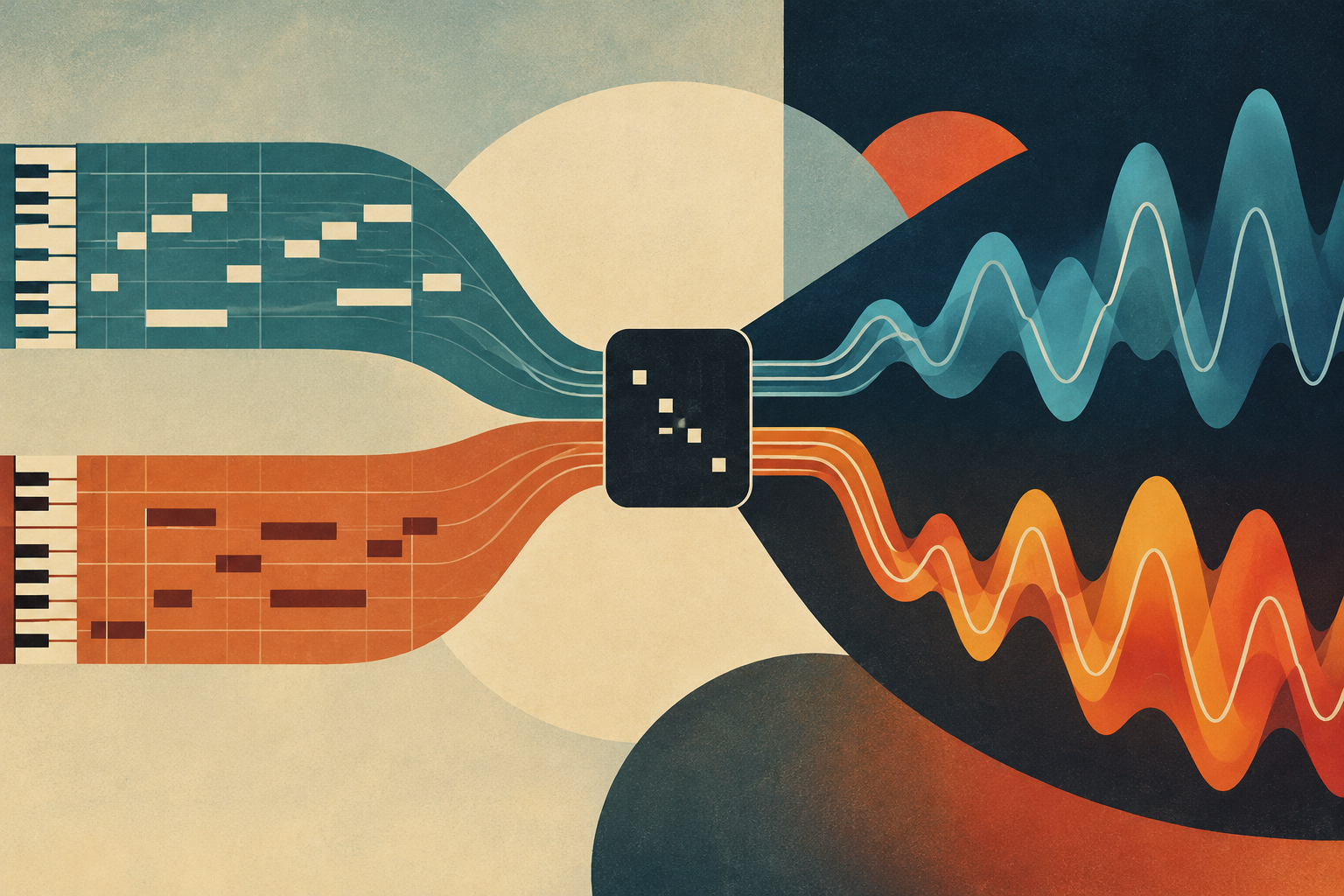
MIDI can appear in a production session, a sequencer, or a connection between electronic instruments. Its presence is often associated with synthetic sounds, but the standard is not itself a recording or an audio format. It carries data that can describe events in a performance. The sound ultimately heard depends on the instrument or module receiving those data. Separating these layers helps explain not only a technology but also a way of organizing music.
The distinction matters because a sequence can preserve musical instructions without fully determining the resulting sound. The same data sent to different equipment do not guarantee the same timbre. MIDI is not equivalent to a recorded acoustic performance: it enables compatible devices to exchange information and coordinate actions. In digital production, this separation between instructions and sound makes it possible to treat performance as manipulable information, although the available material does not detail the specific technical operations involved.
A standard for instruments to communicate
The evidence places MIDI’s official presentation in 1983 and credits its proposal and development to Dave Smith, founder of Sequential Circuits. This is a useful starting point, but not enough to recount in detail every conversation, decision, or interest that shaped the standard. What the available information does support is that MIDI was conceived as standardized data communication between electronic musical instruments.
That idea addresses a problem of coordination. When compatible devices can exchange instructions, production is no longer confined to each instrument considered in isolation. The standard offers a shared framework in which different equipment can take part in the same sequence of events. It does not turn those devices into a single sound source, nor does it determine how a piece should sound. Its role is to make the exchange of musical information possible.
The sequence as a way of working
Sequencers can program and play back musical events in a particular order; the evidence identifies MIDI as their most widespread control interface. This connection helps explain why the standard is associated with changes in digital music production. A sequence can organize events, and electronic instruments can receive data that guide their performance.
The cultural shift is not simply the addition of a technological layer to music. It also changes what can be edited: alongside working with sound that has already been recorded, it becomes possible to arrange information that another device will turn into sound. This distinction does not make one approach more creative or authentic than the other. It shows that recording a signal and encoding musical events are different operations, with different consequences for work and listening.
The sound comes from elsewhere
A MIDI file does not necessarily produce a single, fixed sonic result. The data require an instrument or module to interpret them, and the character of the sound depends on that receiver. Confusing MIDI with audio can therefore obscure a central part of the experience: the standard organizes instructions, while the device supplies the particular sound.
This dependence also means that the idea of “the same piece” needs qualification. A sequence of data may preserve an arrangement of events without preserving exactly the timbre of a particular performance. An audio recording, by contrast, fixes a sound signal, although it too depends on its own conditions of recording and playback. The available evidence supports this general distinction but does not allow a precise account of how each instrument behaves or which parameters MIDI transmits.
A quiet infrastructure for digital production
The sources connect MIDI’s adoption with the evolution of digital music production and sequencing systems. This helps place it culturally: not as an instrument that sounds on its own, but as coordination infrastructure linking processes of composition, programming, and performance. Its importance may lie precisely in that discretion. Audiences hear the instruments’ results, not necessarily the data exchange that helped organize them.
A simple, linear history should also be avoided. The supplied material does not reconstruct the conditions of adoption, differences between implementations, or later revisions of the standard. Nor does it offer a complete timeline of digital music. We can describe MIDI’s broad role in communication between devices and its association with sequencers, but cannot credit it alone with every change in production practice.
What the evidence supports
The available information supports three central points: the standard’s official presentation in 1983, the attribution of its proposal and development to Dave Smith, and its function as data communication between electronic instruments. It also supports a general connection to sequencers and digital music production. It does not suffice to explain the full content of the specifications, the historical negotiations, or the course of each revision.
That caution does not diminish MIDI’s cultural interest. It encourages us to distinguish a work from the instructions that organize a performance and the sound produced by a device. MIDI makes visible that digital music can be transmitted as data without those data being, in themselves, the sonic experience. Its clearest legacy in the available evidence is that of a coordination language: since its presentation in 1983, it has offered a way to think about compatible instruments sharing information and about production separating—and bringing together again—composition, performance, and sound.
- Decade
- 1980s
- Region
- North America
- Level
- Enthusiast
- Entities
- MIDI, Sounds
Sources and references
- El MIDI cumple 40 años -breve historia de su inicio y ...www.futuremusic-es.com · 2026-10-15
- ¿Qué es MIDI? La guía esencial - InSynctranslate.google.com · 2026-10-15
- [Columna] Historia y evolución de DTM (DAW): cómo ha ...monumental-movement.jp · 2026-10-15
- Sintetizadores.wikipedia.org · 2026-10-15
- Secuenciadores.wikipedia.org · 2026-10-15