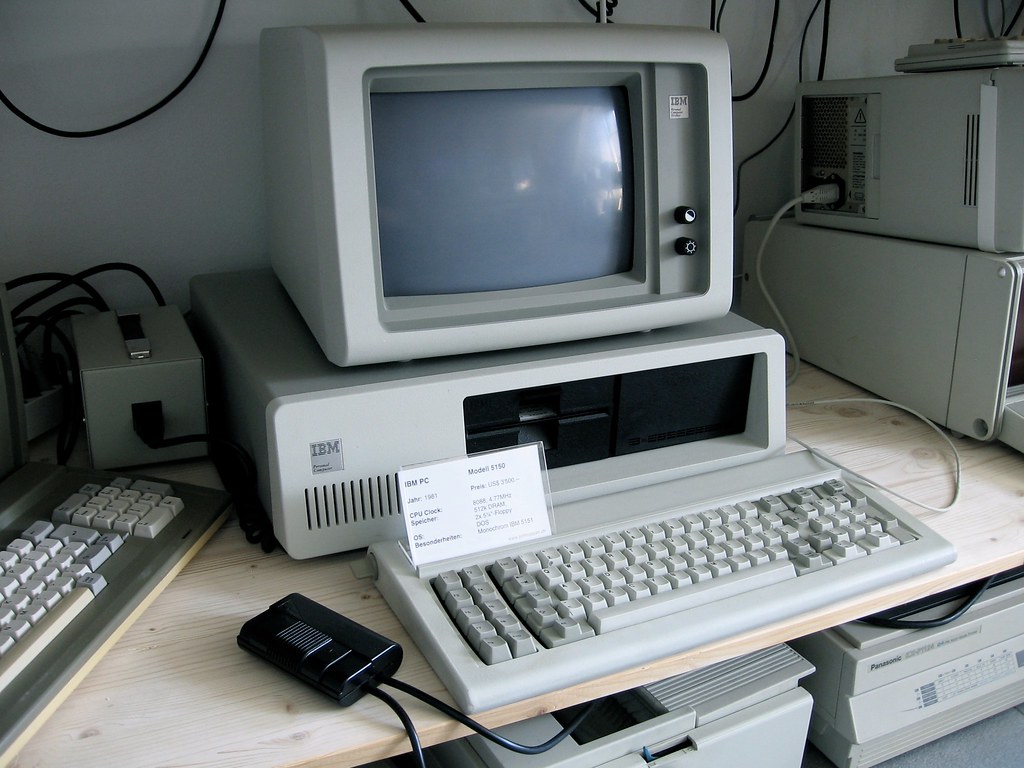
The IBM PC 5150 holds a distinctive place in the history of personal computing: not simply as a computer IBM introduced in 1981, but as the starting point of a platform that other manufacturers could emulate. The available sources make that connection, though it is important to separate the machine’s documented features from broader claims about its impact. The 5150 shows how a particular computer came to matter beyond its original configuration.
A launch that became a reference point
IBM launched the Model 5150 on August 12, 1981. The date and model identification appear in the supplied material, which describes it as a predecessor to modern personal computers and the progenitor of the IBM PC-compatible platform. Those labels summarize its historical standing, but they do not explain the mechanisms behind that influence. The evidence here supports the broad outcome—the later proliferation of clones and compatibles—without, by itself, reconstructing each commercial or industrial step.
Part of the 5150’s significance lies in its association with something larger than an individual product. A compatible platform means that one computer can become a reference for later systems. The sources explicitly connect this model to that development. They do not, however, detail the corporate decisions, agreements, or technical changes between the launch and the spread of compatible machines.
The machine in concrete terms
The 5150 was based on the 16-bit Intel 8088 microprocessor. The supplied material says it was software-compatible with the Intel 8086, placing the processor within a technical family without establishing how particular programs performed. The stated factory configuration included 16 KB of memory, expandable to 640 KB.
The operating system is identified as PC-DOS or IBM PC-DOS and attributed to Microsoft. The sources describe it as a system provided by that company. This is an important part of the computer’s documented profile, but the material does not allow a precise account of the agreement or the respective responsibilities of the companies. That distinction matters: a general description should not be expanded into a contractual history the evidence does not provide.
A recognisable physical presence
The 5150 was presented with a monochrome text monitor, typically described as green, and a detachable keyboard. These details make the computer tangible and distinguish its documented presentation from the modern association of personal computers with graphical interfaces. The sources do not establish how monitors or configurations varied among buyers; they do support this description of the machine as presented.
Its launch price was around $1,565. The figure appears in the supplied information without details about configurations, taxes, or sales conditions. On its own, it cannot show who could afford the machine or what place it occupied in a particular household. Price is part of the 5150’s material history, not a complete account of its social reach.
From product to shared reference
The documentation characterises the IBM PC 5150 as establishing a standard that enabled clones and compatibles to proliferate and transformed the personal-computing business. This is the most consequential industrial and cultural connection supported by the evidence: the computer’s significance extended to a family of machines rather than remaining limited to the original product.
Calling it a “standard” does not mean that the 5150 was the only personal computer of its era or that it alone inaugurated home computing. The available material presents it as a milestone and precursor to a compatible platform. It provides no comparison with other manufacturers and no sales, market-share, or user-reception data. Claims of total dominance, or of alternatives disappearing, would therefore go beyond what can be verified here.
What the sources leave unresolved
The supplied account is stronger on the launch date, processor, memory, operating system, and general appearance than on user experience. A museum text among the evidence identifies the 5150 as a 1981 personal computer with a text display; other references summarise its historical role or repeat configuration details. Some material comes from social-media posts and a question-and-answer page, so repetition does not amount to independent corroboration.
The evidence lacks user testimony, manuals examined here, and enough documentation to describe common tasks, frustrations, relative cost, or presence in particular homes. The conclusion must remain bounded: IBM introduced the PC 5150 in 1981 with the documented configuration, and the sources connect it to the development of the compatible platform. Its historical significance is visible in that legacy; the everyday life around the machine requires further evidence.
Documentary gallery

- Decade
- 1980s
- Region
- Global
- Level
- Introduction
- Entities
- IBM PC 5150, Museum, Intel
Sources and references
- La historia del microprocesador y la computadora personalwww.academia.edu · 2026-10-15
- IBM PC - Wikipedia, la enciclopedia librees.wikipedia.org · 2026-10-15
- 12 DE AGOSTO, Lanzamiento de la IBM PC (Modelo 5150) El 12 ...www.instagram.com · 2026-10-15
- ¿Cuándo compró IBM el primer sistema operativo de ...translate.google.com · 2026-10-15
- La Era del Salto” La evolución del 286 al Pentium marcó ...www.instagram.com · 2026-10-15
- UN VIAJE A LA HISTORIA DE LA INFORMÁTICAmuseo.inf.upv.es · 2026-10-15
- Timeline: Siglo XXwww.timetoast.com · 2026-10-15