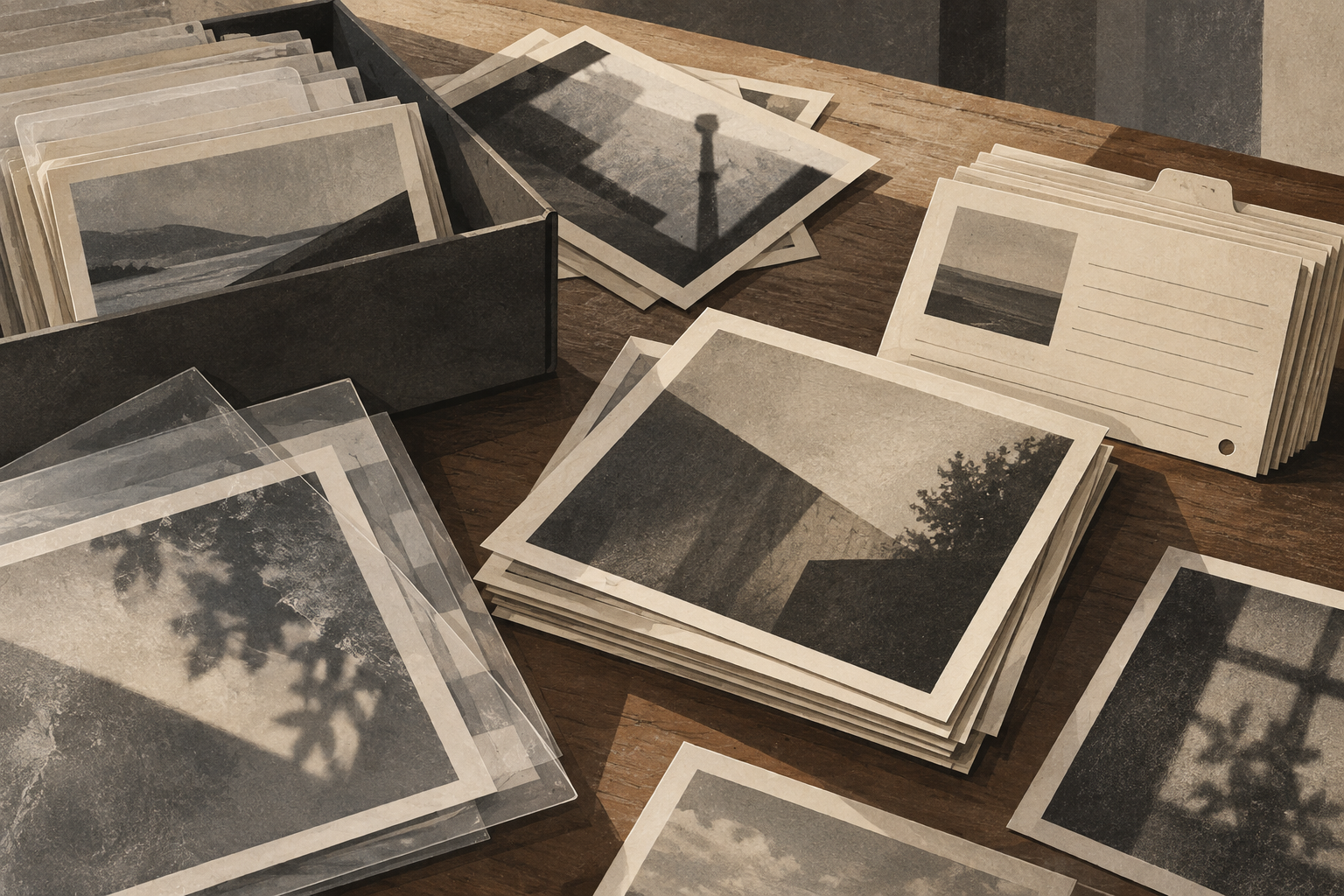
A preserved image is not a complete story
A photograph seems to offer an immediate answer: someone was there, looked, and pressed the shutter. The archive complicates that impression. An image arrives with—or separated from—information about its origin, use and journey. It may belong to an institutional collection, a group assembled later, or a digital repository searchable by title, subject or provenance. Each case offers different ways to understand what the image shows and what it leaves unexplained.
The supplied sources illustrate this variety in Spanish institutions. The Photographic Library of Spain’s Institute of Cultural Heritage describes images dating from 1844 to the present. The Museum of Zaragoza discusses an archive formed over the institution’s history, containing images of varied origins, subjects and techniques. The National Archaeological Museum, meanwhile, has its own photographic holdings connected to the museum’s history, as well as donations and acquisitions. These collections are not interchangeable: how they were formed shapes the questions we can ask of them.
The archive has a history too
A collection does not appear all at once or necessarily follow a single plan. Institutional descriptions refer to accumulations, contributions and different provenances. This matters because present-day organization should not be mistaken for the circumstances in which each image was made. A photograph may have been produced to document, research, inform or record an activity, then added to a collection according to different criteria.
A study of early photographic holdings related to Aragonese art, the National Library, the Prado Museum and the National Historical Archive places these materials within an institutional and documentary history. The Fotocinema article on photography and archives offers another framework for considering the relationship between image and archive. Together, these references support one caution: preserving a photograph and preserving its context are connected tasks, but they are not identical.
Searching is also interpretation
Search systems shape what we find. According to its description, Castilla-La Mancha’s Image and Word Archive supports searches by title, subject, collection or fonds. These categories are useful, but not neutral: they guide queries and make some connections easier to see than others. Searching by subject is not the same as searching by authorship, and a record with a title does not necessarily explain who commissioned the image or how it circulated.
Reading an archive therefore means paying attention both to photographs and to the tools used to describe them. An unsuccessful search does not prove that a subject is absent; it may mean the material is catalogued under different vocabulary, placed in another collection or missing a field that the search tool can use. Conversely, finding several images under one label does not prove they shared an original intention. The grouping may be useful for research without being a historical category used by their makers.
Collections, fanzines and cultural memory
The study of underground photography through the fanzine Rockocó and the Miguel Trillo Archive at the Reina Sofía Museum connects photographs with forms of circulation and a particular publishing format. As its title and academic record indicate, its interest lies in approaching images through an archive and a publication rather than as isolated objects. This approach helps raise questions about the relationships between image, selection and cultural context without assigning a single meaning to every photograph.
It is important to distinguish what the reference supports from what would need to be checked in the full study. The bibliographic record identifies the subject and object of analysis, but the supplied material does not give its conclusions or describe the photographs. It cannot establish the scenes, dates of individual images, fanzine print runs or specific conservation decisions. A responsible reading treats it as a documented lead for investigating how a publication may participate in the history of a photographic group.
What can be established, and what remains open
The cited descriptions document repositories and collections with different histories, scopes and access methods. They also support the idea that photography can be studied as a document within archives and collections, and that how materials are organized affects public access. They are not enough, however, to reconstruct the full history of each image, assess the physical condition of the holdings or systematically compare conservation policies.
Looking at a photograph through its archive does not diminish its visual force. It adds questions: who brought it together, under what name it is preserved, which other images accompany it, and what search paths make it findable. Answers may be incomplete and catalogues may change. That is precisely why the archive is not merely a storehouse behind the image; it is a visible, though never total, part of the history we can tell about it.
- Decade
- Contemporary
- Region
- Spain
- Level
- Introduction
- Entities
- Museum, Archivo Histórico Nacional, Museo Arqueológico Nacional
Sources and references
- Fotografía y archivodoi.org · 2026-09-29
- Fondos de fotografía antigua sobre el arte aragonés en la Biblioteca Nacional y unas notas sobre el Museo del Prado y el Archivo Histórico Nacionaldoi.org · 2026-09-29
- Una mirada documental de la fotografía underground a través del fanzine Rockocó. Análisis del Archivo Miguel Trillo en el Museo Nacional Centro de Arte Reina Sofía (MNCARS)doi.org · 2026-09-29
- La conservación de la fotografía en el Museo de Zaragozawww.museodezaragoza.es · 2026-09-29
- Fototeca - Instituto del Patrimonio Cultural de Españaipce.cultura.gob.es · 2026-09-29
- Archivo fotográfico del Museo Arqueológico Nacionalportalvirtualfotografico.es · 2026-09-29
- Archivo de la imagen y de la palabracultura.castillalamancha.es · 2026-09-29