A board game can preserve more than the rules needed to play. Its pieces, board, rulebook and box reveal how an experience was organized and what representation of the world its edition proposed. Reading these elements as cultural sources makes it possible to study both the history staged by a game and the material decisions that make it playable. It does not, however, turn the game into a transparent mirror of its time: components are clues that need context and interpretation.
The box is only a threshold
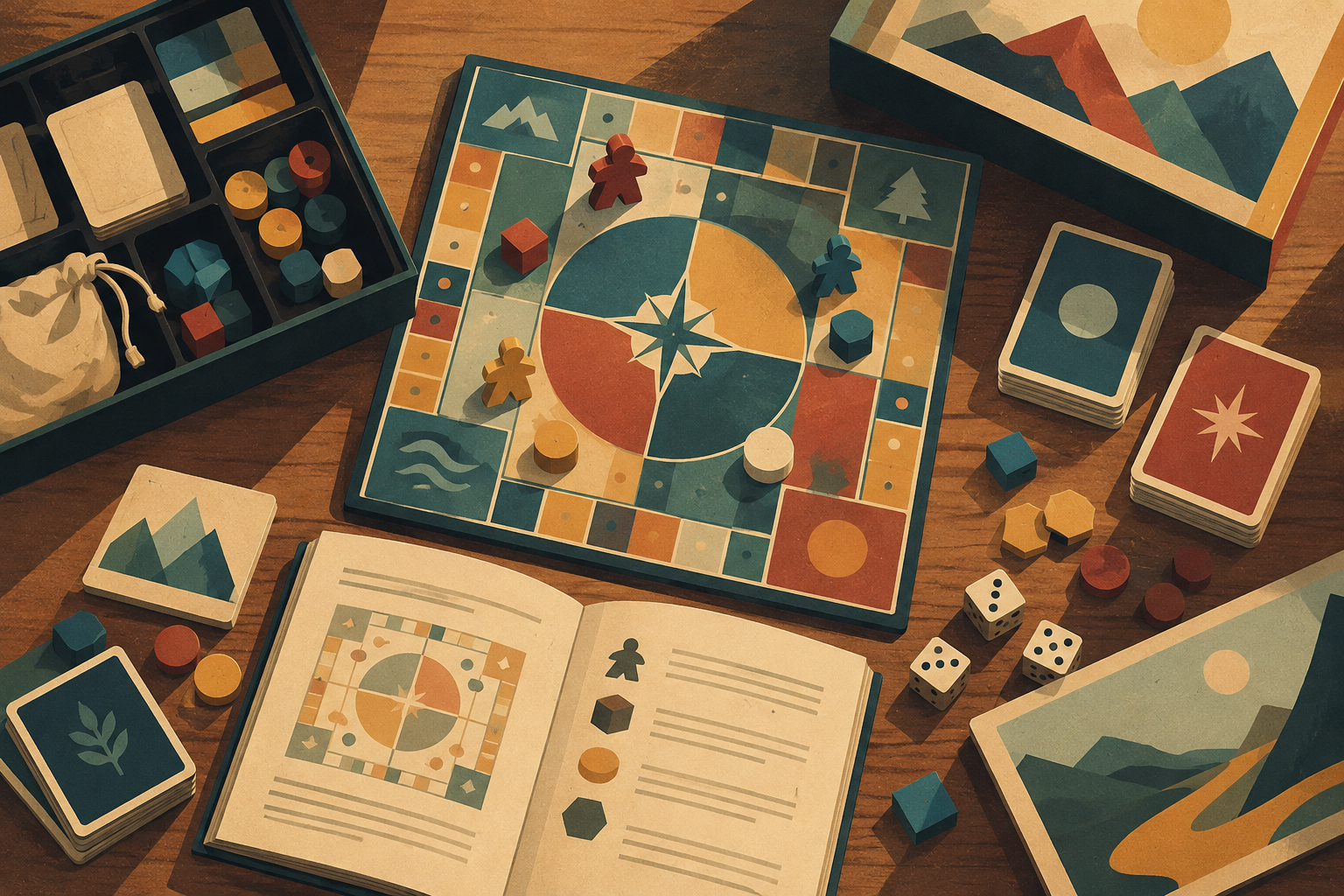
The cover often draws the eye, but it cannot explain on its own how a game works. To understand one, it helps to examine the whole set: what it contains, how those elements relate to the rules, and which actions they enable or restrict. A board is not merely an illustrated surface; it can organize space and indicate which aspects of the world matter in play. Pieces and markers likewise translate abstract concepts into manipulable objects.
This approach shifts attention from appearance to structure. Two games may use components of comparable quality yet offer different experiences if their rules distribute decisions differently. Cultural analysis should attend to the relationship between physical form and system rather than assigning a component a fixed meaning outside its use.
Rules organize a point of view
Rules determine what each participant can do, how actions are resolved and which outcomes count. This architecture matters especially in historical simulation, where complex processes may be translated into decisions, resources and objectives that fit within a game. Jan Gonzalo Iglesia’s chapter on board games about the Spanish Civil War explicitly raises the question of what history is told through components and mechanics.
The issue is not simply whether historical events or places appear. It also matters which relationships the system represents and which it leaves out. A rule can make one dimension of a conflict central while pushing another into the background. This is an analytical tool, not a specific finding about a particular game: the evidence available identifies the research question but supplies no detailed rulebook examples with which to assess individual design choices.
Materials, production and publishing
A game is also an object that is manufactured and sold. A study of its transformation into an editorial product addresses criteria for editing, production and commercialization; the available excerpt mentions high-quality components and notes that they may resemble those in other games. This observation helps distinguish the distinctiveness of a design from the material standardization that may accompany it, although the excerpt cannot stand in for the full study or support generalizations about the industry as a whole.
Material quality, packaging design and physical or commercial constraints all belong to the object’s history. A box must contain and present a game; components must be produced and arranged so that the experience described in the rules can take place. Changes in format or presentation may therefore document editorial priorities, but only when the objects and production conditions being compared are known. Appearance alone does not establish why a decision was made.
Teaching history through play
Educational use offers another way to approach the subject. Alfonso Iglesias Amorín studies the application of board games in history teaching. The existence of this work supports the academic relevance of considering games as teaching resources, but the supplied material does not describe its findings or justify claiming that any game session produces historical learning.
As a public-facing medium, a game can make relationships and decisions visible through participation. At the same time, simplification is unavoidable when a broad subject is translated into a limited set of rules, turns and components. It is therefore useful to treat play as an interpretation that may complement teaching, not as an automatic substitute for other sources. Analysis should ask what a game makes easier to understand and what it leaves off the table.
What can be documented
A rigorous reading distinguishes what can be observed from what must be inferred. Component inventories, rule text and packaging design are examinable features. Their historical significance requires comparison with information about the edition, context and purpose of a game. Data science and public history appear as approaches in the cited research on games about the Spanish Civil War; the material available here does not specify the methods used or provide detailed findings.
There are also clear documentary limits. The supplied excerpts do not identify a particular series of games, offer a chronology of material changes, or describe specific print runs, costs or editorial decisions. They support a method and identify research directions, but not a comprehensive history of changing component design.
Reading a game as object and argument
Components tell a story in two related senses: they make an activity possible and materialize an interpretation. Rules, pieces and packaging shape what a game can represent, while editorial choices place it within conditions of production and circulation. The practical conclusion is that studying a board game as a cultural document requires preserving and examining the whole set, not just its cover or declared subject. It also requires distinguishing the observable object, the narrative it proposes and what the available evidence does not yet allow us to claim.
- Decade
- 1990s
- Region
- Global
- Level
- Enthusiast
- Entities
- Jan Gonzalo Iglesia, Alfonso Iglesias Amorín
Sources and references
- (PDF) Estudio sobre la evolución del juego de mesa y su ...www.academia.edu · 2026-10-18
- ¿Qué historia jugamos? Una aproximación al estudio de los juegos de mesa de simulación históricadoi.org · 2026-10-18
- La aplicación de los juegos de mesa en la enseñanza de la Historiadoi.org · 2026-10-18
- Los juegos de mesa de la guerra civil española como historia pública: una aproximación desde la ciencia de datosdoi.org · 2026-10-18
- (PDF) ¿Qué historia jugamos? Una aproximación al ...www.researchgate.net · 2026-10-18
- Creación y desarrollo de un juego de mesa para devotos del ...uvadoc.uva.es · 2026-10-18