Rewatching is not remembering
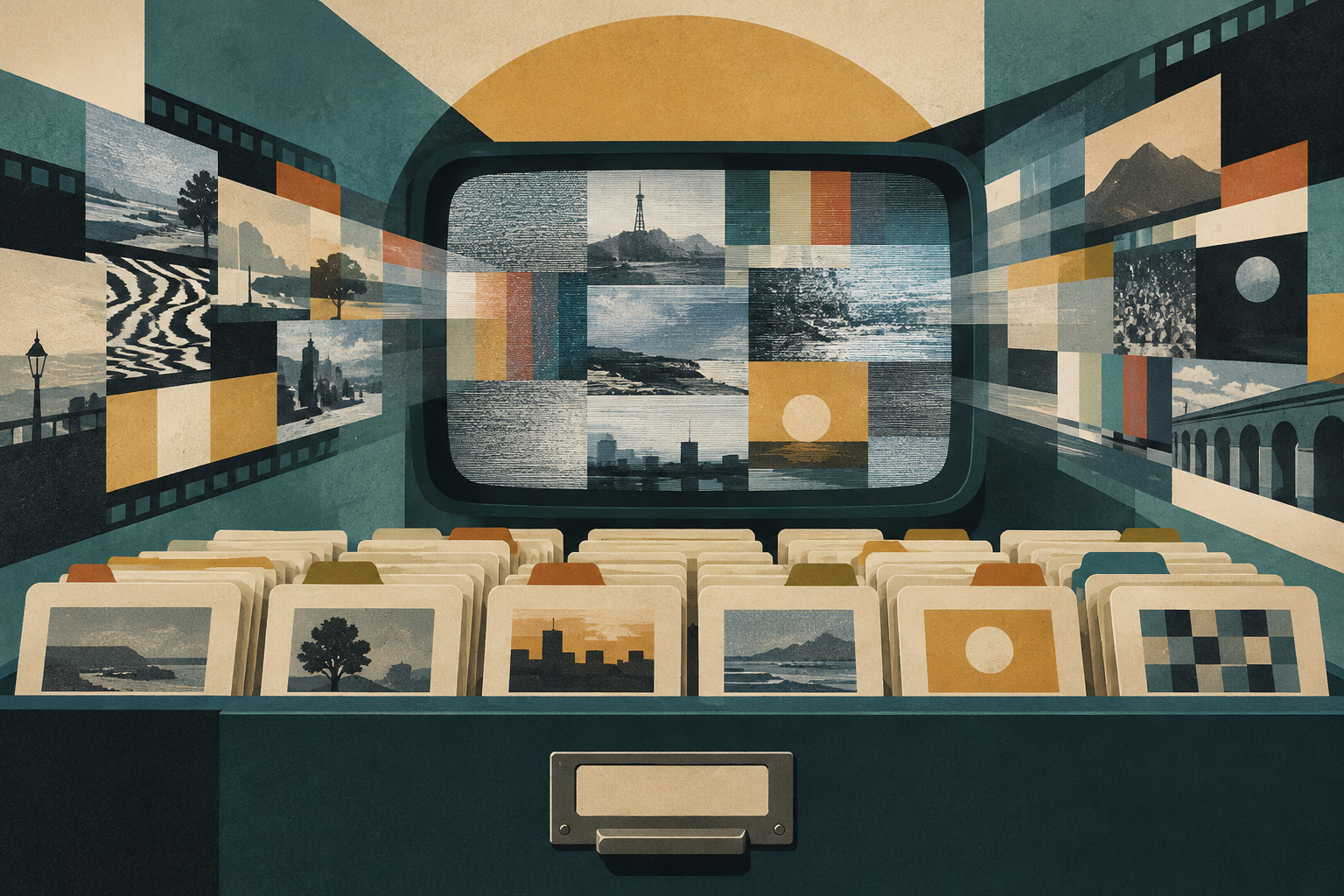
Television history is often told through programmes, faces and sets. For the Spanish period from 1970 to 2000, a RetroPause article explicitly takes that as its starting point, while the Televisión Española archive available through RTVE Play offers a way to revisit broadcast material. These are different approaches to the past: one structures a narrative; the other makes records accessible.
An archive does not, by itself, restore an intact experience. It enables access to some of the material that has survived, but the preserved selection should not be mistaken for everything that was broadcast or everything viewers watched. That distinction is the first limit to keep in view.
The archive as a historical source
María Pilar Hidalgo Goyanes’s research on preserving television’s audiovisual heritage stresses the importance of these archives in retaining information and testimony about contemporary history and society. This places the archive beyond nostalgia: television records can be sources for studying how a society represented itself and what materials it chose to preserve.
That does not mean every document speaks for itself. A surviving fragment can be analysed, but its reach depends on its identification, context and relationship to other documents. The archive is a point of entry; it does not replace historical research.
One period, several scales
The span 1970–2000 is an explicit framework in the RetroPause article on Spanish television. The Association of Communication Historians’ call concerning seventy years of television in Spain also encourages an international and comparative perspective. Together, these references support an approach that does not reduce the medium to a succession of familiar titles.
It is also important not to transfer findings from one period to another without qualification. The Lafond study among the supplied sources addresses characteristics of Spanish television from 1963 to 1969, describing that period as essential to its history. It is useful background for remembering that periods connect, but it is not direct evidence for every change between 1970 and 2000.
Preservation shapes what we can tell
The RTVE archive provides access to Televisión Española material, while the preservation study explains the historical value of conserving audiovisual heritage. Together, these references prompt a straightforward editorial question: what kind of history can be written when access depends on what has been preserved and catalogued?
The answer must be cautious. The supplied sources do not detail which programmes are missing, how each item was selected or what proportion of broadcasts from the period survives. Nor do they establish, on their own, what each household watched or how viewers interpreted it. Presenting those matters as settled facts would exceed the available evidence.
Looking beyond the screen
El Mundo’s feature on forty years of television evolution structures its account around the 1970s, 1980s, 1990s and 2000s. That chronological approach works as a broad map, but the history of the medium also calls for comparison among different kinds of sources: audiovisual material, academic research and synthetic accounts.
Combining them helps distinguish three levels: the record that can be consulted, the interpretation offered by a study and the panoramic view of a historical account. They are not interchangeable. If their detail or scope differs, that difference is a reason to investigate, not to automatically choose the most evocative version.
What the archive leaves open
The available sources support a limited conclusion: audiovisual archives are a central tool for studying television, and the period 1970–2000 can be approached through preserved material, research on preservation and historical overviews. They do not, however, provide a complete inventory of broadcasts or an exhaustive picture of social reception.
Rewatching a broadcast and reconstructing its history are related but distinct tasks. The archive provides traces; research puts them in context and acknowledges their gaps. This caution does not impoverish television memory: it helps distinguish what is documented from what remains to be verified.
- Decade
- 1970s
- Region
- Spain
- Level
- Enthusiast
- Entities
- Televisión
Sources and references
- El archivo como puerta de entrada a la televisión española de ...www.retropause.com · 2026-09-29
- Archivo de Televisión Española | Ver en RTVE Playwww.rtve.es · 2026-09-29
- Preservación del patrimonio audiovisual de televisión El ...produccioncientifica.ucm.es · 2026-09-29
- "La vieja pantalla: 70 años de televisión en España". CFP ...www.ashiscom.org · 2026-09-29
- Historia y evolución de 40 años de televisión en Españalab.elmundo.es · 2026-09-29
- La televisión en España: expansión y consumo social, ...raco.cat · 2026-09-29


