From garment to document
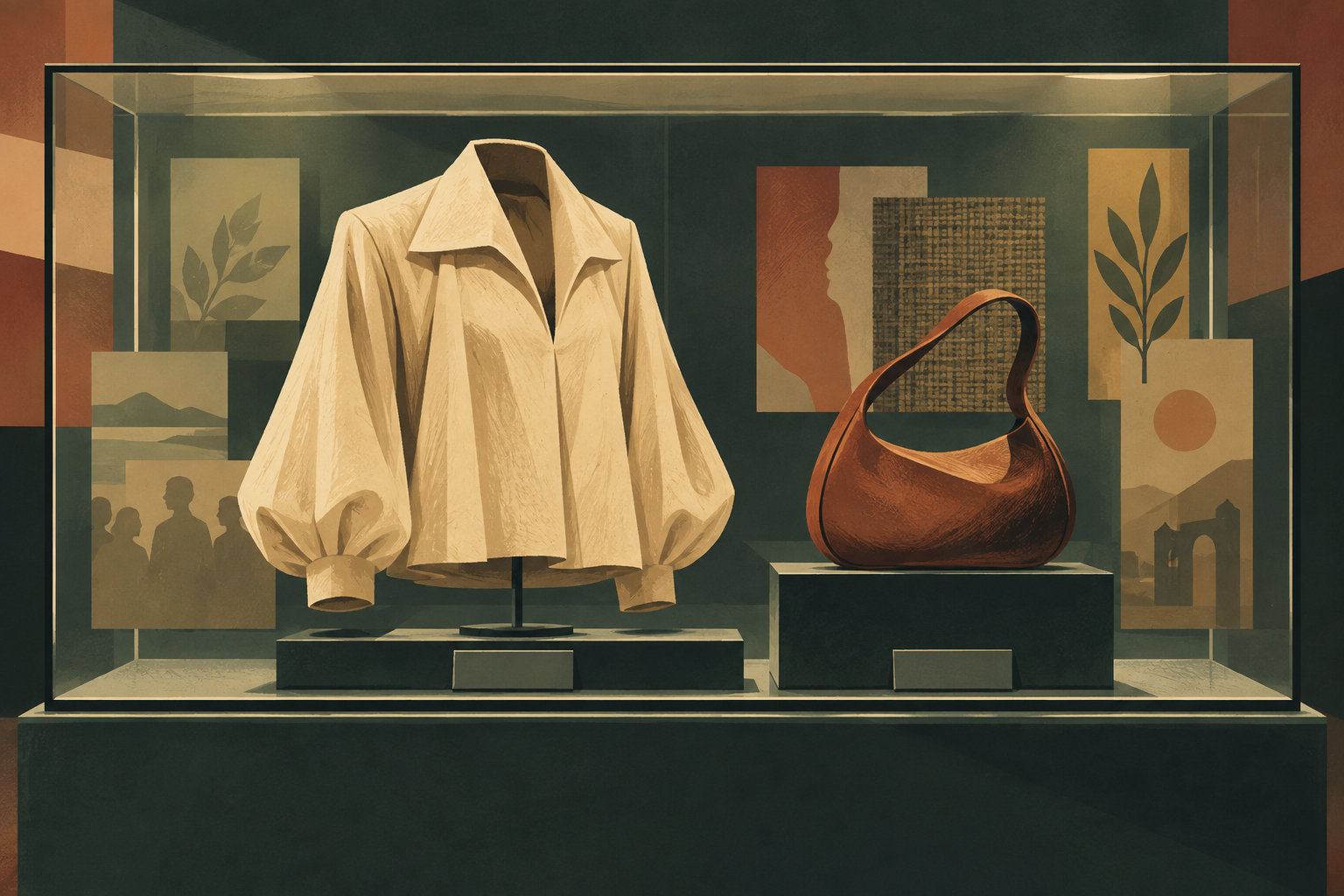
Clothing is made to be worn, and that use is part of what it can tell us. A piece preserved in a museum changes circumstances: it no longer takes part in the everyday movement of the person who wore it, but is observed, described and placed in relation to other objects and documents. That does not make it a complete explanation of its era. A display case makes an object visible; it also prompts us to ask what context is missing if we are to understand it.
The Museo del Traje states that it preserves almost 30,000 pieces of clothing and fashion, as well as jewellery and accessories. The figure suggests the breadth of a collection, but it does not replace interpretation: on its own, it cannot explain who wore each object, how it circulated or what it meant in its setting. It is useful to distinguish what has been preserved from what can be claimed about it.
Fashion is more than a succession of silhouettes
The virtual exhibition «La moda en la historia» presents a journey across three centuries and points to the dialogue between customs and fashions: some fashions become customs, while some customs go out of fashion. This offers a less linear reading than a chronology of trends. Dress belongs to social life; changes in appearance can therefore be read alongside habits, norms and forms of representation, provided the available evidence supports that reading.
This approach avoids treating every garment as automatic proof of an entire era. A piece may be exceptional, incomplete or have reached the museum without all the information needed to reconstruct its use. Responsible interpretation acknowledges that difference and does not fill the gaps with certainty the object cannot provide.
Accessories matter too
Dress cannot be understood through principal garments alone. The Museo del Traje includes jewellery and accessories among the materials it preserves; according to a museum communication, its exhibition on fashion in Cervantes’s time presents ornamental items associated with the upper classes. These indications remind us that accessories form part of the experience of dressing and may offer clues about choice, appearance and distinction.
That reading nevertheless requires caution. Knowing that an object is described as an adornment, or that it appears in an exhibition, does not automatically give it a universal meaning. It is better to consider the object’s description, its documented context and the limits of what the available sources allow us to conclude.
What an exhibition chooses to tell
Exhibiting involves selection. The Ministry of Culture page listing museums with fashion or dress collections shows that material relating to clothing can be found in different institutions and alongside textiles, uniforms, flags and other objects. No single place or category can encompass every story of clothing.
The selection of objects and the way they are grouped create an argument. An exhibition may help visitors compare forms or show connections between objects and customs; it may also leave out experiences that are not represented in the collection. Critical writing on fashion’s cultural legitimisation invites us to consider precisely how a museum turns certain objects into heritage and which decisions sustain that process.
Preservation also means recognising limits
Textile conservation appears as a distinct subject in material from the Museo del Traje and in an audiovisual resource about its current situation. Because the available sources do not provide verifiable technical details, it would be inappropriate to describe specific procedures, environmental conditions or treatments. A broader point can still be made: preservation does not freeze an object outside history; it sustains the possibility of studying and displaying it without mistaking its present condition for its original appearance.
Archives also broaden interpretation. The digital collection on fashion, sewing and the history of dress brings together books, magazines, manuscripts, photographs and plates with explanatory texts. The variety of formats matters because it allows garments and representations to be considered together, even though each document has its own scope and gaps.
An open-ended history
Clothing in a museum does not speak alone. Objects, accessories, images and texts acquire meaning in relation to the questions an institution asks and the evidence it preserves. Looking at fashion in this way does not mean finding a definitive history in every object; it means learning to separate fact from interpretation.
That limit does not make a visit less rewarding; it makes it more interesting. A garment can prompt questions about use, custom and memory without answering all of them. The museum provides objects and interpretive frameworks; visitors can observe how the account is constructed and what remains outside the frame. Fashion then becomes more than a succession of appearances: it becomes a way to study material culture.
- Decade
- Contemporary
- Region
- Spain
- Level
- Enthusiast
- Entities
- Museum, Museo del Traje
Sources and references
- Cuando la moda entra en el museo: conservación, contexto y ...www.retropause.com · 2026-09-29
- La moda en la historia - Museo del Trajemuseodeltrajevirtual.com · 2026-09-29
- Museos con moda y/o indumentaria - Museo del Trajewww.cultura.gob.es · 2026-09-29
- Museo del Traje Madridwww.facebook.com · 2026-09-29
- 2- La conservación textil en el Museo del Traje: situación actualwww.youtube.com · 2026-09-29
- Museos y archivos textiles en el mundo para inspiración de ...pinkermoda.com · 2026-09-29
- Coleccion de Moda, Costura e Historia del Trajebvpb.mcu.es · 2026-09-29
- Moda: De la pasarela al museoigeca.net · 2026-09-29