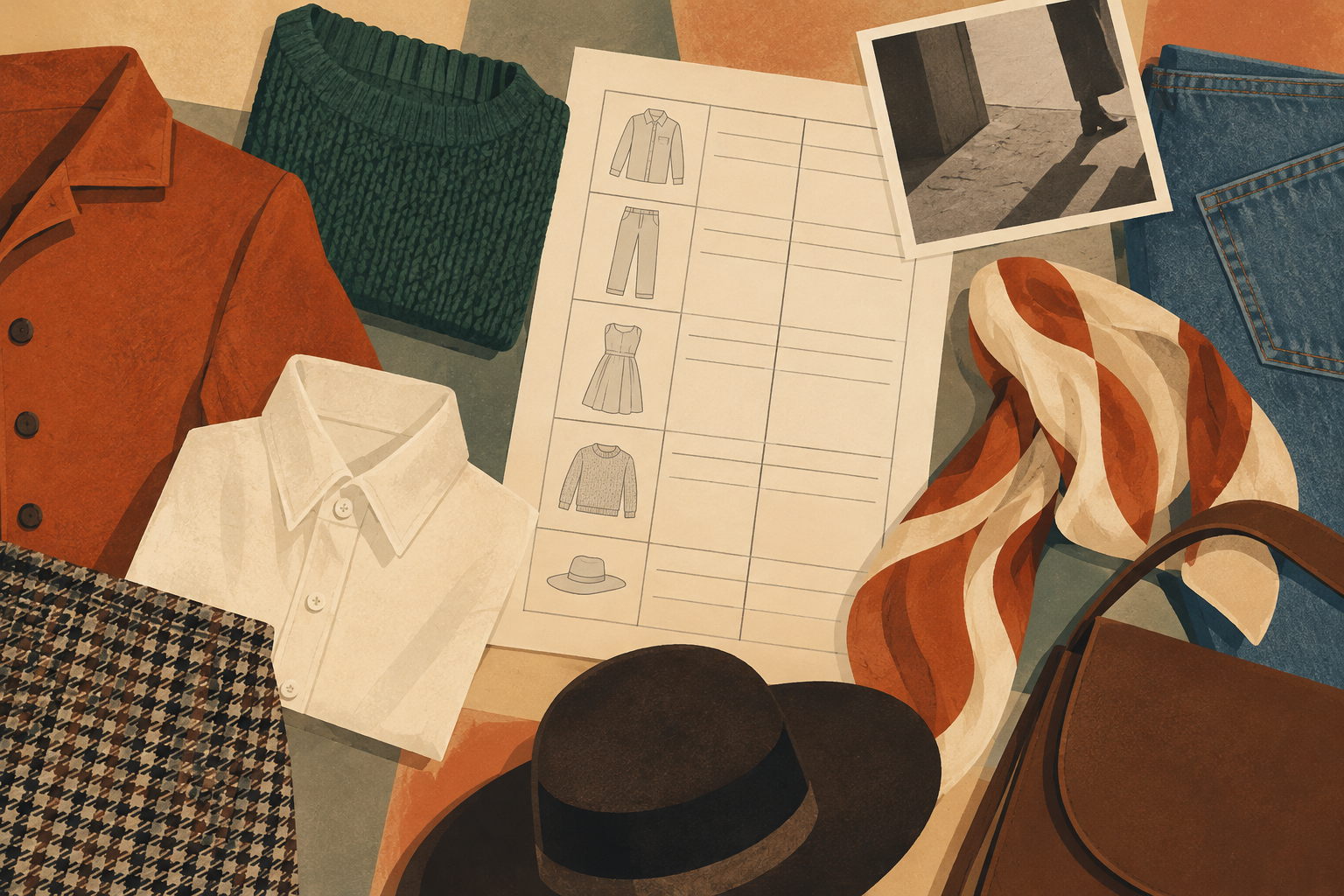
An exhibition is not a sample of everyone
The exhibition “En Madrid. Una historia de la moda, 1940–1970” is described as a journey through the evolution of fashion and its protagonists in the city. The available information says it addresses both public and private spheres. That scope is valuable: it encourages us to look beyond fashion shows and promotional images, toward the spaces where clothing is worn. But neither a title nor an exhibition description is enough to establish what people habitually wore or who could afford it.
An exhibition organizes objects and narratives; it is not, by itself, a survey of dress. To make claims about everyday use, we would need to identify which items survive, who owned them, how they were documented, and what criteria determined their inclusion. The supplied evidence does not provide that detailed inventory. The Madrid exhibition therefore serves here as a starting point for questions, not as grounds for assigning uniform habits to its residents.
A garment offers one kind of evidence
A preserved garment lets us examine material features that an image may conceal: fabric, construction, shape, and present condition. General histories of dress distinguish materials, textile techniques, and aesthetic and social dimensions. Yet a single item does not automatically tell us who wore it, how often, on what occasion, or how it was understood in its setting. Those details require associated documentation.
Clothing also changes through use and over time. Responsible interpretation should therefore separate what is visible from what is inferred. An observable shape or material is not the same as a claim about social class, popularity, or identity. A collection record, established provenance, or attributable testimony might support some inferences; the supplied sources do not detail such evidence for each object in the exhibition.
Photographs show use, but leave context incomplete
Photographs can show garments on bodies and in particular situations. In that sense, they offer something different from advertising: a represented scene, with people, surroundings, and combinations of clothing. But they are not neutral windows. Framing selects what appears; pose, the purpose of the image, and the identification of the people can all affect interpretation. One photograph alone cannot prove that a style was common.
The exhibition description says that it addresses public and private dimensions, but the available reference materials do not identify specific photographs or explain their provenance. It would therefore be inappropriate to reconstruct scenes or claim what those images show. A sound method would record authorship, attributed date, location, occasion, and the image’s relation to the garment, while distinguishing catalogued information from editorial interpretation. A photograph becomes more useful when read alongside independent sources.
Fashion magazines and images have a purpose
The supplied history of fashion notes the emergence of specialist publications and the growing circulation of styles through images. Such sources document proposals, ideals, and systems of circulation; they do not necessarily represent what most people wore. The distinction between depicting a garment and documenting its use is crucial. An advertisement may show that a product or style was promoted, but it cannot by itself establish purchase, acceptance, or frequency of use.
This caution also matters when studying music and design. Their scenes can help contextualize visual languages and forms of identification, but they do not replace the material history of garments. An interpretive link between a musical aesthetic and a silhouette needs specific evidence; a parallel alone does not establish a direct relationship. Research must return to objects, their records, and images whose context can be checked.
What can be said, and what remains open
The available sources support the claim that an exhibition was devoted to Madrid fashion from 1940 to 1970 and addressed its protagonists and public and private dimensions. They also provide general frameworks for understanding fashion as an aesthetic and social practice, alongside a Crossref-identified academic study of street culture’s influence on Brazilian fashion in 1960–1970. That study concerns a different geographical context; it should not be used as evidence of dress practices in Madrid.
What is missing here is a detailed object catalogue, identified photographs, and accounts of use that would allow a garment to be followed from its context into preservation. This absence limits conclusions, but it does not make the question unimportant. Careful reading means refusing to turn a display case into a portrait of an entire society: garments, images, and advertising texts provide different kinds of evidence, and their silences belong in the account too.
- Decade
- 1960s
- Region
- Spain
- Level
- Enthusiast
- Entities
- En Madrid. Una historia de la moda, 1940-1970
Sources and references
- A influência da cultura street na moda brasileira (1960–1970)doi.org · 2026-10-12
- Así fue... Exposición: En Madrid. Una historia de la moda, ...www.comunidad.madrid · 2026-10-12
- La moda en la historia - Museo del Trajemuseodeltrajevirtual.com · 2026-10-12
- En Madrid. Una Historia de la moda, 1940-1970www.liceus.com · 2026-10-12
- Historia de la Moda: del siglo XX a la actualidadextension.uned.es · 2026-10-12
- La moda imposible. Moda de vanguardia, 1960 - 2010www.cultura.gob.es · 2026-10-12
- publicacióngestiona3.madrid.org · 2026-10-12