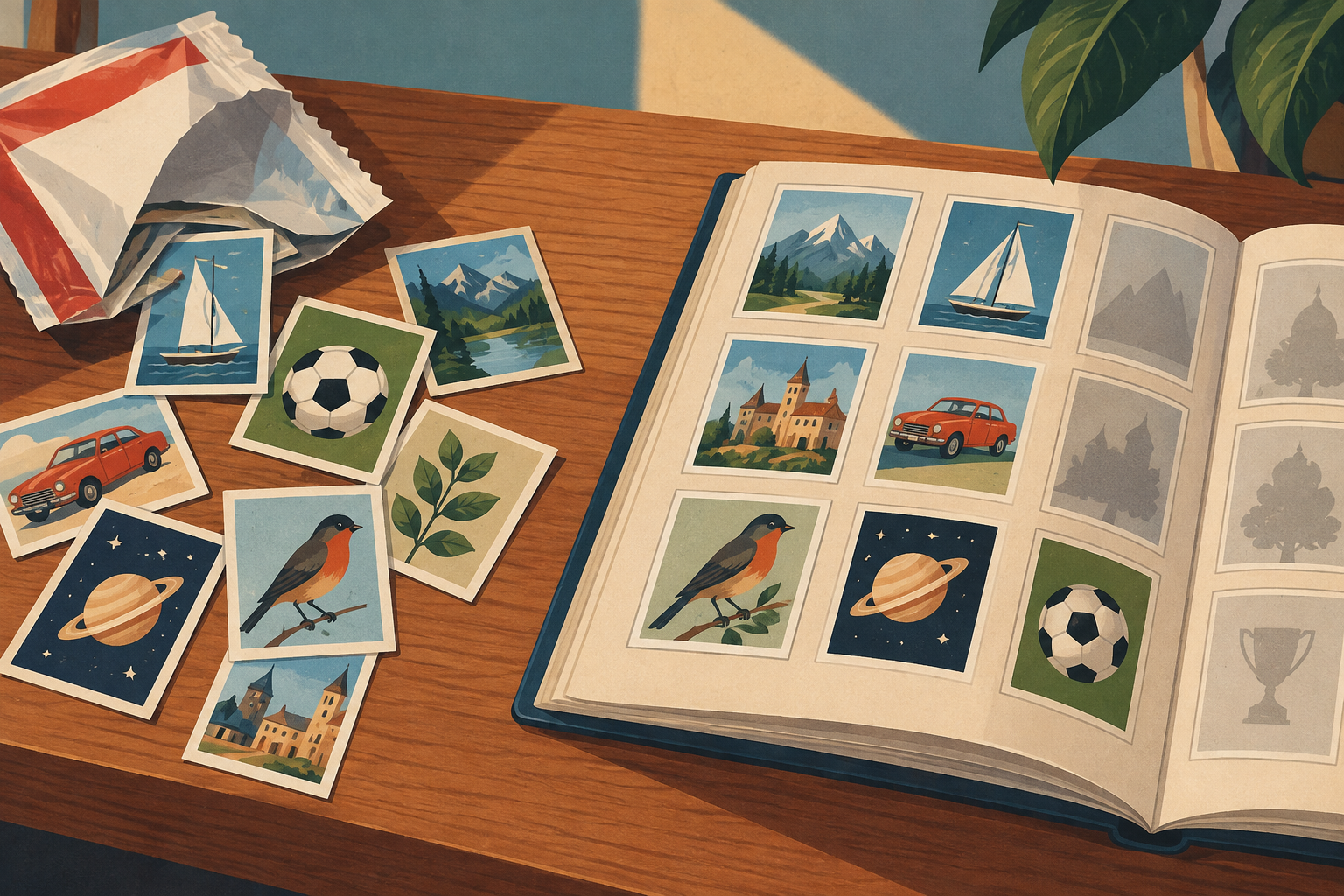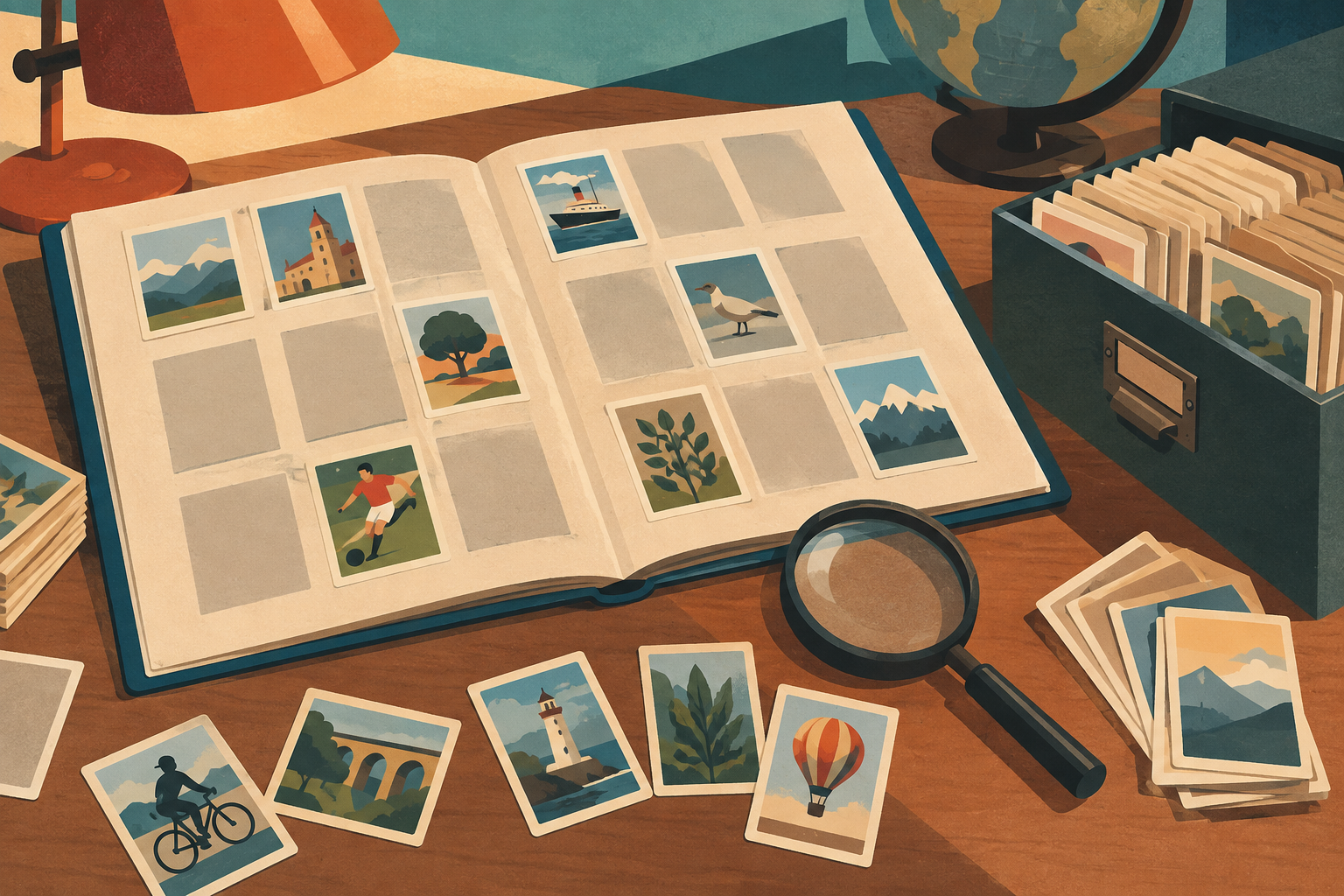
An album is more than a surface for sticking down cards: it also proposes a way to recognize a collection. Its pages define a series, assign spaces, and turn the search for individual items into an ordered task. Yet a surviving album cannot, on its own, tell us which variants circulated, how cards were exchanged, or which ones went missing. Answering those questions means comparing the object with catalogues, institutional records, and documentation of circulation. The available sources let us examine that distinction without confusing what an album shows with what remains unproven.
An identifiable object, not a complete history
The Spanish Ministry of Culture’s CER.es catalogue records the album Historia del Circo, attributed to Rosés and Ediciones Ada of Barcelona and held at the Museo del Traje. The Museotik catalogue, meanwhile, identifies Oceanía as an album published in Barcelona by Publicaciones Reunidas S.A. in 1968, with printed cardboard covers. These references are useful because they connect titles with attributed publishers, place, and—in the second case—year and physical characteristics.
Such details help distinguish specific objects from general memories of “albums from the old days.” They do not, however, reconstruct every edition, print variation, or change in content. A catalogue record identifies the item it describes; it does not automatically certify every variant a collector may encounter. The distinction matters: an incomplete description is not proof that other versions do not exist, but neither does it justify treating them as documented.
The album as a system of classification
An empty space on a page makes absence legible: it indicates that a particular item is expected within a sequence. That structure helps organize a collection and identify what is missing according to the album itself. It also sets limits: it may tell us about the publisher’s organization of that collection, but not necessarily about every image produced or distributed separately.
The Historia del Circo record provides a title and attributions; the Oceanía record adds a date and a physical description. These are starting points for comparing documents and copies, not an exhaustive catalogue of variants. Pixartprinting’s general account of collectible cards outlines a broad shift from materials associated with consumption to organized collections. For research into a particular title, that overview needs to be paired with sources that describe the object and its particular features; by itself, it cannot identify an edition.
From wrapper to collectible object
The page on Colombia’s Jet chocolate bar links the product, reportedly marketed since 1961, with the creation of collectible card albums. It is an example of a collectible appearing alongside a consumer product in an account of a brand. With the information available here, it does not identify specific album titles, series, variants, or exchange rules. Those claims should remain separate: the general connection appears in the source; details of individual collections still need verification.
Panini’s page, in turn, presents commercial information about its collectibles, cards, and albums. It can be used to observe how the company describes products and new releases. On its own, it is not an independent historical record of past editions or a neutral guide to rarity. A comparative study could bring institutional catalogues together with surviving copies and publisher materials for each series, while stating which source supports each detail.
Exchanges leave an archive too
A collection is completed through actions that are not necessarily printed on its pages. Exchange is a relevant practice in the social history of collecting, but the sources gathered here do not describe particular networks, meeting places, trading rules, or communities. Those elements therefore cannot be presented as established facts on the basis of these records.
A research route can still be proposed: look for exchange lists, advertisements, correspondence, photographs, or published and attributable accounts, and record their dates and provenance. Each document might help explain how items moved, but it should not be extrapolated to an entire community without further evidence. Preserving these traces could complement the material history of albums with a history of their use, without inventing collective memory from an empty page.
Identification without turning it into a valuation
A rigorous description separates what can be observed from what is inferred: title, publisher, place, documented date, materials, and verifiable differences between copies. It then states clearly what remains unconfirmed. The available records provide examples of specific details—such as the publisher and place attributed to Historia del Circo, or the year and physical description of Oceanía—but no complete table of variants and no basis for assigning prices or rarity.
The conclusion is simple: an album helps organize a collection; an archive helps explain the limits of that organization. Catalogues, objects, and exchange records can build a fuller history when linked cautiously and when each source’s contribution is made clear. Until specific evidence emerges, undocumented variants and trading practices should remain research questions, not certainties or value estimates.
- Decade
- 1960s
- Region
- Global
- Level
- Enthusiast
- Entities
- Museo del Traje
Sources and references
- Álbum de cromos - CER.es - Ministerio de Culturaceres.mcu.es · 2026-10-01
- Una historia de cromos - Pixartprintingwww.pixartprinting.es · 2026-10-01
- Del envoltorio al álbum: cómo los cromos se hicieron ...www.retropause.com · 2026-10-01
- Cromos y coleccionables Paniniwww.panini.es · 2026-10-01
- Álbum de cromos 'Oceanía' - Coleccionesmuseotik.euskadi.eus · 2026-10-01
- Jet (chocolatina)es.wikipedia.org · 2026-10-01