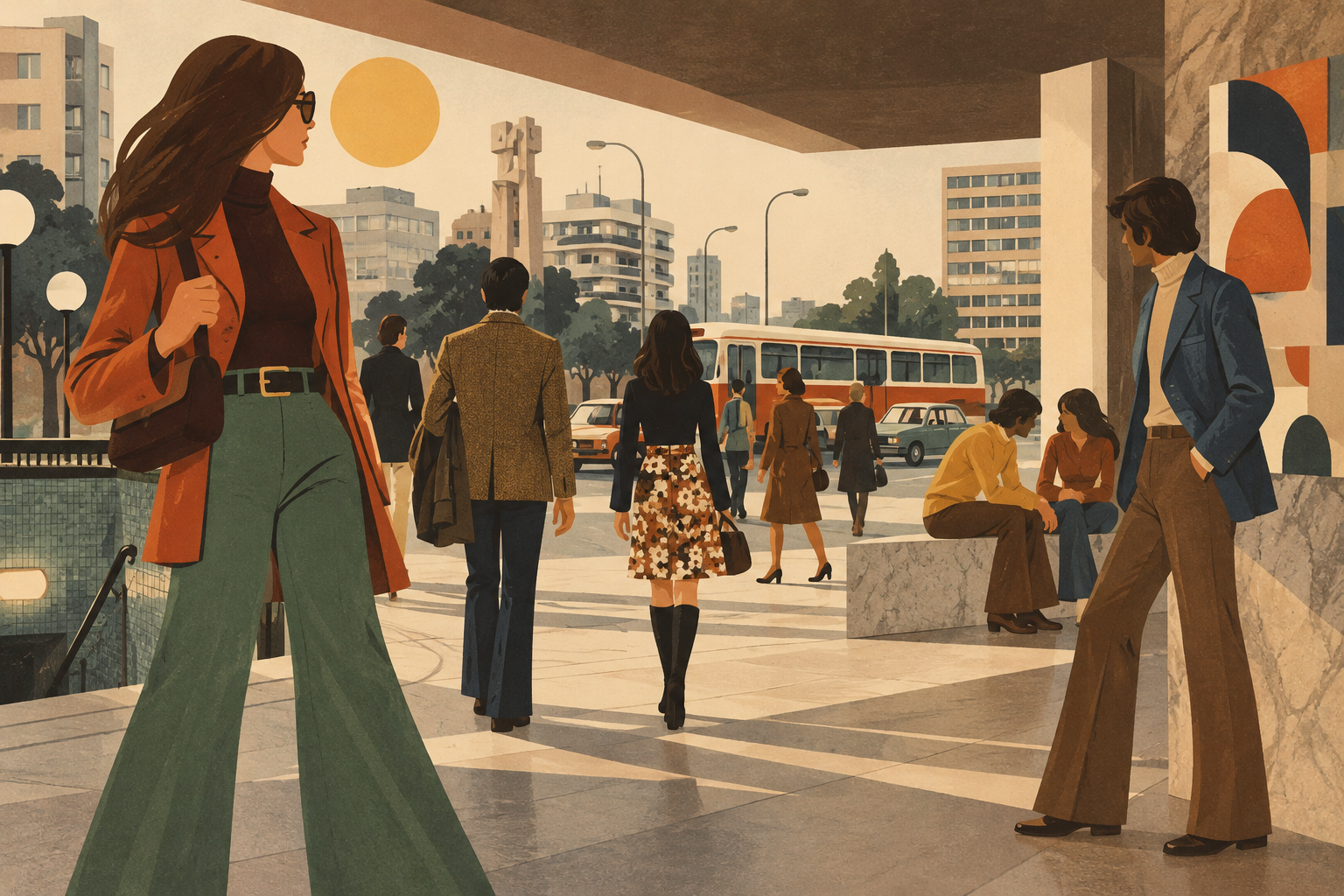
Fashion in 1970s Spain cannot be reduced to a list of garments or a homogeneous aesthetic. Sources preserved in institutions such as the Costume Museum and exhibitions dedicated to the history of fashion in Madrid reveal a more nuanced reality. Clothing from that era functioned as an identity marker, a reflection of social transformations, and an element of differentiation in a context of cultural opening. Studying fashion from this perspective requires going beyond advertising and focusing on real uses, everyday decisions, and the interaction between the individual and their environment.
The context of the post-war period and the transition
The exhibition "In Madrid. A history of fashion, 1940-1970" offers a journey that spans from post-war Spain to the 1970s. This period was crucial for the evolution of fashion in the capital. The city underwent a profound transformation, and clothing became a means to express new social aspirations. Fashion did not only reflect individual taste, but also the political and economic tensions of the time. Documentary sources show how clothing adapted to changes in social structure, moving from a more rigid and controlled aesthetic to greater diversity and freedom of expression.
Fashion as a social practice
According to sociological theory, fashion is a phenomenon that aggregates psychological, political, and economic aspects. In the 1970s, fashion in Spain became a space for negotiation between tradition and modernity. Garments did not only serve to cover the body, but to communicate belonging, status, and values. Academic research, such as that conducted by Marina Bargón García on the semiotics of fashion, highlights the importance of reading clothing as a cultural text. Each garment, each accessory, each color and texture transmitted messages that had to be interpreted by society. This semiotic reading allows us to understand fashion not as a mere aesthetic object, but as a tool for social communication.
The role of museums and archives
Museums and archives are fundamental for fashion research. The Costume Museum, for example, preserves a collection that allows the study of the evolution of clothing over the centuries. Preserved garments, along with photographs and documents, offer a more complete view of fashion from the era. However, it is important to note that preserved clothing does not always represent everyday reality. Many of the preserved garments are haute couture or ceremonial pieces, which can distort the image of popular fashion. Therefore, it is necessary to complement museum sources with other sources, such as archive photographs, magazines of the time, and oral testimonies.
The influence of international culture
Fashion in 1970s Spain did not develop in a vacuum. It was influenced by international trends, especially those from France, Italy, and the United States. The arrival of new artistic and musical currents, such as rock and pop, also had a significant impact on clothing. Street culture, for example, began to influence fashion, introducing elements of sportswear and casual wear. This international influence was combined with local traditions, creating a unique and diverse fashion. Research by Ronaldo Salvador Vasques on the influence of street culture on Brazilian fashion offers an interesting parallel, as it shows how global trends adapt to local contexts.
The economic dimension of fashion
Fashion also has an important economic dimension. In the 1970s, the fashion industry in Spain was in full development. Clothing production was industrialized, which made garments more accessible to the population. The appearance of new stores and the expansion of advertising also contributed to the democratization of fashion. However, this democratization was not uniform. Class and gender differences continued to be determinants in access to fashion. Women, in particular, had fewer options and were more subject to social norms. Research on fashion from the era must take these inequalities into account and analyze how clothing was used to reinforce or question power structures.
The limits of evidence
It is important to recognize the limits of the available evidence. Many of the sources on 1970s fashion in Spain are fragmentary or incomplete. Photographs, for example, often show only a part of reality, and written documents may be biased by the perspective of their authors. In addition, fashion is an ephemeral phenomenon, and many of the garments from the era no longer exist. Therefore, research must be cautious and avoid generalizations. It is necessary to work with the available sources, but also to be aware of what is missing and what cannot be known. Intellectual honesty is fundamental in fashion research, as it allows building a more realistic and nuanced image of the era.
Conclusion
Fashion in 1970s Spain was a complex and multifaceted phenomenon. It cannot be reduced to a unique aesthetic or a uniform trend. Museum, academic, and press sources allow the study of fashion as a social practice, linked to identity, culture, and economy. However, it is necessary to be cautious and recognize the limits of evidence. Fashion research must be rigorous, critical, and open to new interpretations. Only in this way can fashion be understood not as a mere consumer object, but as an expression of the social and cultural life of an era.
- Decade
- 1970s
- Region
- Spain
- Level
- Enthusiast
- Entities
- Museum, Museo del Traje, En Madrid. Una historia de la moda, 1940-1970
Sources and references
- Exposición "En Madrid. Una Historia de la Moda, 1940-1970" ...www.youtube.com · 2026-10-13
- Así fue... Exposición: En Madrid. Una historia de la moda, ...www.comunidad.madrid · 2026-10-13
- La moda en la historia - Museo del Trajemuseodeltrajevirtual.com · 2026-10-13
- La moda imposible. Moda de vanguardia, 1960 - 2010www.cultura.gob.es · 2026-10-13
- La MOP Library recorre las últimas cuatro décadas de ...www.facebook.com · 2026-10-13
- En Madrid. Una Historia de la moda, 1940-1970www.liceus.com · 2026-10-13
- En Madrid. Una Historia de la moda (1940-1970) ...www.instagram.com · 2026-10-13
- Historia de la Moda: del siglo XX a la actualidadextension.uned.es · 2026-10-13