Broadcast and archive are not the same thing
Remembering a broadcast often takes us back to the screen: a programme, a scene, a voice. But reconstructing television from a particular period requires separating what was transmitted from what survives today. A RetroPause article on Spanish television between 1970 and 2000 argues that more than preserved programmes is needed: archives, studies and documents also matter. Another article in the section cautions that the television remaining in an archive is not all the television that was broadcast. These are editorial starting points, not complete inventories, but they help establish an essential caution: the absence of a recording does not prove that a programme was never transmitted.
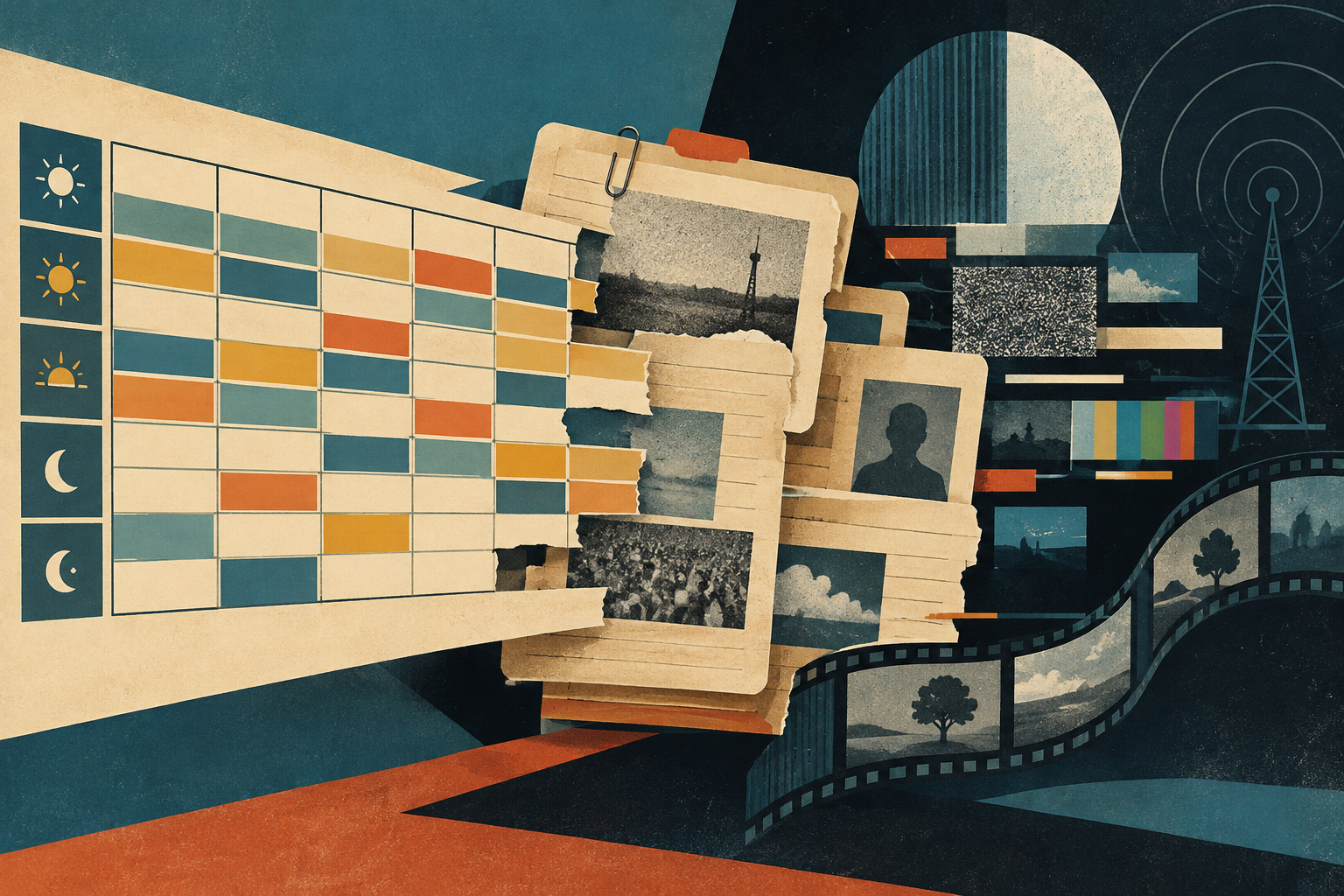
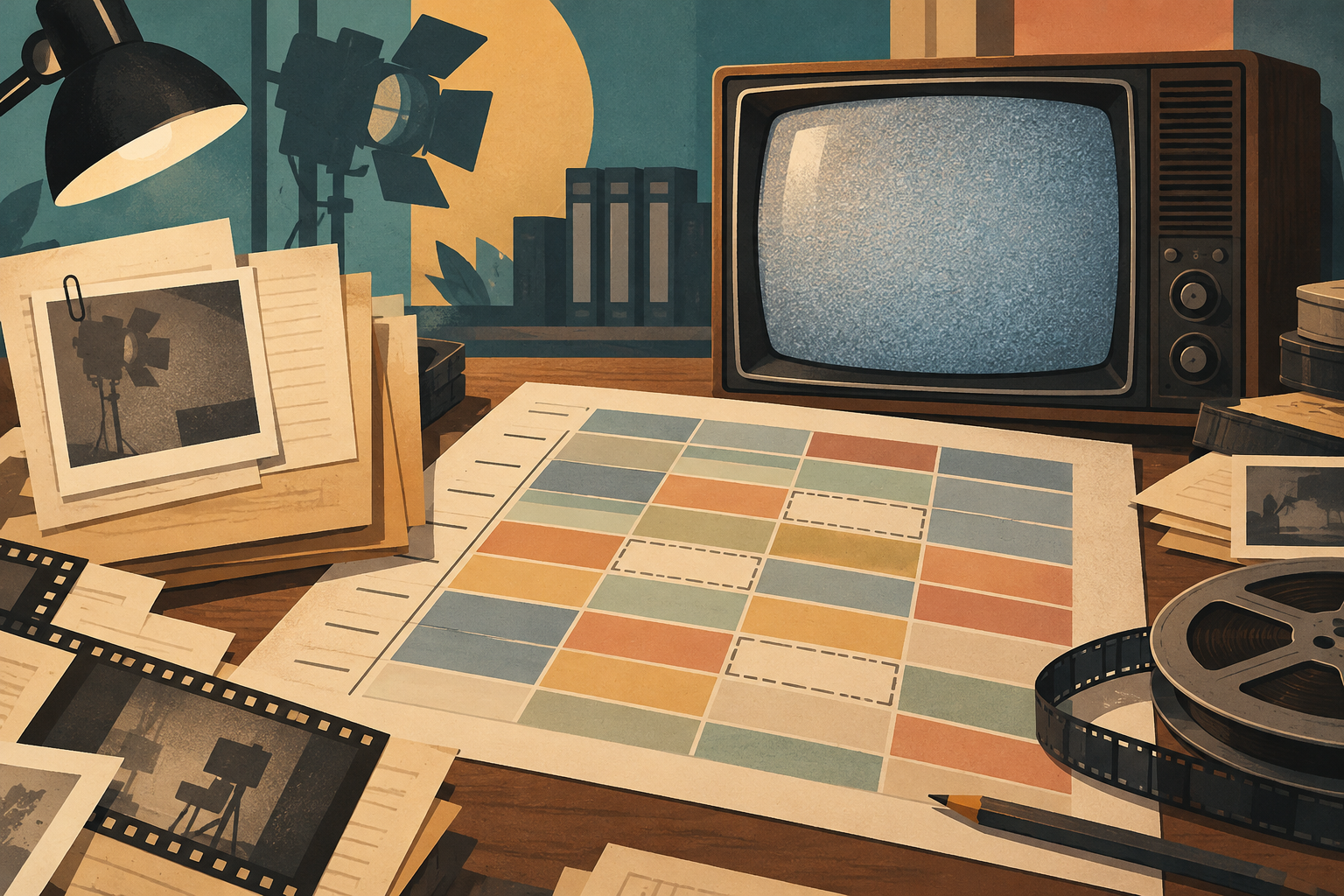
A schedule offers a different perspective. It is not the programme itself, but a record of temporal arrangement that can help researchers study times and sequences when it survives. A broadcast documents what reached the screen; a schedule may provide clues about how the offer was organised. Neither, by itself, answers every question.
Read documents according to their scope
The Complutense University journal article on RTVE’s audiovisual archive describes preserved material relating to programmes about the Spanish Civil War broadcast between 1956 and 1978. That thematic and chronological scope matters: the study shows that an archive can be examined as a defined collection. It does not establish that its contents represent all Spanish television or all programming from those years.
The distinction between a sample and the universe of broadcasts must remain visible. A catalogue, academic article or recording can document something specific without establishing how often it was broadcast, who watched it or the full circumstances of its transmission. A rigorous account should identify the kind of document behind each claim and the period or collection it covers.
Schedules as evidence of organisation
If a source says so explicitly, a schedule can help establish that a title was listed for a particular time. It can also guide archival searches and comparisons between documents. But a programme name in a table does not, on its own, prove that the broadcast happened without changes, that a complete copy survives or that viewers received it in a particular way.
This caution matters when interpreting schedules. Martín-Quevedo’s study of the development of cultural television notes that the arrival of second channels in Europe in the mid-1960s produced markedly different situations across countries. That finding warns against a general history that treats every schedule as equivalent. The organisation of programming depended on the context documented by each source; the supplied summary does not support specifying those national contrasts here.
From an individual programme to the history of television
Television has also been studied through genres, representations and institutional change. The bibliographic record for Manuel Palacio’s work identifies a history of television in Spain and its programming from 1956 to 1996. José Carlos Rueda Laffond’s article, meanwhile, studies the representation of the Spanish Communist Party on television between 1975 and 2011. Their titles and bibliographic details identify lines of research, but they are not enough to attribute conclusions that are absent from the supplied evidence.
The methodological lesson is modest but useful: a schedule is better understood when connected to other documents and questions. A timetable can provide temporal structure; an audiovisual archive can provide access to preserved broadcasts; a study can supply an analytical framework. They should not be conflated, or expected to answer for one another.
Recording changes the question, but does not complete the archive
The question of how being able to record programmes changed television viewing is important, but the sources provided here do not document precisely when, where or for which audiences the practice spread, or allow its effects to be measured. This evidence cannot establish that recording removed the need to watch at a scheduled time or changed domestic habits uniformly.
It is possible to identify a difference in the evidence sought: a schedule records an intended offer; a recording, if it exists and is identified, preserves a particular broadcast. A history of recording habits would require specific sources about devices, practices, households and periods. Without them, turning a technical possibility into a general social transformation would exceed what can be verified.
What can be said, and what remains open
Reconstructing a schedule does not mean filling gaps with collective memory. It means gathering documents, describing their provenance and keeping their limits visible. The sources cited here support the points that archives may contain specific thematic collections, that preservation does not necessarily encompass everything broadcast, and that comparisons between television systems require context. They do not, by themselves, provide a complete schedule for every year or a detailed history of home recording.
That boundary does not weaken research; it makes it more precise. Television history can proceed by distinguishing broadcast, programming and preservation, and by treating each document as evidence with a specific scope. What is missing is not automatically proof, but it can guide the next search: a dated schedule, a catalogue, a study or an identifiable recording. The archive then ceases to be a supposedly complete window and becomes what it is: a collection of traces whose coverage is itself part of the story.
- Decade
- 1970s
- Region
- Spain
- Level
- Enthusiast
- Entities
- Televisión, Televisión Española
Sources and references
- Orígenes y desarrollo de las televisiones culturales en ...revistas.unav.edu · 2026-10-12
- Escritura de la historia en televisión: la representación del Partido Comunista de España (1975-2011)openalex.org · 2026-10-12
- El horario dejó huellas fuera de la pantalla - RetroPausewww.retropause.com · 2026-10-12
- El archivo audiovisual de RTVE. Programas emitidos entre ...revistas.ucm.es · 2026-10-12
- Historia de la televisión en España / M. Palacio.www.researchgate.net · 2026-10-12
- La televisión que queda en el archivo no es toda la televisión quwww.retropause.com · 2026-10-12