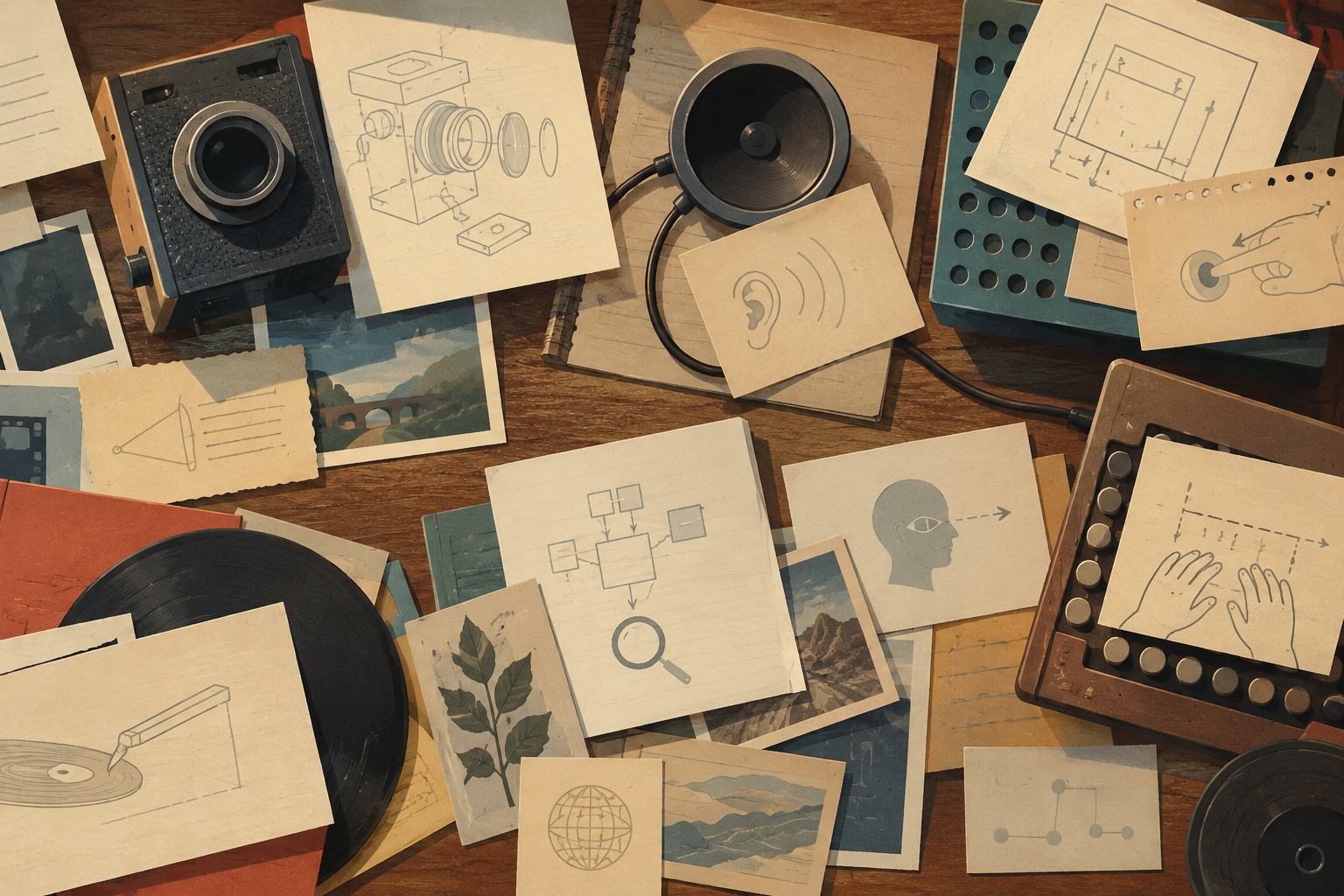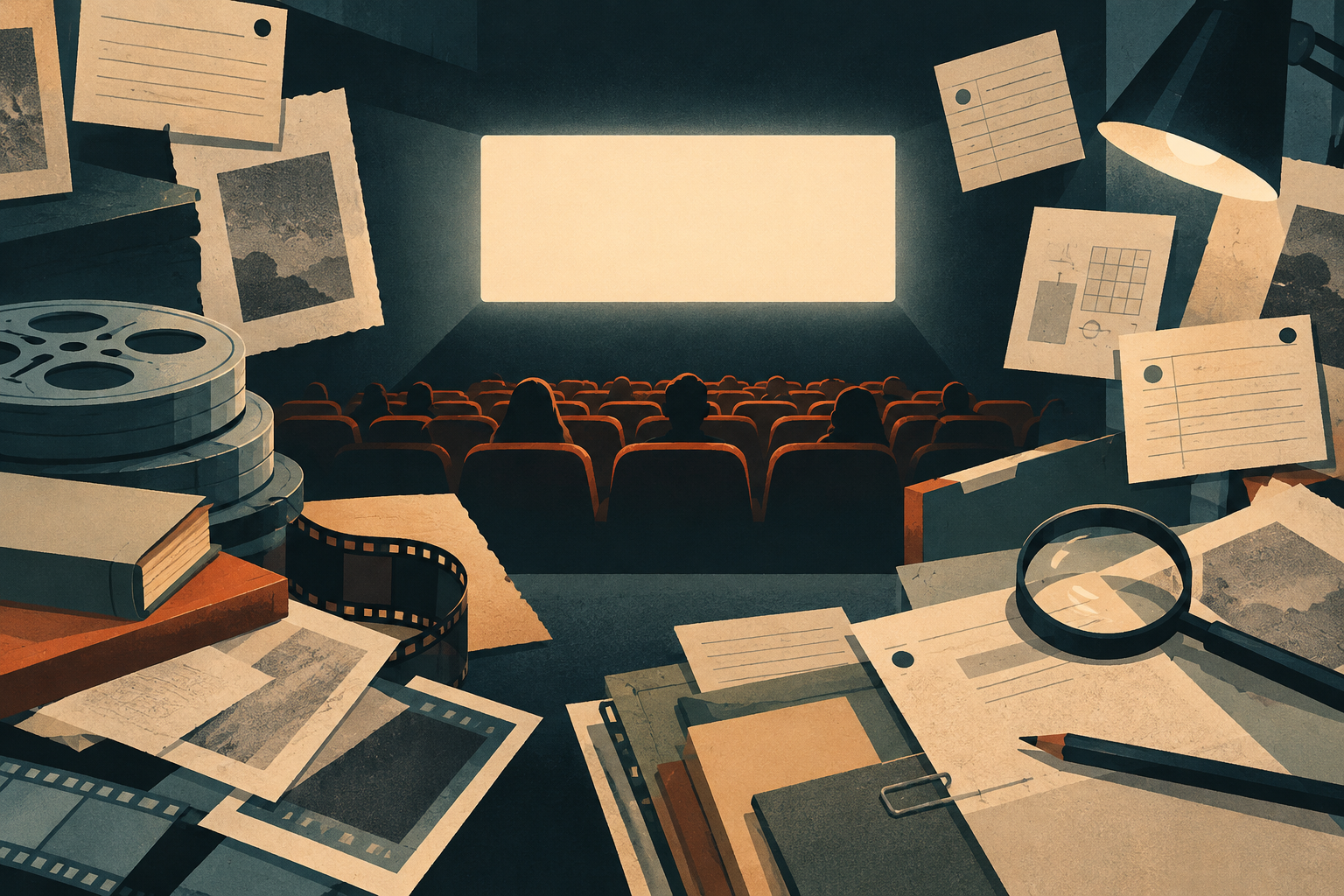
A film may be missing while traces that make research possible survive: a catalogue record, a production photograph, or documents connected with filming and post-production. But a trace is not the work. The distinction seems obvious until a catalogue, image or description begins to stand in for something that is unavailable or no longer preserved. Reading such materials carefully makes it possible to study how cinema was recorded without turning documentary remains into an imagined film.
A record points the way; it does not reconstruct
Research on film documentation describes records that can include information such as title, filmmakers, genre and filming dates. This is useful for identifying, organising and connecting materials. It also sets limits on what can be known: a record speaks to the fields it contains, not to everything that happened during production or everything a film means.
A record can be a starting point for asking what was catalogued and in what language. If a genre is listed, for instance, we can establish that the record assigns that category. Without further evidence, we cannot conclude that it expressed the filmmakers’ intentions or the audience’s response. The category is part of the object’s documentary history as well as a search aid.
From filming to archive: materials with different purposes
A cinema-museum project included among the sources distinguishes production stills and mentions, for that group, advertisements, documents from film sets and materials related to post-production. This list opens a line of enquiry: objects associated with a film are not interchangeable. A production document and an advertisement may refer to the same project, but they serve different purposes and belong to different moments.
The caution is not to attribute more to them than they show. A photograph of a set may document a particular image of work, but it is not a complete record of filming. An advertisement can be studied as a form of communication, although the evidence available here is not sufficient to describe campaigns, audiences or outcomes. The distinction between document types is clear; a detailed reconstruction of any particular case would require consulting the materials themselves.
Film as source and as agent
The academic volume on history and cinema advances an important idea: a film can be considered both a documentary source and a historical agent. As a source, it allows questions about images, stories and ways of representing the past. As an agent, it forms part of the production of ideas and of how a society explains particular experiences.
That dual status does not make a film a transparent record. A work is not a neutral window onto the period it depicts. Filming documentation may provide context about how it was made, while analysis of the film must attend to its form and choices. Keeping these levels separate prevents a document from becoming absolute proof of what appears on screen, or a film from becoming direct proof of what reality outside it was like.
What changes—and what we do not know—between formats
The question of reception in cinemas and on video is compelling, but the materials gathered here do not, by themselves, document a specific change between those experiences. The sources concern film documentation, archives, cinema as historical evidence, and production materials; they do not provide exhibition data, audience testimony or format comparisons that would support a claim about how a particular reception changed.
They do offer a useful rule: before telling a story about audiences, locate the appropriate evidence. A catalogue record does not necessarily document the cinema-going experience. A production document does not prove how a film was later watched on video. Such a comparison would require sources related to exhibition, circulation or reception, and would need to identify the period and film under study. Without them, leaving the question open is more accurate than filling it with generic recollections.
A method for keeping nostalgia separate from evidence
An archive becomes valuable when we ask what each item allows us to claim and what it leaves unresolved. Research on audiovisual archives and historical writing notes, through the example of a documentary production, that filmmaking can also be affected by events that shape production. This kind of reference reminds us that a work’s history may include circumstances of making that cannot be inferred from its content alone. The cited example does not justify generalising those circumstances to other films.
The strongest approach, then, is not to fill gaps with nostalgic evocation. It is to keep the film, its catalogue record, its production documents and sources that might illuminate circulation and reception distinct. Each can open a different question. When a film is unavailable, traces can still support a history, but that history must acknowledge where the documented evidence ends. An archive does not replace the experience of watching cinema: it helps us understand what was preserved, how it was organised and which questions remain open.
- Decade
- 2000s
- Region
- Spain
- Level
- Enthusiast
- Entities
- Museum
Sources and references
- El archivo audiovisual y la escritura de la historiaidartesencasa.gov.co · 2026-10-09
- ¿Qué puede contar el archivo cuando la película no está?www.retropause.com · 2026-10-09
- La Documentación Fílmica: marco contextual históricorevistas.ucm.es · 2026-10-09
- Historia y cine. La construcción del pasado a través de ...ifc.dpz.es · 2026-10-09
- PROYECTO DE CREACIÓN DE UN MUSEO DE CINE EN ...eldocumentalistaudiovisual.com · 2026-10-09
- Cine y casi cine 2002www.museoreinasofia.es · 2026-10-09