A device may retain its shape long after the context that explains what it was for, who used it, or what limits it imposed has disappeared. Its casing, buttons and connections reveal design choices; on their own, they cannot reconstruct the experience of using it. That requires reading the object alongside documents that described, classified or preserved it—and distinguishing what those sources prove from what they merely allow us to ask.
The object is a clue, not a complete explanation
The history of technology is not simply a succession of ever-newer devices. An article on the historical emergence of technology proposes understanding it as a historical construction that creates a space and helps characterise an institution. That perspective encourages us to ask not only what an object could do, but also the setting in which it made sense. The idea can inform research on a console, player or office machine, but it does not by itself establish how a particular model was used.
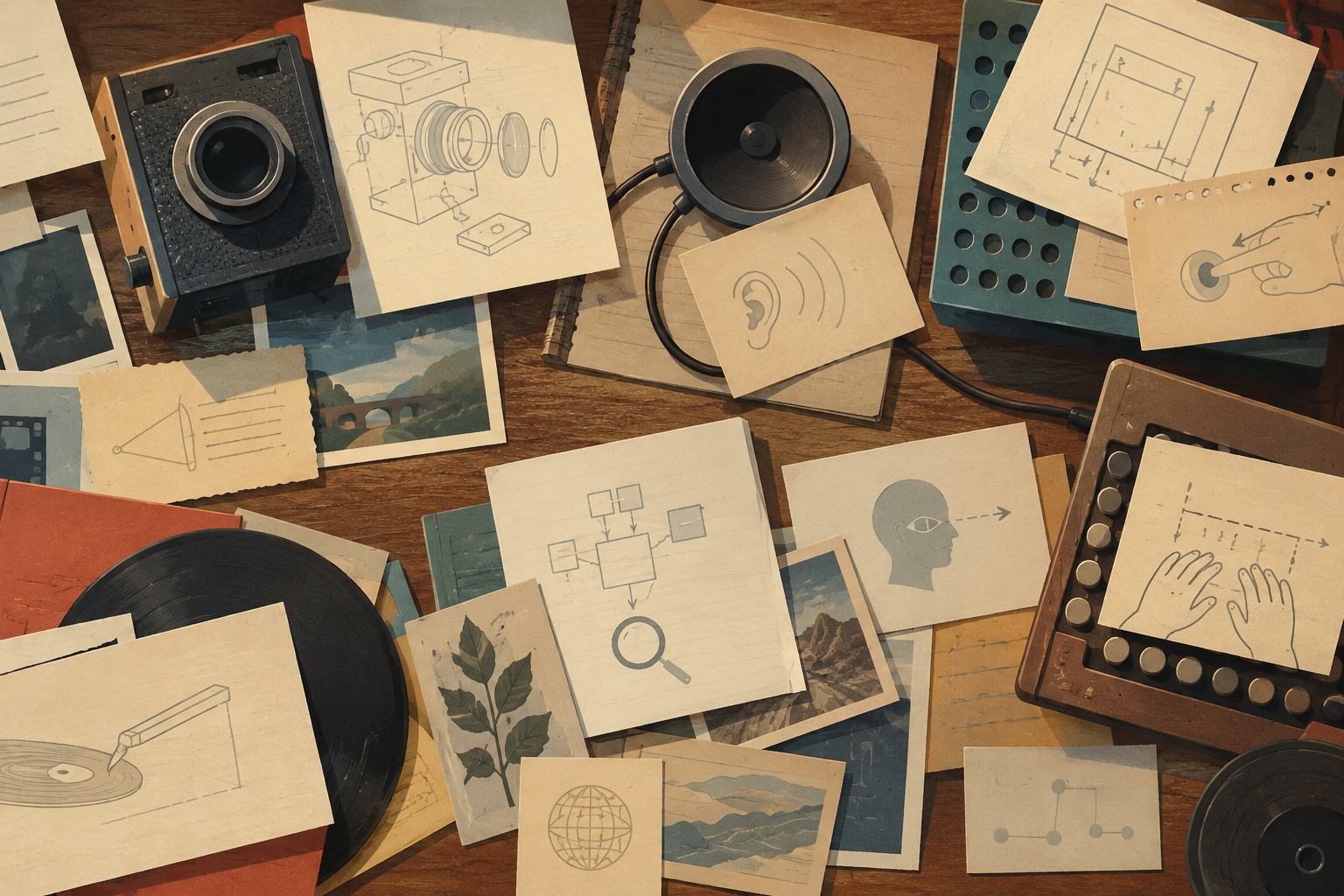
Physical form helps generate testable questions: what could be connected, what actions did the controls permit, and what instructions accompanied the device? Without relevant manuals, advertisements, catalogues or other records, answers may remain open. A visible detail can suggest a function, but suggestion is not documentation. It is better to mark that distinction than to turn a plausible hypothesis into fact.
Documents record different points of view
A manual describes an intended or explained use from the perspective of its author; it does not prove that every user followed the instructions. An advertisement can show how a product was presented, but its promises are not a direct measure of performance or reception either. Documents can therefore identify expectations, vocabulary and proposed conditions of use, but they cannot automatically stand in for evidence of practice.
The sources gathered here do not include a manual or advertisement for a specific device. That absence imposes an important editorial limit: this evidence cannot establish the real-world uses of an identifiable product. It can, however, explain why such sources are worth seeking and how to read them cautiously. Where records of different kinds can be found, comparing them may reveal agreement or contradiction. Where they cannot, the gap should remain visible.
Archives also shape what we can know
A study of company museums links their existence to growing historiographical interest in material culture. The connection matters: preserving objects and documents makes it possible to revisit design and production decisions through historical questions. But preserving an object does not guarantee preserving all the information about its use. A device may survive while its instructions, repair records, advertising or user accounts disappear.
A text from Spain’s National Archaeological Museum addresses the transition from scholarly catalogue cards to the digital catalogue on the Internet. Although it does not focus on a particular consumer device, it reminds us that the ways collections are described and found matter too. A catalogue record can help identify and locate materials; it should not be mistaken for a complete account of an object’s history. In research, the catalogue can be an entry point to evidence, not the end of the work.
Technical collections have their own context
Material from the Universitat Politècnica de València on the history of computing includes operating systems and refers to early versions managed by specialised personnel. This observation is a reminder that the experience of a technology may depend on procedures and people as well as on the visible device. It does not justify generalising about every system or user. It does suggest a useful question for further research: what tasks, skills or intermediaries were needed to make the system work?
Patent archives offer another kind of document. The institutional description provided presents them as a resource for researching the history of science, industry and technology, among other fields. A patent can help researchers examine a registered technical proposal, but by itself it does not prove that the proposal was manufactured, sold or widely used. Before treating it as evidence of everyday experience, it would need to be compared with sources that establish those other stages.
What can be stated—and what must remain open
The supplied documentation supports the view that material culture, catalogues, archives and the history of computing are relevant avenues for researching technology. It does not provide detailed evidence about the everyday use of an identifiable model, or data from which to reconstruct its reception, reach or performance. Respecting that limit does not impoverish a history; it prevents an object’s appearance or promotional language from taking the place of evidence.
A sound investigation can proceed in layers: identify the object; look for instructions and presentation materials; locate archival and cataloguing records; and distinguish between proposed function, documented capability and evidenced practice. Each layer answers different questions. The most useful result is not always a closed narrative. Sometimes it is a transparent map of what we know, which document supports it, and what evidence is still needed to answer how a device was actually used.
- Decade
- 2000s
- Region
- Spain
- Level
- Enthusiast
- Entities
- Museum, Museo Arqueológico Nacional, Internet
Sources and references
- Los Museos de Empresasevemuseografia.com · 2026-10-09
- De la ficha erudita al catálogo digital en Internetwww.man.es · 2026-10-09
- EL SURGIMIENTO HISTÓRICO DE LA TECNOLOGÍAdialnet.unirioja.es · 2026-10-09
- UN VIAJE A LA HISTORIA DE LA INFORMÁTICAmuseo.inf.upv.es · 2026-10-09
- Los archivos históricos y su digitalización en Españawww.albadoc.com · 2026-10-09
- apps, redes sociales y dispositivos móviles en educacion ...www.cultura.gob.es · 2026-10-09
- el archivo histórico de la oficina española de patentes y ...www.mintur.gob.es · 2026-10-09