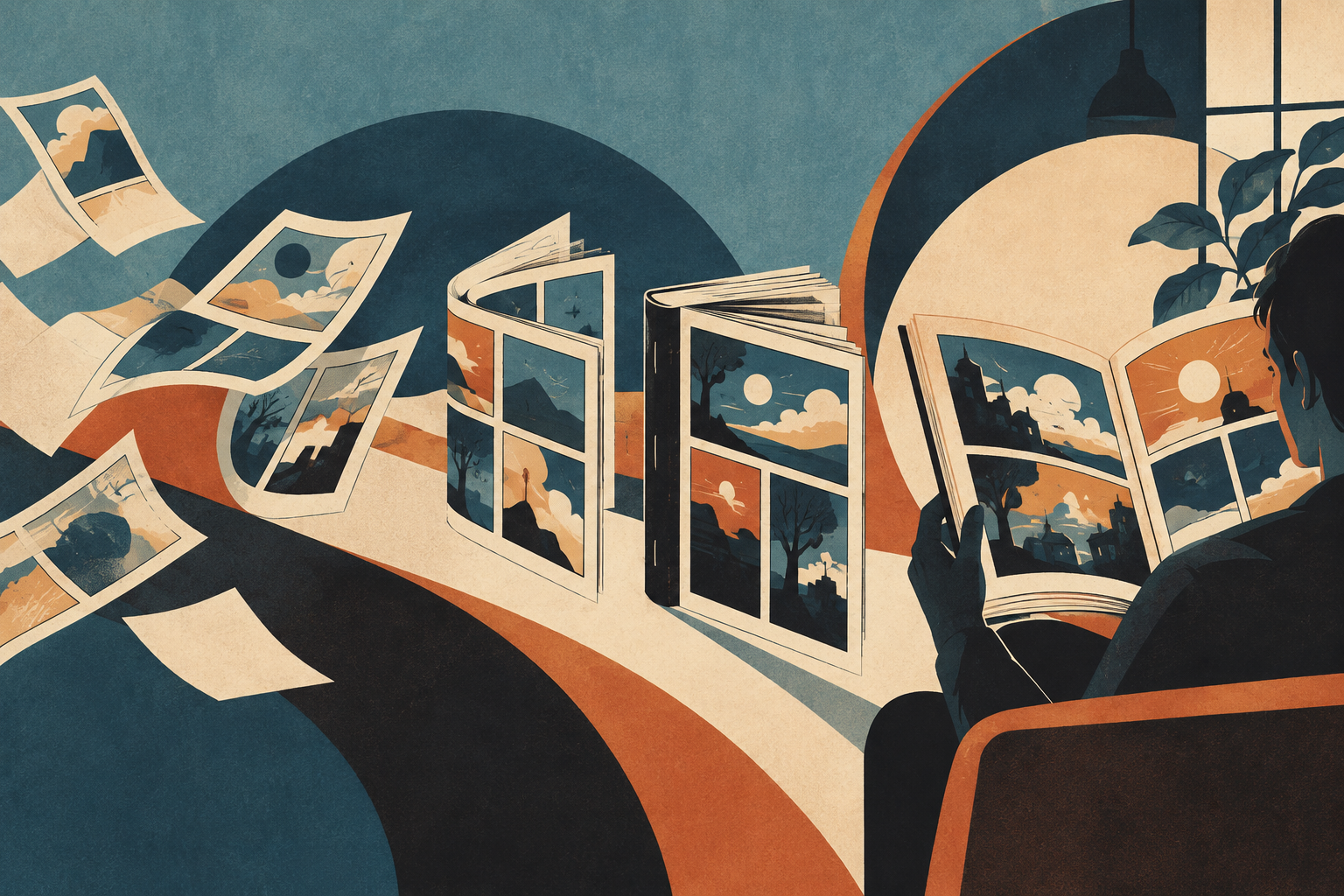
A comic does not encounter its readers in the abstract. It arrives in a publication, gathered with other pages or presented as a distinct publishing object; these conditions belong to its history, even though they do not determine how any individual interprets it. Rubén Varillas raises this question in “El cómic, una cuestión de formatos (2),” whose subtitle lists comic magazines, fanzines, mini-comics, albums and graphic novels. The list opens a path for analysis: to consider comics alongside the ways they are published and circulated. The available evidence supports that relationship, but cannot reconstruct each reader’s experience in detail.
Formats are not interchangeable labels
Varillas’s list matters because it distinguishes several forms of publication. Calling them formats does not mean each has one appearance or that there is a simple boundary between them. It does invite questions about the object readers encounter and the conditions in which a story appears. A magazine, a fanzine and an album are not equivalent terms in the article’s list; nor does naming them establish their material characteristics. Varillas’s full text is not included in the supplied evidence, so detailed conclusions about design, dimensions, paper or frequency cannot be attributed to it. The distinction is a starting point, not a complete description.
The page within an object
Format can guide how a work is organized. A story published in a magazine shares the object with other content; an album presents reading in a distinct publishing volume. This comparison describes general possibilities suggested by the categories, not verified details about particular publications. For research, it encourages looking beyond the panels: how pages are grouped, what unit of publication is preserved and what material information accompanies the narrative. Without identified copies, it is not possible to establish the choices made by a specific edition or how those choices affected its readers. Caution prevents a difference in labels from becoming an undocumented claim about experience.
Circulation and historical context
Circulation helps situate an encounter with a work, but a format’s name does not reveal who read it, where they obtained it or how long it remained available. Answering those questions would require objects, catalogues, advertisements, distribution records or attributable testimony. None of those materials is included in the evidence assembled here. Antonio Martín Pons’s study of the comic industry in Spain offers a reason to bring cultural production into the analysis. The available record identifies it as research on that industry; it does not provide the full study needed to reconstruct phases, figures or publishing networks. The industrial framework is relevant, but its details must remain open.
Japan and the limits of a clue
The excerpt from Varillas’s article offers one concrete, though bounded, example: it says that in Japan the manga magazine is understood as a perishable, disposable consumer product. The passage suggests that a format can also be described by its place in consumption, not only by its content. It is not enough, however, to turn that sentence into a description of all Japanese readers, all manga magazines or an entire period. Nor does the excerpt establish how that condition translated into reading or preservation habits. It is a relevant clue for framing questions, not a sufficient basis for generalization.
From reading to exhibition
The research titled “Las exposiciones de cómics: historia y contexto global” reminds us that comics are also presented in exhibition spaces. Its summary says exhibitions have been common since the medium’s beginnings, though they may seem recent, and mentions “Bande Dessinée et Figuration Narrative.” This information places exhibition among the ways works are mediated for the public. A displayed page is viewed under different circumstances from a copy that can be browsed, but the supplied sources do not describe particular installations or establish how a specific audience responded. Exhibition and reading are related practices, not equivalents; the move from one to the other also requires its own documentation.
A conclusion proportionate to the evidence
The evidence supports a precise, limited conclusion: the formats listed by Varillas are publishing categories that deserve attention alongside drawn narrative. The Spanish industry study and research on exhibitions broaden the inquiry to production and public presentation. But the available excerpts do not authorize a detailed chronology of changes in reading, a comprehensive material description of each format or a universal experience associated with them. Further work would require the complete articles and examination of specific copies and documents. Format alone does not explain a work or its readers; it enables verifiable questions about how a work is organized, published and circulated.
- Decade
- 2000s
- Region
- Spain
- Level
- Enthusiast
- Entities
- Rubén Varillas
Sources and references
- El cómic, una cuestión de formatos (2): revistas de cómics, fanzines, mini-cómics, álbumes y novelas gráficasdoi.org · 2026-10-09
- (PDF) Las exposiciones de cómics. Historia y contexto globalwww.researchgate.net · 2026-10-09
- El contexto de la historietarevistascientificas.us.es · 2026-10-09
- Las exposiciones de cómics: historia y contexto global - Dialnetdialnet.unirioja.es · 2026-10-09
- La industria del cómic en España: radiografía de ¿un mito ...arbor.revistas.csic.es · 2026-10-09
- El cómic, una cuestión de formatos (2)erevistas.publicaciones.uah.es · 2026-10-09