Begin by distinguishing the traces
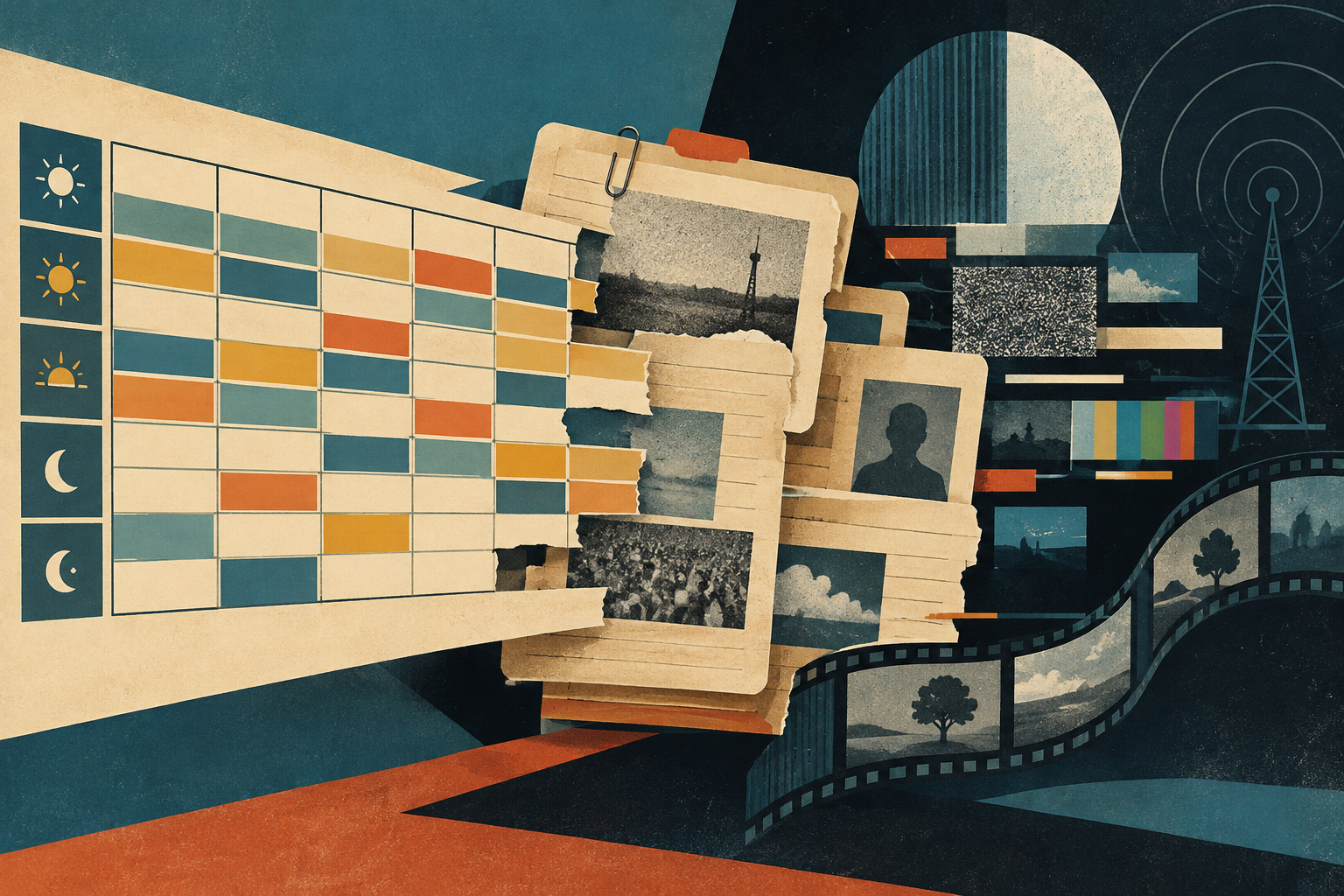
Reconstructing a schedule is not the same as collecting preserved programmes. A broadcast documented by a recording, an archival description and a published timetable are different kinds of trace: they may refer to the same content, but they do not prove the same thing. The evidence available for this article identifies several kinds of source about Spanish television, but it does not provide a complete schedule or a series of dated listings that can be checked programme by programme.
That distinction matters. An accessible archive helps locate surviving audiovisual material; a historical study may describe periods and forms of viewing; a general history may offer a broad chronology. To recover the schedule for a particular day would require broadcast documents or publications specifying dates and times. The supplied sources point to where research can begin; they do not show that the reconstruction has already been completed.
An archive preserves broadcasts, not necessarily the schedule
RTVE presents its archive as a place to watch older Televisión Española programmes in streaming form. It is a relevant entry point for studying which materials survive and how they are now made available. But an announcement of archive access does not guarantee that every broadcast survives, that recordings represent all the programming on a given day, or that the catalogue always provides original broadcast dates and times.
The thesis on preserving television audiovisual heritage offers another angle: it frames the safeguarding of audiovisual archives as a heritage issue and notes UNESCO’s recognition in 1980, as well as mentioning later developments in 2004. The supplied excerpt does not give its conclusions in detail or describe an exhaustive schedule inventory. The thesis should therefore be used as a reference on preservation, not as proof that a particular programme aired at a particular time.
Historical studies provide context, not a substitute schedule
The academic article available through RACO studies features of Spanish television between 1963 and 1969 and presents that period as essential to its history. Its scope offers historical and social context, but the supplied summary does not list daily programming. ASHIS’s call for papers, meanwhile, proposes examining seventy years of television in Spain and placing its development in an international, comparative perspective. It indicates possible research directions; it is not a research finding or a broadcast catalogue.
Both sources help formulate more precise questions: what changed in each period, which institutions and practices should be studied, and what comparisons might be useful. To verify a particular time slot, researchers would still need programming documents, period newspapers or broadcast records with explicit details. Academic titles and summaries should not be turned into claims more specific than the information they contain.
General histories and advertising memory
The history of four decades published by El Mundo organises its account around the 1970s, 1980s, 1990s and 2000s. It can serve as a broad chronological guide, but the supplied excerpt contains no programme listings or evidence with which to verify individual schedules. The page about the television set from La historia de la publicidad begins its account with Televisión Española’s inaugural broadcast on 28 October 1956. That detail illuminates the context of television in Spain, but it cannot by itself reconstruct a later schedule.
These materials show why sources must be combined carefully. A narrative chronology, a content archive and academic research serve different purposes. If they converge on a date or programme, that convergence may guide further research; an exact time or broadcast order still needs specific supporting evidence.
Recording changes the question, but evidence is missing here
The question of how habits changed when people could record programmes is relevant, but the supplied evidence does not document recording devices, adoption dates, household practices or measured audience changes. It cannot establish when recording became widespread or how it affected family schedules. Making such claims here would go beyond the available sources.
The evidence does allow us to distinguish two research objects: announced programming and surviving audiovisual material. A recording can help researchers study a work or broadcast, but it does not automatically prove that it was recorded during its first transmission or that it represents every viewer’s experience. Research into recording habits would require additional, specific sources—such as technical documentation, advertising, attributable testimony or reception studies—none of which is included in the material supplied.
A reconstruction should show its limits
The soundest starting combination here is simple: consult RTVE’s archive to locate materials; use historical studies to define periods and questions; and treat general histories as orientation rather than final proof. Every claim about a date, time, audience or domestic practice should be linked to supporting documentation.
The historical schedule is not necessarily found in one source. It can be reconstructed only by distinguishing what survives from what aired, context from direct evidence, and an archive’s present-day availability from the completeness of its catalogue. The references provided can map a research path and its limits; they cannot establish that a complete schedule has been recovered or show how recording transformed viewers’ habits.
- Decade
- 1970s
- Region
- Spain
- Level
- Enthusiast
- Entities
- Televisión, Televisión Española
Sources and references
- Archivo de Televisión Española | Ver en RTVE Playwww.rtve.es · 2026-10-11
- "La vieja pantalla: 70 años de televisión en España". CFP ...www.ashiscom.org · 2026-10-11
- Preservación del patrimonio audiovisual de televisión El ...eprints.ucm.es · 2026-10-11
- La televisión en España: expansión y consumo social, ...raco.cat · 2026-10-11
- EL TELEVISOR, UNO MÁS DE LA FAMILIAwww.lahistoriadelapublicidad.com · 2026-10-11
- Historia y evolución de 40 años de televisión en Españalab.elmundo.es · 2026-10-11