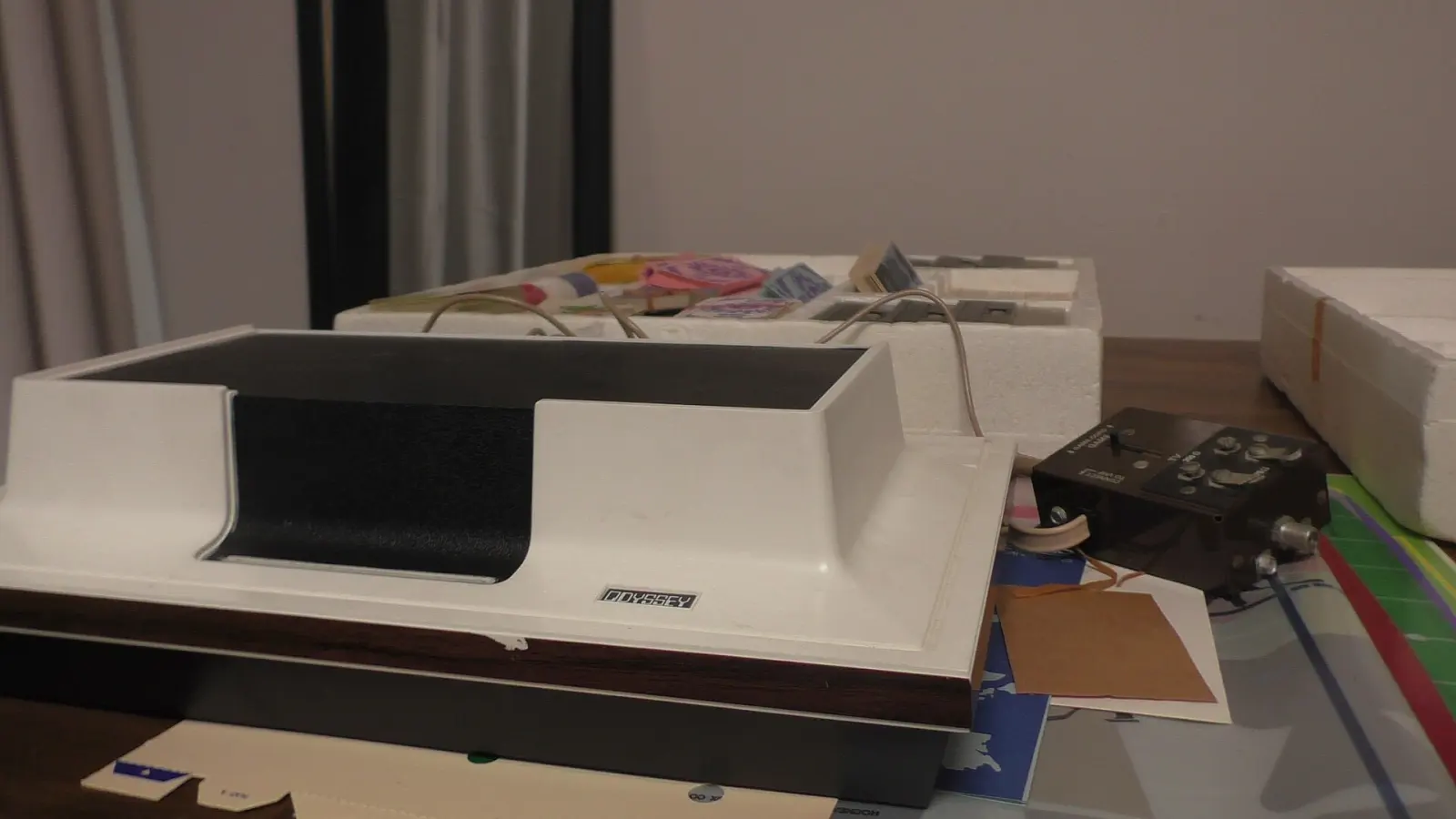
Console history is often told as a succession of generations, names and technical improvements. The Magnavox Odyssey offers another starting point: a closer look at what playing at home meant when images were very simple and many games came built into the system itself. Launched in 1972, the Odyssey appears in the sources consulted as one of the early home consoles and as part of a period in which the forms of electronic play for the home were still taking shape.
A console was not yet a cartridge library
The first generation is commonly placed between 1972 and 1983. One feature distinguishing it from later generations is that many games were built into the console rather than distributed on interchangeable media. The available account of the period also notes that images were made up of simple geometric forms—dots, lines or blocks—and that colour and sound were limited on several systems.
That context changes how we picture using a console. It was not necessarily a matter of choosing from a large collection of titles, inserting a disc or cartridge, and expecting a complex audiovisual experience. In the Odyssey, according to the Museo de los 8 Bits summary, players found a selection of games and could alter the experience through accessories or cartridges. The source does not detail every game or the precise function of each accessory here, so it is better not to turn that general description into an exhaustive inventory.
What the date 1972 tells us
The sources place two nearby milestones in 1972: Atari’s founding in June, according to the first-generation overview, and Magnavox’s launch of the Odyssey in September, also recorded by that source. These are separate events, but together they help explain why the early years of the decade are regarded as a formative moment for the home industry.
The important point is not that one console changed everything at once. The available evidence describes an experimental and limited period in which people were testing the possibilities of bringing electronic games into the home. The Museo de los 8 Bits identifies the Odyssey as the first home console launched in 1972; other overviews describe it as an early system and stress how limited its offering was compared with later machines. That combination—precedence and limitations—helps us understand it without attributing to it features that belong to later generations.
Simple forms, recognisable rules
Simple graphics do not mean an absence of design. The sources describe games built from elementary visual elements and note that the controllers allowed objects to move across the screen. From these details, it is reasonable to interpret much of the experience as relying on understanding basic rules and movements rather than on detailed depictions of settings or characters.
This is an interpretation of documented features, not a description of what every user thought or felt. The supplied material contains no personal testimony, so there is no basis for reconstructing players’ memories or presenting a universal experience. It can be said, however, that technical limits were part of the medium’s form: they shaped what appeared on screen and how games could be designed.
From built-in games to an expandable system
The first generation was not uniform. The overview of the period says the Odyssey introduced features that would become important, including interchangeable cartridges and separate controllers for two players. Yet the same general account describes many consoles of the time as systems with built-in games. This difference is a reason to avoid an overly neat story in which every model represents a fully established technology.
The sources do not always summarise historical development in the same way, and some use broad generational classifications. It is therefore useful to separate features specifically attributed to the Odyssey from general characteristics of the first generation. The available evidence supports the claims that the console launched in 1972, belongs to the early period of home gaming, and is associated with early cartridge use and separate controllers. It does not, however, offer enough detail to reconstruct its complete catalogue, distribution across territories or the differences among all its variants.
A beginning is not a complete history
General console histories often move from the Odyssey to other systems of the 1970s and, later, to consoles with cartridges and larger game libraries. This is a helpful outline, but it can make innovation seem linear. The supplied sources do not justify that simplification: they describe a diverse first generation and a process of change, not a single inevitable path.
The Magnavox Odyssey matters here as a concrete reference point for examining that beginning. Its launch date and technical limits help establish the scale of what a home console could offer in 1972. It also lets us ask a more precise question than “which one came first?”: which elements of home gaming were already present, which remained experimental, and which details cannot yet be verified from the evidence assembled.
The most careful conclusion is also the most useful: the Odyssey belongs to the earliest attempts to bring video games into the home, in a period when built-in games, elementary graphics and simple controls coexisted with ideas that anticipated more expandable systems. There is no need to turn it into a miniature modern console to recognise its place. Its history is best understood as an initial phase, with its own limitations and with innovations that should be attributed carefully.
- Decade
- 1970s
- Region
- North America
- Level
- Introduction
- Entities
- Magnavox Odyssey, Atari
Sources and references
- 【 Historia de las Consolas de Videojuegos 】Cronología ▷ 2026internetpasoapaso.com · 2026-09-27
- Videoconsola - El Museo de los 8 Bitsmuseo8bits.com · 2026-09-27
- Un paseo por todas las generaciones de consolas a lo largo de la historiaeloutput.com · 2026-09-27
- Video Juegos Por Computador : La prehistoria de las consolas en España - prehistoricgamingprehistoricgaming.com · 2026-09-27
- Timeline completo: todas las consolas de juegos de la historia - Digital Trends Españoles.digitaltrends.com · 2026-09-27
- Videoconsolas de primera generaciónes.wikipedia.org · 2026-09-27