The widespread perception of LEGO as a marketing phenomenon or iconic brand often overshadows its most crucial technical foundation: the interlocking system. While the corporate history of the company, founded by Ole Kirk Christiansen in 1932 in Billund, is well known, the true cultural turning point did not occur when the name «LEGO» became popular, but when the internal engineering of the brick was standardized. This article examines the transition from a wooden block manufacturer to a plastic building system, focusing on how the technical definition of «System» in the 1950s and 1960s laid the groundwork for the open-play philosophy that defines the company today.
From Wood to Plastic: A Material Shift
In its early days, Christiansen's company produced wooden blocks, a material that limited the precision and durability of connections. The transition to plastic, initiated in the 1940s, was not just an aesthetic change but a functional necessity. Plastic allowed the mass reproduction of complex shapes with minimal tolerances. However, the material alone did not guarantee compatibility between pieces. It was necessary to develop a mechanism that ensured any brick produced in one factory could fit perfectly with another produced elsewhere, decades later. This technical standardization is the basis of what the company calls the «LEGO System».
The Emergence of the Term «System»
The use of the word «System» in the brand identity was not accidental. Between 1955 and 1964, the company's logo incorporated this term to differentiate its products from other generic building blocks. This linguistic decision reflected a technical reality: LEGO blocks were not just loose pieces, but components of an interconnected set. The inclusion of «System» in the logo marked the moment when the company shifted from selling toys to selling a construction methodology. This semantic change was fundamental in establishing the perception that value lay in the interaction between pieces, not just in the individual piece.
The 1958 Patent and the Inner Tube
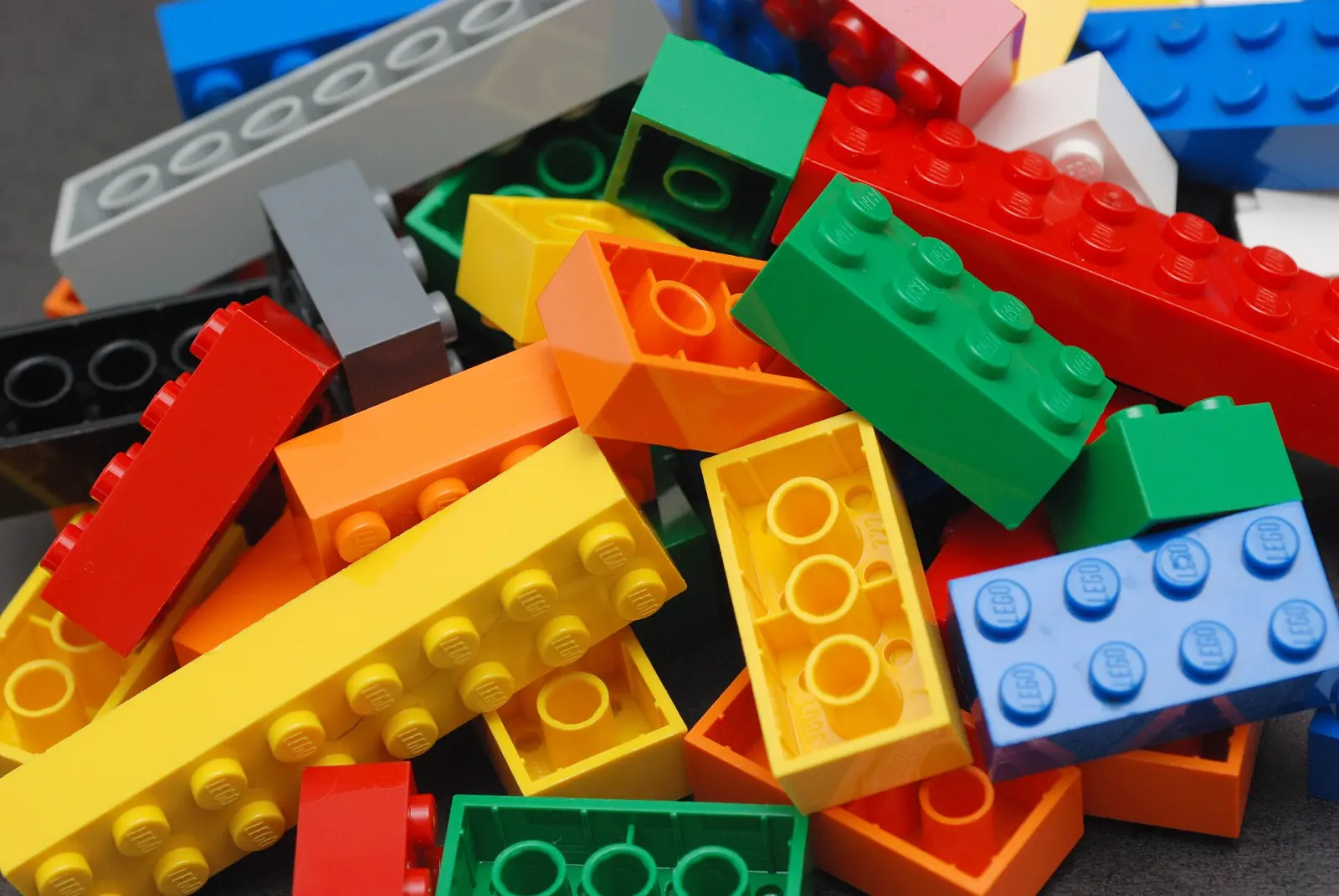
The definitive technical milestone arrived in 1958 with the granting of a patent for the internal interlocking system. This design introduced hollow tubes in the bottom of the bricks that aligned with the tubes of the upper bricks. This mechanism, known as «tubing», provided the necessary friction to keep structures together without the need for glue or tools. The innovation was subtle but revolutionary: it allowed for the total disassembly of constructions, an essential requirement for creative play. Without this ability to rebuild, LEGO would have been merely a static object, not a medium of expression.
Consolidation of Visual Identity
As the technical system matured, the brand's visual identity consolidated. In 1973, the company adopted the name «LEGO System of Play», unifying the nomenclature and reinforcing the concept that the product was a play system. During this period, the logo's typography underwent minimal changes, shifting from more rounded shapes to more angular lines, but maintaining chromatic and symbolic coherence. Visual stability was crucial for generating consumer trust, who associated the characteristic red and specific typography with the guaranteed quality and compatibility of the system.
The Open-Play Philosophy
The combination of technical precision and visual identity established the foundations for the «open-play» philosophy. Unlike toys with a predefined use, the LEGO System allowed users to create unlimited structures. This feature transformed the toy into an educational and creative tool. The company did not just sell bricks, but the possibility to build. This vision aligned with the company's core values, which prioritized creativity and innovation. The ability of users to modify, disassemble, and rebuild their creations was what distinguished LEGO from the competition and turned it into a lasting cultural phenomenon.
Limits of Historical Verification
It is important to note that, although key dates such as the founding in 1932, the 1958 patent, and the brand consolidation in 1973 are well documented, specific details about the early development of the interlocking system may vary depending on the sources. Available evidence confirms the existence of the patent and its impact, but does not provide an exhaustive breakdown of the prior experiments that led to this design. Similarly, the evolution of the logo is a continuous process, and descriptions of typographic changes are interpretations based on the visual observation of brand materials over the decades.
Conclusion
The history of the LEGO System is, ultimately, a story of engineering applied to play. The transition from wood to plastic and the implementation of the inner tube system were not just technical improvements, but strategic decisions that defined the brand's identity. By standardizing the interlock, the company created an ecosystem where compatibility was the norm, allowing generations of users to share a common language of construction. This technical legacy remains the backbone of the company, demonstrating that innovation in industrial design can have a profound and lasting cultural impact.
- Decade
- 1970s
- Region
- Global
- Level
- Enthusiast
- Entities
- LEGO System
Sources and references
- Evolución del logo de LEGO: historia de un iconowww.imprentaonline.net · 2026-10-22
- Sistema - Brickipedia - Fandomtranslate.google.com · 2026-10-22
- LEGO (empresa) - Wikipedia, la enciclopedia librees.wikipedia.org · 2026-10-22
- La evolución del logo de LEGOwww.facebook.com · 2026-10-22
- La Transformación de LEGO (2004–2022)transformalix.com · 2026-10-22