Three traces, three questions
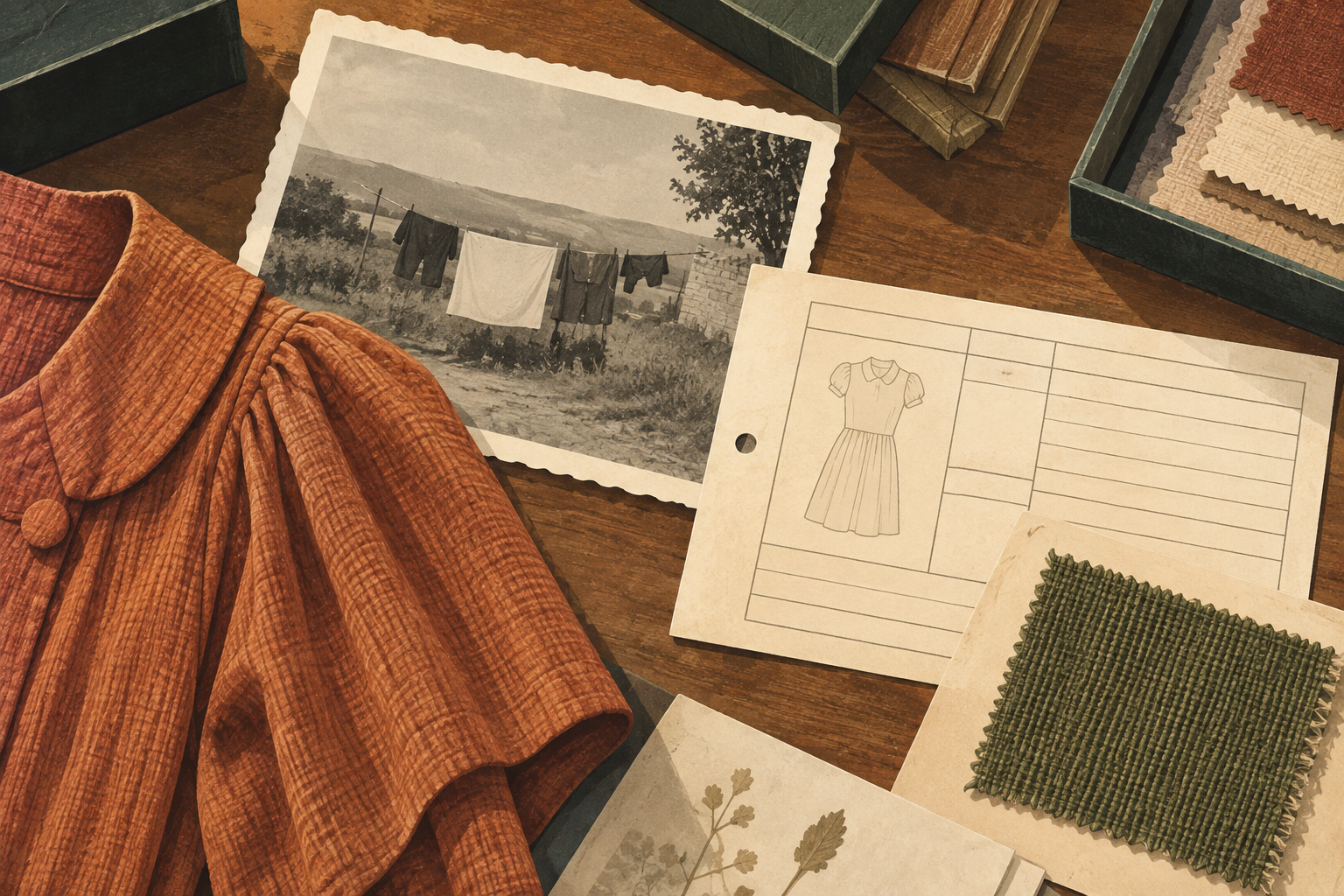
A preserved garment seems to offer an immediate answer: it is there, with its shape, materials and details. A photograph appears to bring us closer to the person who wore it. A magazine or advertisement shows how people were invited to dress. Yet none of these sources speaks for itself. Each records something different and leaves other things out. Research into dress begins by recognizing those differences, not erasing them.
The Museo del Traje resources and the studies on textile collections and documentary heritage included in the supplied evidence point to a field built from objects as well as documents. Their coexistence does not automatically make one source confirmation of another. The task is to ask what each piece of evidence can support and what remains beyond its reach.
The garment: material evidence, not representativeness
An object can support study of particular features of its construction and materials, provided that the record or specialist examination supports those observations. Scholarship on textile collections stresses the importance of documenting treatments associated with textiles: an intervention history is part of what is known about an object and how that knowledge has been produced.
This matters because a preserved garment is not a statistical sample of what a population wore. Its presence in a collection tells us that it survived and was preserved, not how many people owned similar clothing, how they used it on different occasions, or how long it remained in circulation. Even a garment with visible details cannot by itself tell us who wore it, where, how often, or with what meaning.
Caution does not diminish the object’s value; it makes that value more precise. It allows researchers to describe what they can observe while keeping separate the hypotheses that require other sources. It also encourages them to treat the object’s present condition as part of its material history: conservation, deterioration and treatment may affect what is visible today.
The photograph: a framed scene
Images provide clues about appearance, posture and visible context. But a photograph frames a scene: something or someone is included, while everything else is left outside. An image may document a particular situation, but it is not, by itself, a survey of how a period dressed.
Researchers should ask who produced the photograph, for what purpose, what information accompanies the original, and whether its provenance is known. It is also important to distinguish an image recording a situation from one constructed to present an appearance. Without such information, assigning a precise documentary function to the image would go beyond the available evidence.
The supplied text on Madrid dress notes that paintings and prints have left visual documentation of changes in clothing in the city. This is a useful indication that representation can serve as a historical source. It does not make an artistic image a transparent record of daily life: genre, commission and conventions all belong in the interpretation.
Magazines and advertisements: proposals, not proof of use
A magazine can be used to study fashion discourse, models and proposals; an advertisement records an intention to promote. Both can show which images circulated and which garments, textiles or styles were presented in that medium. Neither automatically proves that readers adopted them, that they were accessible to everyone, or that people dressed exactly as they appeared in print.
It helps to separate three levels: what the printed item directly shows; what its editorial context allows us to infer cautiously; and what would require independent corroboration. An identified advertisement can establish that a promotional image was published. On its own it does not prove sales, social reach or everyday use. A photograph of someone wearing a style likewise cannot establish how many others adopted it.
The supplied studies on fashion documentation and information resources help frame the variety of materials an investigation may bring together. Variety adds strength only when each source is described according to its function and its limits are compared, rather than when images are accumulated as if they were equivalent testimony.
Textile and conservation records
Textiles invite attention to texture, structure and technique, but specialist description must support any identification. The Museo del Traje resource on fashion history, for example, defines brocade in relation to precious-metal decoration worked on a loom. That definition provides a term for research; it does not authorize calling a particular object brocade without examining and documenting it.
Likewise, a conservation record is not an administrative detail separate from an object’s history. The article on textiles in Spanish museum collections emphasizes that documentation of treatments is bound to the history of the textile. For researchers, this means recording what survives, what has been treated, and which claims rest on direct observation or earlier documentation.
What can be concluded—and what cannot
When an object, image and document agree on a detail, their agreement may strengthen an interpretation, but it does not remove the need to check that they refer to the same context. If they disagree, the difference need not be an error: one source may show a proposal and another a practice, or they may belong to different moments or situations. Without provenance data, a reconciliation should not be invented.
The soundest framework is modest: identify each source, describe its nature, ask an appropriate question, and distinguish observation from inference. The history of dress becomes more precise when a preserved garment is not turned into an entire society’s wardrobe, nor an advertisement into evidence of universal use.
A material object, an image and a printed document can open complementary lines of inquiry. Together they help us study fashion as both social practice and representation, provided that the distance between what was proposed, what was depicted and what can actually be documented about use remains visible.
- Decade
- Before 1950
- Region
- Spain
- Level
- Enthusiast
- Entities
- Museum, Museo del Traje
Sources and references
- Recursos de información sobre moda: fuentes bibliográficas, instituciones de memoria y objetos de contenidodoi.org · 2026-10-04
- La moda en la historia - Museo del Trajemuseodeltrajevirtual.com · 2026-10-04
- Tejidos, moda y cuerposhistoriadeldisseny.org · 2026-10-04
- Museos de la moda y el vestidounesdoc.unesco.org · 2026-10-04
- Los tejidos en las colecciones de los museos españoles, una ...revistas.ucm.es · 2026-10-04
- velasco--a--la-moda-femenina---.pdfwww.cultura.gob.es · 2026-10-04
- Moda, patrimonio documental y legado en la colección ...studiahumanitatisjournal.com · 2026-10-04