Music does not fit into a single kind of document
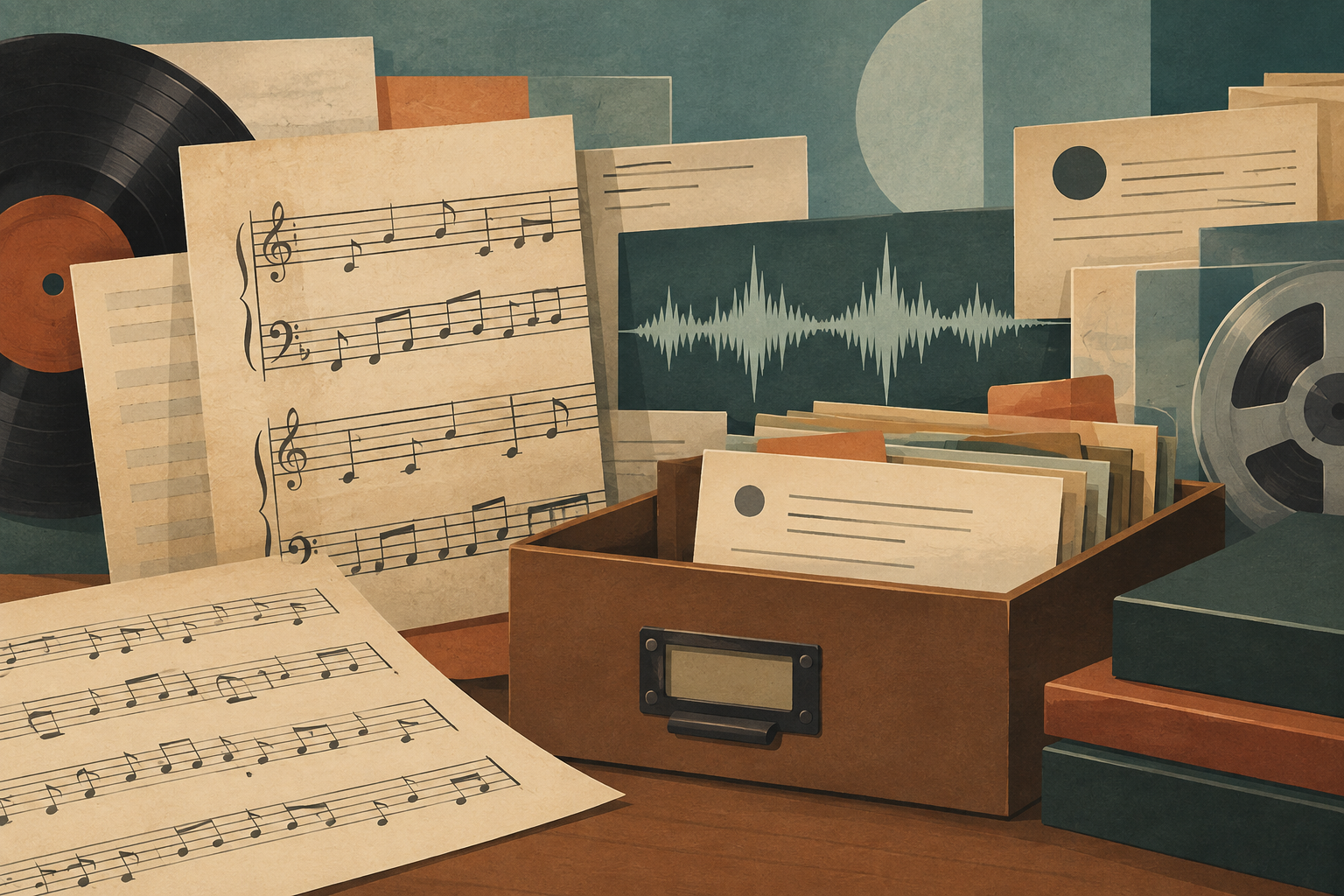
Music may be recorded as a score, but it can also be represented by photographs, recordings, catalogue entries and other materials describing a collection or an institution’s activities. The sources gathered here show that variety, though they do not provide a complete inventory of holdings or a general history of music archives. That limitation matters: an archive is not music itself, but a body of documents and resources that represent it, put it in context or help people find it.
El Museo Canario describes a guided visit to the music holdings kept in its archive and identifies scores as a point of reference. The Museo Nacional de Artes Escénicas, meanwhile, says that most of its musical heritage comes from the Museo-Archivo del Teatro Real, created by its director Luis París in 1919. These are specific institutional descriptions. On their own, they do not establish the full scope, detailed composition or history of either collection.
The score as a starting point
A score is a visible form of musical notation: it preserves organized signs that represent a work. EC Bolaños’s research on the organization of music archives offers a broader conceptual framework, defining a music archive as an information unit that organizes, safeguards, administers and preserves written music. That definition emphasizes management and preservation as well as the material being kept.
This definition should not be mistaken for a comprehensive account of every archive. The available evidence explicitly concerns written music, while institutional pages refer to holdings, heritage or multimedia resources. Taken together, they suggest that documentary work can involve different kinds of material, but they do not show that every archive holds all these formats or manages them in the same way.
From documents to collections of resources
The Museu de la Música in Barcelona says its Multimedia Archive contains more than 60,000 items documenting both the collections and the museum’s activities. The examples given include photographs used for identification and restoration. This indicates that institutional documentation can extend beyond musical works to record processes associated with objects and the life of a museum.
The figure and examples come from the museum’s own page. The information provided here does not specify how the items are divided, their formats, access conditions or the dates they cover. The safest reading is therefore that the description signals the documentary scope of the multimedia archive—not that it represents all musical activity in Barcelona or a complete historical period.
Archives that tell stories about music
An exhibition at the Bilbao Fine Arts Museum, titled “Music in History,” is described as a presentation of charts and texts by Juan…; the available information says it ran from 1 August to 1 September 1983 and refers to more than 15,000 composers and titles. The record points to another way of ordering and presenting musical knowledge: an exhibition combining graphic and written material. Without further information, it is not possible to say what was shown or how it was arranged.
The National Archaeological Museum’s musical itinerary offers another institutional example of approaching music through exhibition rooms. Its description promises a route featuring unusual objects, but does not identify them. These cases are not the same as a music archive: they are ways of interpreting or presenting material in a museum. The distinction matters. Preserving, organizing and exhibiting are related activities, but the pages consulted do not establish them as a single function.
The challenge of documenting music in the streaming era
A 2024 article in the journal PH explicitly addresses “the challenge of the music archive in the streaming era.” Its summary says that a conference included a presentation about a joint initiative by Subterfuge Records and Spain’s National Library. This is enough to establish that music archiving is being discussed in connection with streaming, and that the initiative mentioned involves a record company and a library institution.
The supplied summary does not explain how the initiative works, what materials it gathers or what solutions it proposes. It does not support claims about which streaming services are preserved, how rights are handled or whether a shared model exists. It does, however, point to a relevant editorial question: when music circulation is described through an archive, what documents remain available to explain works, their context and the activity that keeps them accessible? Answering that would require more detailed sources on specific projects and practices.
What the sources allow us to say
The examples form a limited but useful picture: archives that use scores as a point of reference; musical heritage tied to an institutional history; multimedia resources documenting collections and activities; exhibitions and itineraries that communicate content; and recent debate about archives in relation to streaming. They do not amount to a systematic comparison or a complete chronology of music preservation in Spain.
The firmest conclusion is also the most modest: preserving music involves attending to the documents that make it identifiable and understandable, and institutions can describe those documents in different ways. Scores, photographs and multimedia resources are not interchangeable, but each can provide a documentary perspective. Understanding how they relate within a particular archive would require catalogues, access policies and collection descriptions not present in the available evidence.
- Decade
- Contemporary
- Region
- Spain
- Level
- Introduction
- Entities
- Museum, Museo Nacional de Artes Escénicas, Museo Arqueológico Nacional
Sources and references
- la organización de archivos musicales marco conceptual ...agora.edu.es · 2026-09-29
- “Los Sonidos del Archivo”, una visita para conocer el ...www.elmuseocanario.com · 2026-09-29
- Archivo Musical - Museo Nacional de Artes Escénicasmuseodeartesescenicas.inaem.gob.es · 2026-09-29
- Música en el museo - | Ministerio de Culturawww.man.es · 2026-09-29
- EDR | Museu de la Músicaajuntament.barcelona.cat · 2026-09-29
- La música en la historia. Gráficos y textos de Juan ...bilbaomuseoa.eus · 2026-09-29
- ¿Dónde están las canciones? El reto del archivo musical en la ...www.iaph.es · 2026-09-29