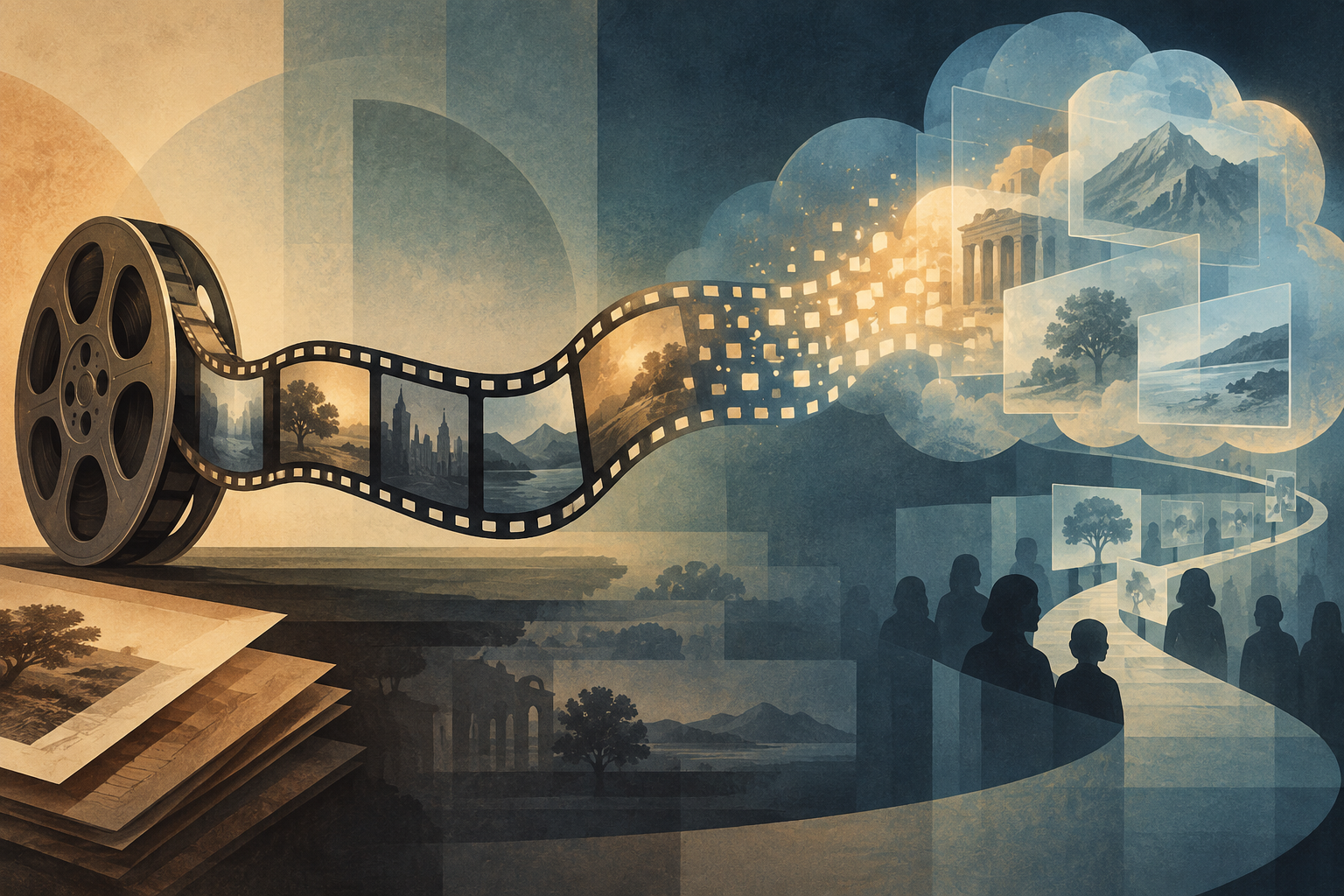
Film memory cannot be preserved through a single operation. Maintaining physical materials and making films accessible are related but distinct tasks: an archive may protect objects without bringing them into public view, while an online digital copy does not by itself guarantee the work’s continuity or context. The evidence available here points to a central tension: preservation also involves decisions about how audiovisual heritage is shared and interpreted.
Conservation and exhibition belong together
A UNESCO document on creating a film culture describes archival work as involving both the conservation and the exhibition of moving-image artefacts in their social context. That formulation moves the archive beyond the image of a closed repository. It presents preservation as a way of connecting objects with the circumstances in which they circulated and were seen.
The material provided mentions MOMI and notes that its approach encompasses overlapping chronologies in the evolution of cinema. There is not enough detail here to describe its structure or collections. The reference nevertheless points to a wider question: film history need not be arranged as one uninterrupted sequence. Preserving objects and presenting them publicly can make intersecting paths visible rather than reducing them to a single linear account.
From physical materials to digital archives
Online access changes the potential scale of consultation. A study on the value of digital film-history archives reports results suggesting a connection between online availability, awareness that cultural heritage remains accessible, and willingness to share or consult those resources. The excerpt does not provide enough information to assess the study’s methods or the scope of its findings. It does support a measured observation: accessibility may shape how audiences relate to heritage, not merely how conveniently they can locate a film.
But “digital” does not mean “preserved.” The evidence specifies no formats, protocols, costs, backup policies or technical storage conditions. It therefore cannot establish which particular solutions ensure the survival of digital holdings. What can be said is that digital access is one dimension of preservation, not an automatic replacement for conservation work.
Restoration and circulation
The evidence cites the Filmoteca Española as an example of an approach that identifies restoration and dissemination among the factors enabling cinema to survive as cultural heritage. It also refers to Costa Rica’s Centro de Cine, in an institutional post inviting people to discover, value and preserve the audiovisual heritage held in its image archive.
These references do not support a comparison of the institutions’ resources, methods or outcomes. Their significance here is narrower: both point to preservation alongside public circulation and cultural appreciation. Restoration addresses the work and its materials; dissemination allows it to take part in shared memory. Neither makes the other unnecessary.
Memory across more than one medium
A 2025 academic project cited in the evidence develops a preventive-conservation proposal for eight films on film stock. The available description does not explain the proposed measures or show that they apply to other collections. Even so, the case confirms that physical carriers remain an explicit subject of planning, even as contemporary access increasingly relies on digital media.
This suggests a cultural interpretation rather than a technical prescription: film memory depends on the relationship between preserved materials, accessible copies and accounts that place films within society. If one element is missing, the heritage experience is incomplete. A preserved object that remains unknown has a different reach from a film that people can consult and understand in context.
What the evidence can—and cannot—show
The sources support the importance of conserving and exhibiting films, the possible significance of online access, and the roles attributed to restoration, dissemination and preventive conservation. They do not document a comprehensive history of the transition from film stock to the cloud, nor do they provide comparable figures on loss, costs, access policies or storage systems. They also do not show that sharing digital resources alone guarantees their long-term survival.
That caution sharpens rather than weakens the argument. Preservation is not a state achieved once and for all; it is work combining material care, access decisions and the transmission of context. The practical conclusion is straightforward: a film archive serves its cultural purpose best when conserving a work and enabling the public to find it are treated as complementary responsibilities.
- Decade
- 2000s
- Region
- Global
- Level
- Advanced restoration
- Entities
- No linked entities
Sources and references
- Crear una cultura del cine: el Archivo Cinematográfico ...unesdoc.unesco.org · 2026-10-19
- El valor del archivo digital de la historia del cine: disposición a ...translate.google.com · 2026-10-19
- Ministerio de Cultura de Panamáwww.facebook.com · 2026-10-19
- (PDF) El cine como patrimonio cultural: el caso de la ...www.researchgate.net · 2026-10-19
- La memoria del cine vive aquí 🎞️ En el Archivo de ...www.facebook.com · 2026-10-19
- Preservación de la memoria cinematográfica - RiuNet - UPVriunet.upv.es · 2026-10-19