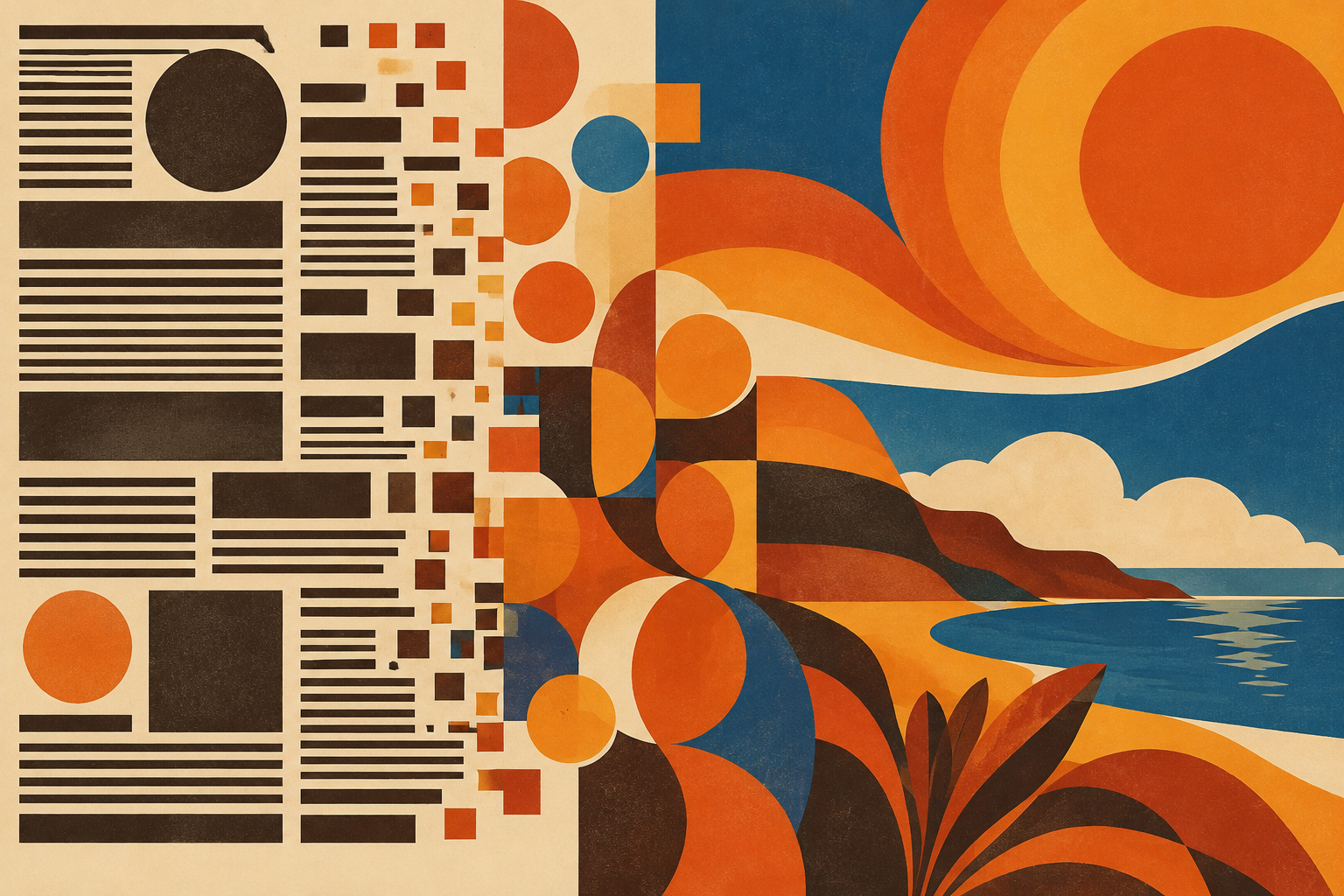
The transition between the 1960s and 1970s marked a turning point in commercial communication. During this period, advertising ceased to rely exclusively on descriptive text, focusing instead on imagery and creativity as primary elements of differentiation. This change was not merely aesthetic but structural, redefining the role of graphic design as a discipline capable of organizing consumer perception beyond literal information. The article explores how the saturation of public spaces forced brands to adopt a more direct visual language, consolidating the image as the main vehicle of persuasion in the era of mass communication.
The End of Textual Dependence
Historically, advertising relied on text to detail product characteristics. However, historical sources from the sector indicate that between 1960 and 1970, creativity and imagery became the differentiating sign against competition. This evolution surpassed the exclusive dependence on descriptive text, establishing a new communicative hierarchy where visual impact prevailed over verbal explanation. The image ceased to be an illustrative complement to become the central argument of the commercial proposal.
The Consolidation of Graphic Design
This period coincided with the consolidation of graphic design as a differentiated profession. Although its origins date back to the 15th-century printing press and its association with advertising in the 19th century, it was in the 20th century that it consolidated as an academic and practical discipline. Graphic design came to be understood not only as the combination of text and images but as a tool to project visual communications intended to transmit specific messages to social groups with determined objectives. This professionalization allowed visual communication to be approached with a technical and creative rigor that did not previously exist.
The Designer as Message Encoder
The function of the graphic designer underwent a profound transformation during these years. Their role evolved into that of a message encoder or interpreter. The work started from a linguistic demand, oral or written, which the designer transformed into a graphic manifestation. This process was not limited to translating words into images but used the aesthetics of typography, compositional layout, and ornamentation to transmit ideas, feelings, and attitudes that language alone could not express. Design became a medium to communicate beyond the literal, adding layers of emotional and cultural meaning.
The Saturation of Public Space
A key factor in this transition was the growing saturation of public spaces by advertising. Critics of the time already pointed out the invasion of advertising in environments such as schools and radio waves, which generated growing annoyance in the audience. This overexposure forced brands to seek more efficient ways to capture attention. In an increasingly visual environment, the need to stand out drove the adoption of a more direct and impactful language. The image, due to its capacity for rapid processing by the brain, became the ideal tool to compete for the viewer's attention in a sea of stimuli.
Form and Function in Professional Practice
The principle that 'form follows a specific function' became a fundamental pillar of professional practice of the time. Graphic design was based on the definition of problems and the determination of objectives for decision-making through creativity and innovation. It was not an arbitrary application of styles, but a search for optimization in graphic communication. The relationship between form and function defined how brands approached the creation of their visual identities, seeking not only beauty but efficacy in the transmission of their message. This functionalist approach distinguished pure aesthetics from persuasive intent, aligning design with commercial objectives.
Persuasion and Social Criticism
The capacity of the image to persuade also generated criticism. Advertising was pointed out for using psychological pressure on the consumer, appealing to feelings of insufficiency or created needs. Critics argued that visual communication, being more subtle than text, could subconsciously influence purchasing decisions. This ethical dimension of advertising intertwined with criticism of the media, questioning the honesty and social impact of visual persuasion. Despite these criticisms, the advertising industry continued to evolve, adapting to the new realities of mass communication.
Legacy and Limits of Evidence
The 1970s laid the foundations for modern visual communication. The transition from text to image was not an isolated event, but the result of a convergence of technological, social, and economic factors. However, it is important to point out the limits of the available evidence. Historical sources provide a general framework, but do not detail the specific strategies of each brand or the quantitative results of these campaigns. The understanding of this period is based on the observation of general trends and the evolution of the graphic design discipline, rather than specific performance data. Nevertheless, the impact of this visual reconfiguration is undeniable, leaving a legacy that continues to define how we interact with commercial information today.
- Decade
- 1970s
- Region
- Global
- Level
- Enthusiast
- Entities
- No linked entities
Sources and references
- Análisis histórico de la publicidadwww.juangalera.com · 2026-10-19
- Historia del diseño gráficotranslate.google.com · 2026-10-19
- (PDF) Historia del diseño de marcas: una propuesta para ...www.researchgate.net · 2026-10-19
- la historia de la publicidadwww.lahistoriadelapublicidad.com · 2026-10-19
- Diseño gráficoes.wikipedia.org · 2026-10-19
- Crítica a la publicidades.wikipedia.org · 2026-10-19