The music of the 1970s is often remembered through its icons: the Bee Gees, Fleetwood Mac, Elton John, or Donna Summer. However, this narrative omits the element that made their consumption possible: vinyl. This article analyzes how the technological infrastructure of the time was not a passive container, but an active agent that conditioned sound perception and listening habits, establishing a physical relationship between the listener and the composition that hit charts fail to capture.
The physical structure of listening
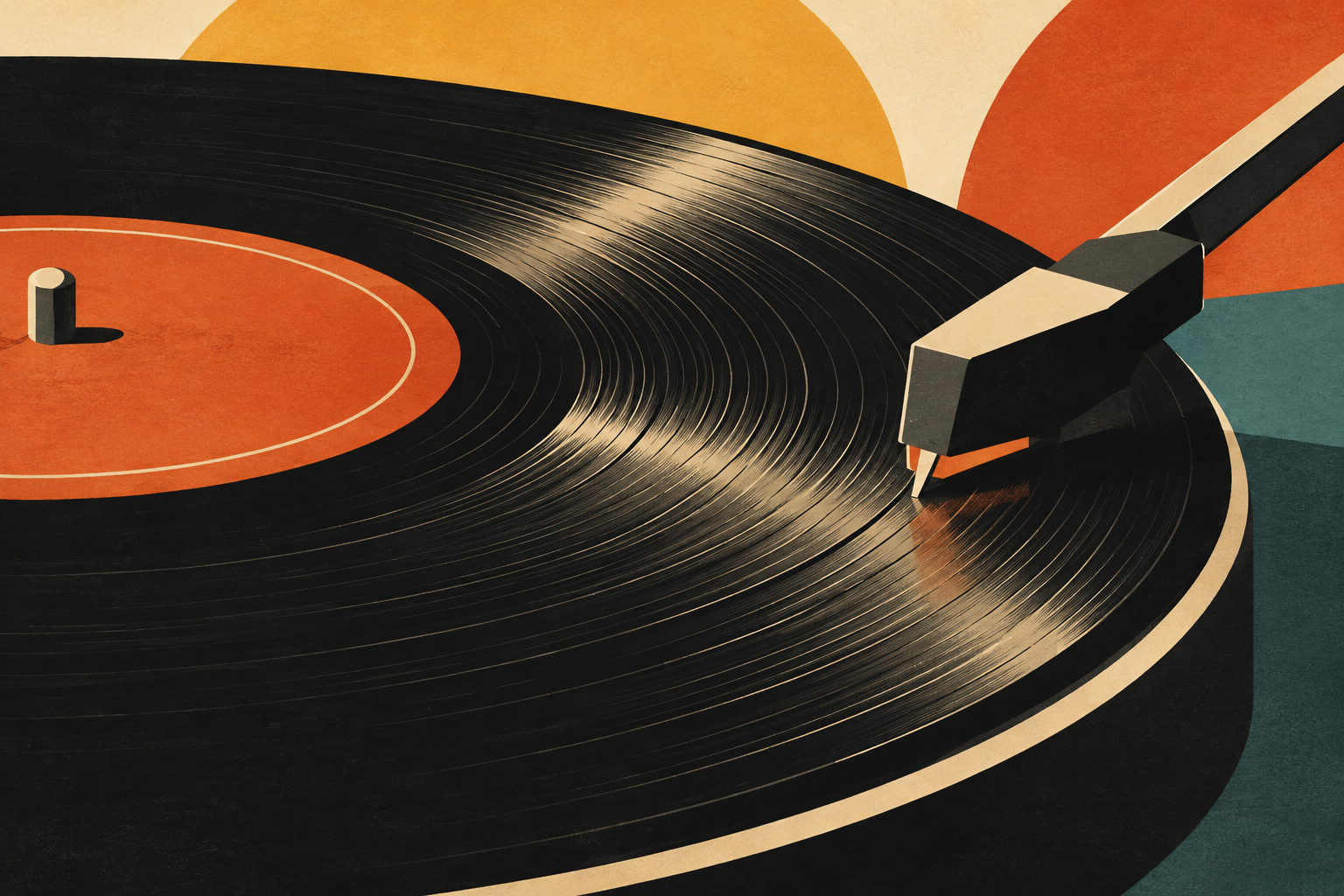
Vinyl imposed a tangible architecture on the act of listening. Unlike current digital formats, which allow instant and random access, the vinyl record required constant physical interaction. The listener had to manipulate the object, flip sides, and manage the needle. This need for human intervention created a forced pause in the musical flow, structuring the experience into blocks defined by the groove's capacity. The quality of the turntable and the fidelity of the audio system were not secondary technical details, but determining variables that altered sound perception, adding layers of background noise and dynamics that were integral parts of the work as it was experienced at that moment.
Academic and social context
Academic research on the social history of popular music provides keys to understanding this dynamic. Studies such as the one conducted in Chile for the 1950-1970 period by Juan Pablo González, Óscar Ohlsen, and Claudio Rolle demonstrate that technological and social changes interacted to shape cultural consumption habits. In this context, music did not exist in a vacuum; it was closely related to the economic organization, technological development, and traditions of each society. Vinyl, as the dominant technology, acted as a filter that mediated the relationship between producer and consumer, defining not only what was heard, but how and under what conditions.
Beyond hit charts
Hit charts, while useful for identifying trends and measuring the popularity of specific songs, offer an incomplete view of the decade's musical culture. These metrics quantify playback frequency or sales, but do not capture the complexity of the listening experience. A hit on the radio and the same song on a vinyl record in a living room were distinct experiences, mediated by equipment quality, acoustic environment, and listener attention. The transition to digital formats in later decades eliminated these physical barriers, allowing instant accessibility that did not exist in the vinyl era, which radically altered the cultural dynamic.
Analogy as an integral experience
The analog nature of vinyl meant that the medium and the message were inextricably linked. Background noise, the vibration of the turntable motor, and variation in groove depth were not defects to be eliminated, but characteristics that defined the authenticity of the experience. This quality contrasts with digital purity, where the signal is reproduced identically in every playback. In the 70s, technical imperfection was part of the medium's identity, creating an emotional and physical connection with the music that later formats have transformed, though not necessarily eliminated, in cultural memory.
Limitations of available evidence
It is important to note that, although the available evidence confirms the dominance of vinyl and its impact on consumption infrastructure, it does not provide specific data on the listening preferences of the global majority in that decade. The cited studies, such as the Chilean one, offer a valuable but localized case study. Generalizing the vinyl experience to the whole world requires caution, as access to audio technology varied significantly by region and social class. The narrative of the 70s as a unified era of vinyl listening is, in part, a retrospective construction that must be nuanced with the reality of technological inequalities of the time.
Conclusion
Understanding the music of the 1970s requires going beyond songs and artists to examine the devices and practices that made their listening possible. Vinyl was not just a format, but a cultural filter that conditioned the musical experience. By recognizing the active role of the physical medium, the understanding of how technology shapes culture is enriched, reminding us that the history of music is also a history of its transmission media.
- Decade
- 1970s
- Region
- Global
- Level
- Enthusiast
- Entities
- No linked entities
Sources and references
- Historia Social de la Música Popular en Chile 1950-1970 ...www.academia.edu · 2026-10-19
- (Reseña) Juan Pablo González, Oscar Ohlsen y Claudio Rolle, "Historia social de la música popular en Chile, 1950-1970"doi.org · 2026-10-19
- Juan Pablo González, Oscar Ohlsen y Claudio Rolle. 2009. Historia Social de la Música Popular en Chile, 1950-1970. Santiago: Ediciones Universidad Católica de Chile.doi.org · 2026-10-19
- Los mayores éxitos de los años 70 por año (1970–1979)translate.google.com · 2026-10-19
- Reseña bibliográfica: Historia Social de la Música Popular en ...observatorio.cultura.gob.cl · 2026-10-19
- Historia de la músicaes.wikipedia.org · 2026-10-19