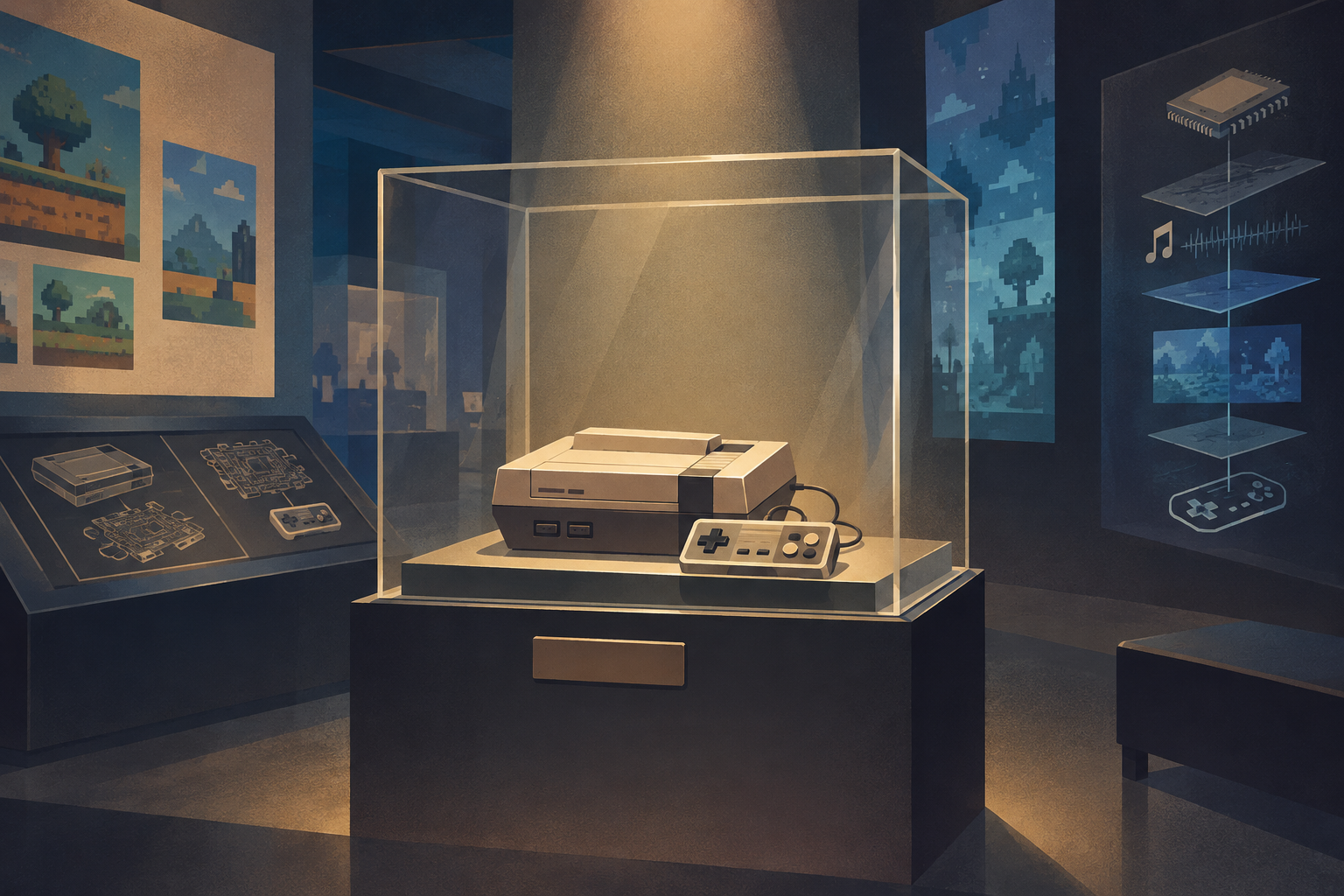
The preservation of video game consoles has ceased to be a mere collector activity focused on the physical integrity of the object. Today, it has consolidated as a museum discipline that requires a deep understanding of the cultural, technical, and social context in which these machines operated. This transition reflects a paradigm shift: the console is not just an electronic device, but a cultural artifact whose relevance lies in the experience it generates and the social practices surrounding its use. Specialized institutions have begun to address this complexity, recognizing that effective preservation requires much more than storing hardware in stable conditions.
The role of specialized institutions
In Spain, the Video Game Museum and MUVIC (Museu del Videojoc de Catalunya) are highlighted examples of this new approach. The Video Game Museum is actively dedicated to the recovery, documentation, cataloging, and preservation of historical heritage related to video games. For its part, MUVIC operates as a cultural and museum project dedicated to preserving, studying, and disseminating the history of video games, using temporary and itinerant exhibitions as dissemination tools. These institutions do not limit themselves to exhibiting objects; they work on building a historical narrative that contextualizes each piece within the evolution of the industry.
The console as a cultural industry
Academic evidence supports the idea that video games have firmly established themselves as a cultural industry. Recent studies point to a vertiginous rise at the technological, economic, and social levels, which has forced museums to renew their spaces and methodologies. This cultural legitimization obliges institutions to treat consoles with the same rigor applied to other forms of art or industrial heritage. The console ceases to be a niche object to become a central element of contemporary culture, deserving of systematic analysis and preservation.
The challenge of the user experience
One of the biggest challenges in video game preservation is that hardware alone is not enough. Evidence indicates that materials to be custodied are of little use without their context. The main challenge is not only to prevent the physical degradation of electronic components, but to preserve the user experience and the relationship between the user and the machine. This implies keeping the interaction alive, something that is lost if only the static object is preserved. The console is a system that depends on software, peripherals, and social practices to fulfill its cultural function.
The complexity of digital preservation
Nintendo conservation documents and studies on digital preservation policies highlight the complexity of keeping alive an artifact that depends on multiple technological layers. Digital preservation is not an automatic solution; it requires active strategies to ensure that software remains accessible and functional. The degradation of magnetic and optical media, as well as the obsolescence of operating systems, poses significant technical problems. Conservation policies must address not only the hardware, but also the digital ecosystem surrounding it.
Inter-institutional collaboration
Collaboration between libraries, museums, and national archives is key to ensuring that this heritage is not lost in digital oblivion. The systematic activity of these institutions allows for the optimal conservation of a large part of digital heritage. This collaboration is crucial for sharing resources, knowledge, and best practices. Libraries bring experience in collection management, museums in exhibition and interpretation, and archives in long-term preservation. Together, these institutions can create a robust framework for the preservation of video game heritage.
From retro object to historical document
This comprehensive approach allows the console to cease being a simple retro object and become a historical document. As such, it explains design decisions, the technology of its time, and domestic entertainment culture. The console becomes a source of information about the society that created and used it. This change of perspective is fundamental for preservation, as it elevates the console from an object of nostalgia to a resource for research and education.
Limitations and future challenges
Despite the advances, there are limitations in what can be verified and preserved. The fragmentation of the industry and rapid technological obsolescence make exhaustive preservation difficult. Furthermore, the lack of universal standards for video game preservation poses significant challenges. Institutions must continue to innovate in their methodologies to adapt to new technologies and formats. The future of video game preservation will depend on the ability of institutions to keep up with technological and cultural changes.
Conclusion
The preservation of video game consoles is a complex task that requires a comprehensive approach. By moving beyond the mere custody of hardware and integrating the cultural, technical, and social context, institutions can transform the console into a valuable historical document. This work not only preserves the past, but also informs about the present and the future of digital culture. Inter-institutional collaboration and methodological innovation are essential to ensure that this heritage is not lost in digital oblivion.
- Decade
- Contemporary
- Region
- Global
- Level
- Enthusiast
- Entities
- Museum, Museo del Videojuego, Nintendo
Sources and references
- Reportaje - Mantener vivo nuestro patrimonio cultural digitalcordis.europa.eu · 2026-10-20
- Punto de control: estado de las políticas de conservación ...www.academia.edu · 2026-10-20
- Museos y videojuegos. La renovación de los espacios ...www.researchgate.net · 2026-10-20
- Qué hacemos | Museo del Videojuegowww.museodelvideojuego.com · 2026-10-20
- MUVIC – Museu del Videojoc de Catalunya | Castellanomuvic.cat · 2026-10-20
- Introducción a la conservación del videojuego en Españawww.navigames.es · 2026-10-20