Comics were designed to disappear. Their editorial structure, based on periodicity and low cost, placed them in the category of mass-consumption products, similar to news magazines or advertising flyers. However, time has transformed this initial perception. What was an object intended to be read once and discarded has acquired a value that transcends its immediate narrative function, becoming a cultural document that requires institutional attention. This transition is not automatic or universal, but depends on a series of technical, academic, and museum factors that have been consolidating comics as part of graphic heritage.
Material fragility as an obstacle
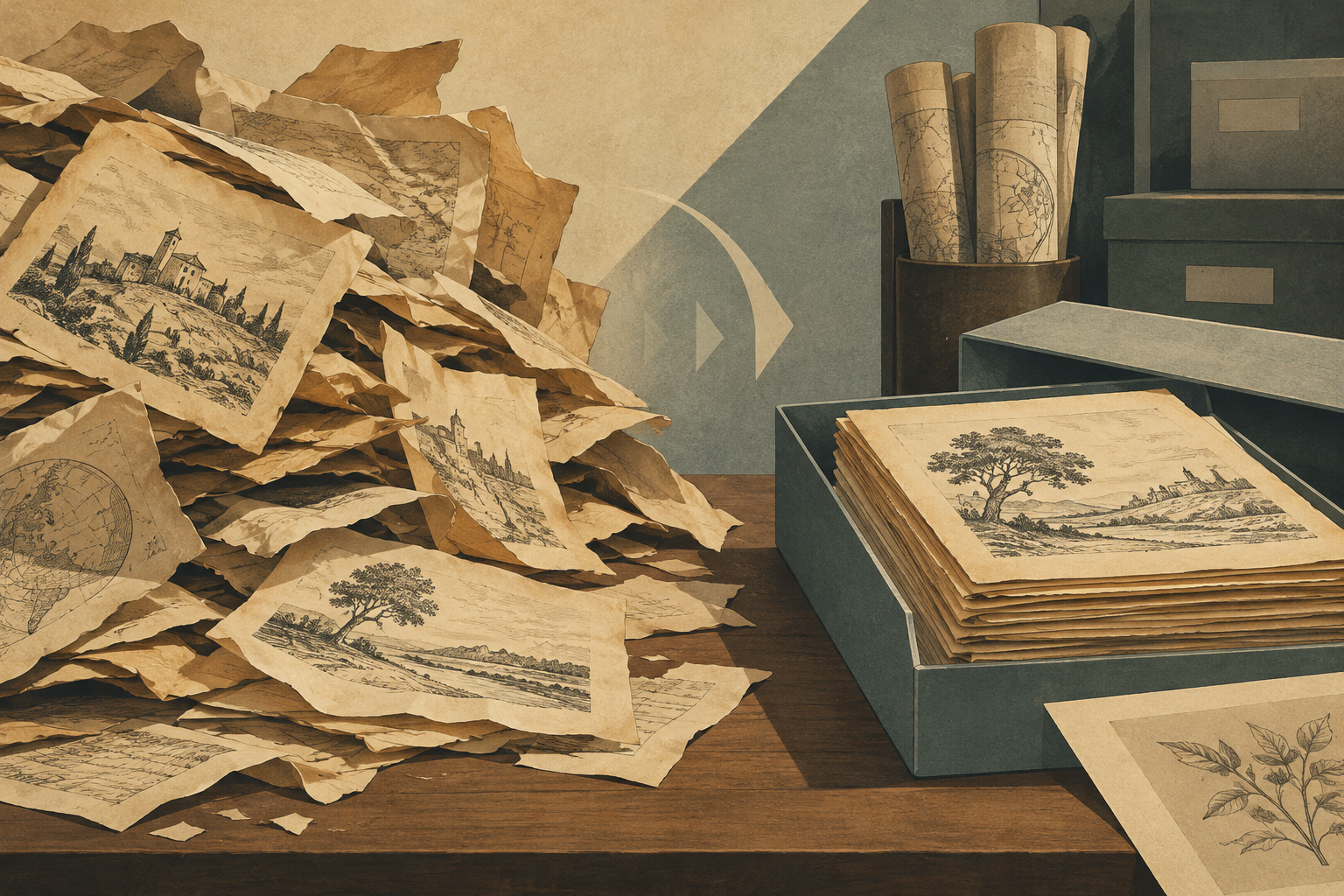
The physical nature of comics poses specific challenges for their preservation. The materials used in mass production, such as low-quality paper and unstable inks, are prone to rapid deterioration. The acidity of the paper can cause yellowing and brittleness, while inks can fade or stain. These technical issues make conservation not just a matter of storage, but of active intervention. Institutions have had to develop specific protocols to stabilize these materials, recognizing that their historical value is intrinsically linked to their physical integrity. Without this intervention, the document would be lost before it could be properly studied.
The role of academic institutions
The legitimization of comics as an object of study has not come only from the collecting market, but from academia. Universities and research centers have begun to integrate comics into their study programs, analyzing their narrative, historical context, and cultural impact. This academic approach has provided a theoretical framework that justifies the conservation of these works. Scholars have highlighted that comics are not just entertainment, but a reflection of the societies that produce them. This perspective has influenced how public institutions perceive the value of these collections, moving from seeing them as curiosities to treating them as primary sources for cultural research.
Museum curation and exhibition
The exhibition of comics in museums has been a crucial step in their recognition as art. Adapting comics to the museum context requires careful curation that balances the visual, literary, and narrative dimensions of the work. Exhibitions do not just show the pages, but contextualize their production and reception. This interpretive process influences how the public understands comics. When presented in a space dedicated to art or history, comics acquire a new layer of meaning. Curation must navigate between fidelity to the original and accessibility for the viewer, creating an experience that respects the complexity of the graphic medium.
Collecting as a preservation driver
Although public institutions play a central role, private collecting has been an important driver for the preservation of comics. Collectors, motivated by personal interest and market value, have kept many editions alive that would otherwise have disappeared. However, collecting has its limits. It often focuses on the rarest or most valuable editions, leaving aside other works that might have significant historical value. Collaboration between collectors and institutions is key to broadening the scope of preservation, ensuring that not only high-market-value pieces are conserved, but also those that offer a more complete view of the medium's history.
Digitalization challenges
Digitalization offers a partial solution to conservation problems, but it is not a panacea. Scanning a comic allows access to its content without handling the original, reducing the risk of physical damage. However, digitalization does not capture all dimensions of the comic experience, such as the texture of the paper, the smell, or the tactile sensation of turning pages. Moreover, the quality of digitalization varies, and not all nuances of color or fine line details are always preserved. Therefore, digitalization must complement, not replace, physical conservation. The original remains the primary source, and its preservation is essential to ensure the authenticity and integrity of the work.
Global context and regional differences
The way comic conservation is approached varies according to geographic and cultural context. In some regions, comics have a longer tradition of recognition as art, which facilitates their integration into cultural institutions. In others, the process is in earlier stages, with fewer resources and defined legal frameworks. This diversity reflects the different relationships societies maintain with the graphic medium. Understanding these differences is crucial for developing conservation strategies that are pertinent and effective in each context. There is no single way to preserve comics, but a set of practices adapted to local circumstances.
Towards an integral graphic heritage
The consolidation of comics as cultural heritage is an ongoing process. It requires continuous collaboration between libraries, museums, universities, and collector communities. The goal is not only to preserve the works but also to facilitate their access and study. This involves developing conservation policies that are sustainable and accessible, as well as promoting academic research that deepens the understanding of the medium. Comics, far from being an object of the past, are a living document that continues to evolve. Their preservation is an investment in cultural memory, ensuring that future generations can access this form of artistic and narrative expression.
- Decade
- Contemporary
- Region
- Global
- Level
- Enthusiast
- Entities
- Museum
Sources and references
- El cómic, una cuestión de formatos (2): revistas de cómics, fanzines, mini-cómics, álbumes y novelas gráficasdoi.org · 2026-10-20
- (PDF) Las exposiciones de cómics. Historia y contexto globalwww.researchgate.net · 2026-10-20
- Del archivo al lector: el valor de las colecciones de cómiclaregenta.org · 2026-10-20
- The Comics Archive Symposium 2022 – Abstractscomics.uni.mau.se · 2026-10-20
- Curating Comics Canonsorbi.uliege.be · 2026-10-20
- coleccionismo y conservación del cómic en estados unidos ...riull.ull.es · 2026-10-20