Fashion is often perceived as a fleeting layer of aesthetics, a phenomenon consumed and forgotten with the same speed it appears. However, when examined from the atelier's perspective, clothing reveals a historical and social density that advertising rarely captures. The case of Lorenzo Caprile, a Madrid-born couturier born in 1967, offers a unique opportunity to unravel this complexity. His trajectory is not just a professional biography, but a tangible archive of the last three decades of Spanish public life, where every stitch and fabric acts as a witness to an era.
Formation Between Two Worlds
The foundation of Caprile's practice was built on a bridge between European tradition and American technical innovation. His studies at the Fashion Institute of Technology in New York provided a systemic view of the industry, while his training at the International Polytechnic of Fashion in Madrid anchored his work in local tailoring heritage. This educational duality is crucial to understanding his approach: it is not imported fashion, but a synthesis that integrates technical precision with historical sensitivity. This training allowed him to see the garment not as a simple object of wear, but as a cultural construct that requires almost architectural rigor in its execution.
The Atelier as a Production Space
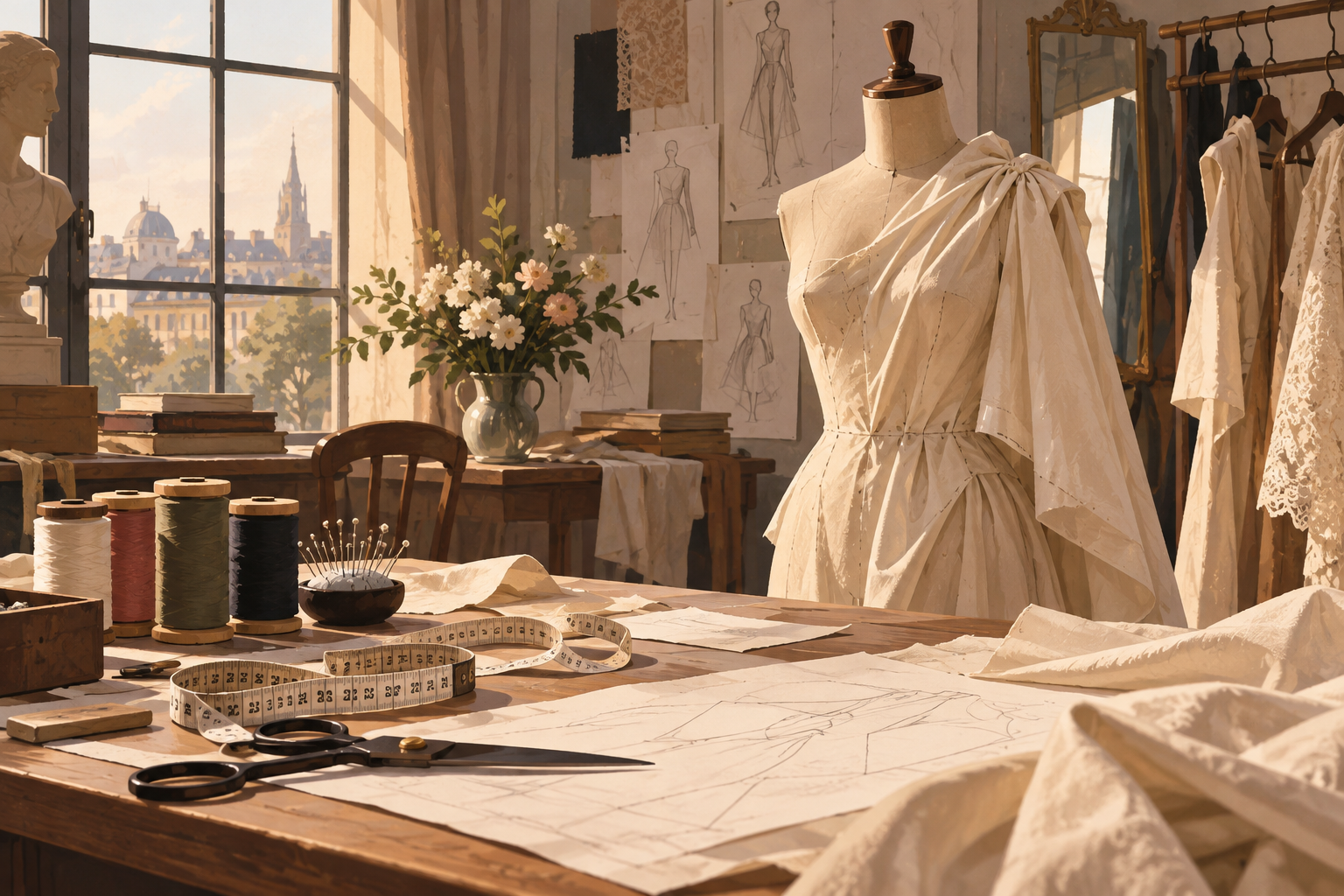
For over three decades, Caprile's atelier has operated as a laboratory of haute couture. Far from being a romantic and disordered space, his work environment is defined by discipline and repetition. Haute couture, as Caprile himself defines it, is a hard industry. This definition demystifies the idea of fashion as purely intuitive art. Instead, it is presented as a high-level industrial process, where the repetition of gestures, pattern calculation, and material selection are as important as the initial inspiration. The atelier is, therefore, the engine that transforms the idea into physical reality, a space where abstraction becomes tangible through sustained manual effort.
Dressing the Monarchy as a Historical Act
Caprile's relevance rises when his designs are associated with figures of maximum public visibility, such as Queen Letizia and Infanta Elena. Dressing the monarchy is not just a commercial commission; it is an act of national image construction. The garments Caprile has created for these figures not only fulfill an aesthetic function but communicate values of sobriety, elegance, and continuity. Analyzing these pieces reveals how haute couture becomes an instrument of visual diplomacy. Each dress is a document that reflects the social expectations and behavioral norms of the Spanish elite in the 21st century. The choice of colors, cuts, and fabrics responds to an unwritten code that Caprile masters with precision.
The Exhibition as a Tangible Archive
The recent exhibition of over a hundred iconic pieces at the Sala Canal de Isabel II in Madrid marks a milestone in the consolidation of his work. This event is not a simple commercial showcase, but a curatorial presentation that invites reflection. By gathering these pieces, a corpus is created that allows studying the evolution of Caprile's style over time. The exhibition functions as a tangible archive, where the viewer can observe the texture of the fabrics, the complexity of the embroideries, and the structure of the garments. This direct access to primary sources allows a deeper understanding of the technique and intention behind each design, moving away from superficial media interpretations.
Precision and Tradition in Contemporary Identity
Caprile's work is characterized by an exquisite sense of haute couture, where precision in details is the norm. This attention to detail is not a whim, but a manifestation of Spanish tailoring tradition. In a world dominated by mass production and rapid obsolescence, Caprile's labor represents a resistance to homogenization. His designs integrate historical heritage into contemporary identity, demonstrating that tradition is not a burden, but a creative resource. Technical precision thus becomes a language that dialogues with modernity, offering an alternative to the fleeting nature of trends.
Fashion as a Social Practice
Studying fashion through primary sources like Caprile's allows avoiding generalizations about what society wears. Instead of talking about abstract trends, specific uses and design decisions that define an era can be analyzed. The connection between design and the public scene, or between clothing and music, is examined here without replacing the history of the garments. The focus remains on the social practice of fashion, understood as a set of actions, interactions, and meanings built around the garment. This perspective enriches the understanding of material culture, showing how clothes not only cover the body but structure social relations.
Limits of Verification and Legacy
Although academic and journalistic sources allow tracing the evolution of Caprile's style, it is important to recognize the limits of what can be verified. The memory of the ateliers, private conversations, and undocumented decisions remain outside the reach of public analysis. However, Caprile's legacy lies in his ability to turn haute couture into a serious field of study. His work demonstrates that fashion is a discipline that deserves the same analytical rigor as other forms of cultural expression. In the end, Caprile's atelier does not just produce dresses, but produces memory, an archive of Spanish identity that will outlast passing fashions.
- Decade
- 1990s
- Region
- Spain
- Level
- Enthusiast
- Entities
- Lorenzo Caprile
Sources and references
- Lorenzo Caprile exhibirá sus diseños más icónicos en ...gentleman.elperiodico.com · 2026-10-15
- Lorenzo Caprile define el diseño de moda como “una ...www.aea.plus · 2026-10-15
- Exposición Caprile Lorenzo en Madrid | PDF | Teatro | Las arteses.scribd.com · 2026-10-15
- Exposición de Lorenzo Caprile en la Sala Canal de Isabel IIguiadelocio.es · 2026-10-15
- Marca de autorwww.youtopia.es · 2026-10-15
- Los vestidos icónicos de Letizia y la infanta Elena 'made in ...www.elespanol.com · 2026-10-15
- de Historiawww.moderna.ih.csic.es · 2026-10-15