One platform, two identities
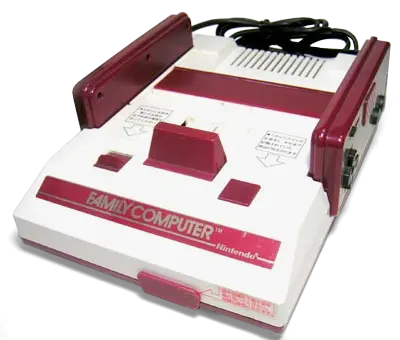
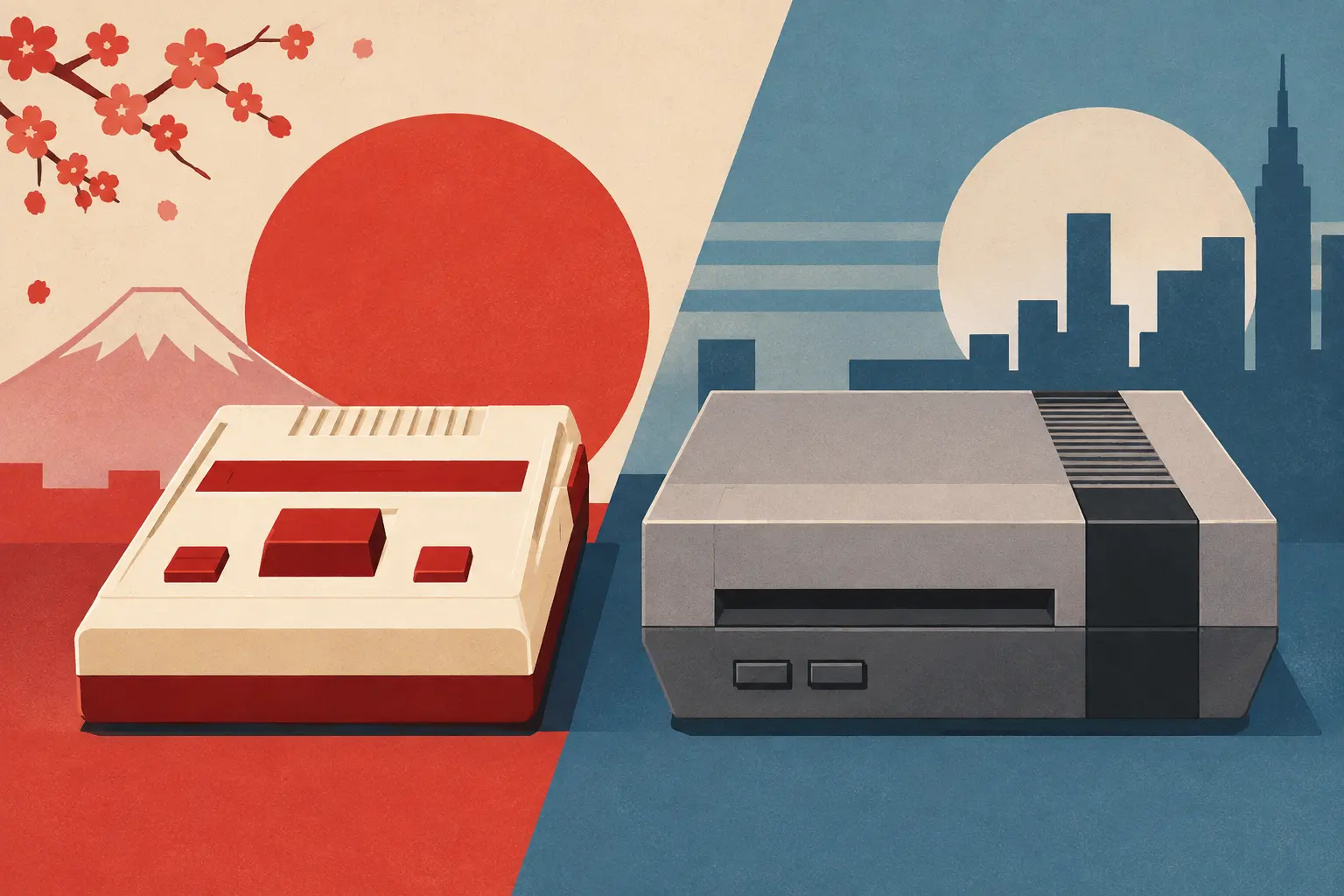
The Family Computer—known as the Famicom in Japan—went on sale in 1983. When Nintendo prepared to enter North America, it did more than change the name: it altered the machine’s appearance and introduced it as the Nintendo Entertainment System, or NES. The two systems shared a technological foundation, but their comparison shows how industrial design could also help position a product in markets with different expectations.
The Famicom had a compact casing in light and red tones, with a top-loading cartridge slot. Its two controllers were attached to the console and could be tucked into recesses on the sides when not in use. The second controller included a microphone, a feature used by some games. The North American NES, by contrast, adopted a grey body and a front-loading slot that concealed the cartridge behind a flap. Its controllers were detachable and plugged into ports on the front.
This was more than a difference in colour or controller placement. Each version suggested a different way of presenting and arranging the machine in the home: the Famicom was small and toy-like, while the NES was more restrained and visually closer to other household electronics.
The North American redesign and the 1983 crash
The NES arrived in the United States after the 1983 video-game market crash, a period that had weakened retailers’ and consumers’ confidence. Nintendo sought to distinguish its system from the consoles associated with that crisis and give it an appearance reminiscent of consumer electronics. The front-loading mechanism, which hid the cartridge behind a flap, evoked the loading action of a videocassette recorder.
The strategy also appeared in the language used to sell the product. Rather than calling the machine a “console” and its games “cartridges”, Nintendo used Control Deck and Game Paks. This was not a technical change but a way of framing the system and making it more recognisable in a retail environment still wary of video games.
The presentation also included accessories such as the Zapper light gun and the R.O.B. robot. These peripherals broadened what audiences could associate with the system and gave retailers a proposition that went beyond a conventional console. The machine’s design, marketing vocabulary, accessories and games formed a coordinated presentation.
Controllers, cartridges and expansion
The design differences also had practical consequences. The Famicom’s built-in controllers reduced the number of visible connections and could be stored in the casing, but they could not be detached. The NES’s removable controllers offered more flexibility for play and for arranging the machine in a living room. Both versions had expansion capabilities, although their ports were placed differently.
The cartridges were not identical either: Famicom and NES games had different shapes and connectors, so they could not be used directly across the two systems without adapters. Regional variation was part of a broader separation between the versions, not evidence of two wholly different platforms.
In Japan, Nintendo expanded the Famicom with the Famicom Disk System, a floppy-disk add-on released in 1986. The format allowed games to be rewritten at retail kiosks and saved progress, offering an alternative to cartridges of the period. But improvements to cartridges—including increased capacity—gradually reduced the disk system’s advantages.
A shared foundation, not an identical identity
The Famicom and NES shared an architecture and many of the same game series, but they also differed in significant ways. The Western NES included the 10NES lockout system, designed to restrict unauthorised cartridges; the Japanese Famicom did not. The distinction therefore extended beyond the casing and affected the relationship between the console, its games and the people able to publish them.
Reception also depended on the market. The system established a particularly strong presence in Japan and North America, while in several European countries it faced competition from home computers and other consoles. “NES” did not represent an identical experience everywhere: distribution and commercial conditions varied from region to region.
The comparison between Famicom and NES therefore tells more than the story of two designs. It shows how one platform could acquire different identities through its shape, controllers, cartridges, accessories and marketing language. The North American redesign was part of a commercial adaptation: it did not change the systems’ shared origins, but it did change how Nintendo sought to place them in domestic life and in the market.
- Decade
- 1980s
- Region
- Japan
- Level
- Enthusiast
- Entities
- Nintendo, Nintendo Entertainment System
Sources and references 5
- L’esthétique percussive de la Famicom et de la Nintendo Entertainment System de 1983 à 1987doi.org · 2026-11-16
- Nintendo Entertainment Systemtranslate.google.com · 2026-11-16
- Super Nintendo - Wikipedia, la enciclopedia librees.wikipedia.org · 2026-11-16
- Bruno Gariazzo Leon - Arte, Ciencia y Tecnéartecienciaytecne.com · 2026-11-16
- Videoconsolaes.wikipedia.org · 2026-11-16