The history of food is often narrated through round dates: the first consumption, the first recipe, or the first advertisement. However, the materiality of food leaves more subtle traces in everyday objects than in major chronological milestones. Boxes of biscuits and sweets, particularly those chromolithographed in the 19th and early 20th centuries, offer a unique window to study the intersection of design, commercial promotion, and domestic life. These items, far from being mere containers, are documents that encode information about ingredients, presentation, and consumption habits.
The Box as a Historical Document
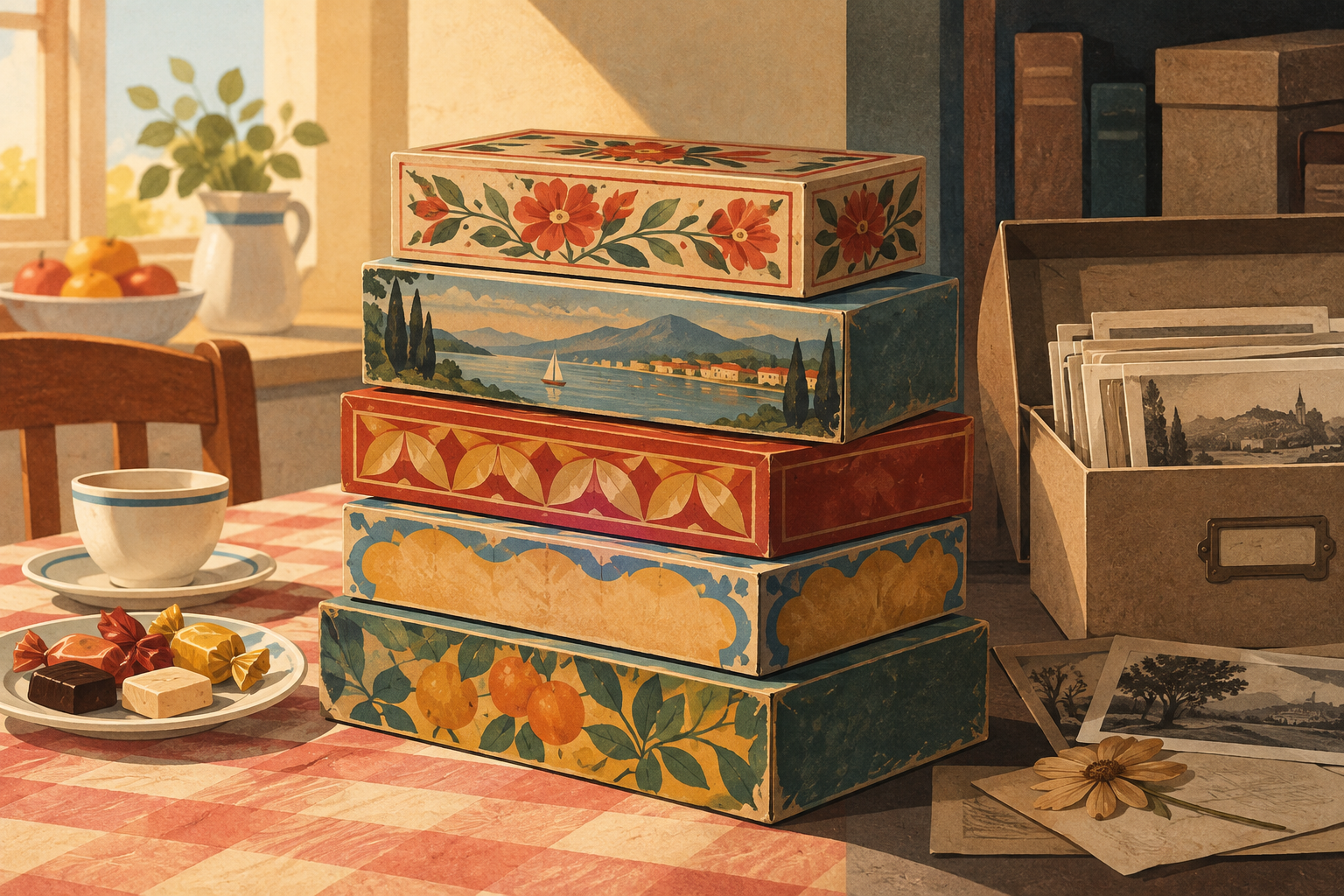
The Madrid Museum of History has incorporated several chromolithographed boxes into its collections in recent years. These items originally served as packaging for the retail sale of confectionery and pastry products. Their value lies not only in their protective function but in their ability to convey visual and textual information. Chromolithography, a printing technique that allowed for the reproduction of vivid colors and fine details, transformed the box into an advertising medium. Every graphic element, from the logo to illustrations of fruits or characters, contributed to building a brand identity that consumers recognized at the point of sale.
Separating Advertising from Habit
One of the fundamental questions in the study of food culture is how to distinguish between what advertising promises and what domestic practice actually executes. Boxes preserved in museums allow this question to be addressed by showing the distance between the commercial ideal and everyday reality. While the packaging may present an image of abundance, luxury, or tradition, the domestic use of the product is conditioned by economic, social, and cultural factors that are not always reflected in the design. Museographic research suggests that interpretation based on food is capable of strengthening community engagement by connecting these objects with personal and collective memories.
Packaging Design and Its Language
The design of these boxes was not arbitrary. It responded to aesthetic trends of the time, such as Art Nouveau or Modernism, which sought to beautify the everyday. Colors, typography, and graphic compositions were designed to attract attention in competitive shelves. Furthermore, the packaging conveyed practical information, such as net weight, ingredients, or storage instructions, although this information was often subordinated to the visual impact. The study of these design languages allows us to understand how food companies built their positioning strategies in the market.
The Domestic Dimension and Ritual
Beyond its commercial function, boxes of sweets and biscuits were part of domestic rituals. In many families, opening a special box was associated with celebrations, visits, or leisure moments. The preservation of these boxes, sometimes empty, indicates that their value transcended the content. They became objects of memory, symbols of an era or a family relationship. This domestic dimension is crucial for understanding table culture, which is not limited to the ingestion of food but includes the spaces, times, and objects that surround the act of eating.
Limitations of Material Evidence
Although boxes offer valuable information, they also present limitations. They do not preserve the taste, aroma, or texture of the original product. Moreover, the selection of items that reach museums is subject to conservation and donation biases, which may distort the representation of the diversity of existing products and brands. It is therefore important to complement the study of packaging with other sources, such as recipe books, newspaper advertisements, or oral testimonies, to obtain a more complete view of the history of food.
The Role of Museums in Preservation
Museums play a fundamental role in the preservation and dissemination of these objects. By incorporating boxes of sweets and biscuits into their collections, institutions such as the Madrid Museum of History contribute to making visible aspects of everyday life that often remain outside the traditional historical narrative. Specialized museography in gastronomy allows for interpretations that connect the object with its social, economic, and cultural context. This approach not only enriches the visitor's experience but also fosters academic research on the history of food.
Conclusion
Boxes of biscuits and sweets are much more than packaging; they are documents that allow the history of food to be studied from a material and cultural perspective. Their analysis reveals the complexity of the relationships between commercial promotion, design, and domestic practice. By preserving and studying these items, museums and researchers contribute to preserving the memory of the table, a space where identity, economy, and culture intertwine.
- Decade
- 1990s
- Region
- Spain
- Level
- Enthusiast
- Entities
- Museum, Museo de Historia de Madrid, Cajas cromolitografiadas de galletas y dulces
Sources and references
- The Food Timeline: cuando la historia de la comida se ...www.retropause.com · 2026-10-13
- Museos, Interpretación y Gastronomíaevemuseografia.com · 2026-10-13
- LA COLECCIÓN DE CAJAS DE GALLETAS, DULCES Y ...www.madrid.es · 2026-10-13
- Alimentos con historiawww.mercasa.es · 2026-10-13
- Sobre la mesawww.museoreinasofia.es · 2026-10-13
- Historia de la gastronomía - Wikipedia, la enciclopedia librees.wikipedia.org · 2026-10-13