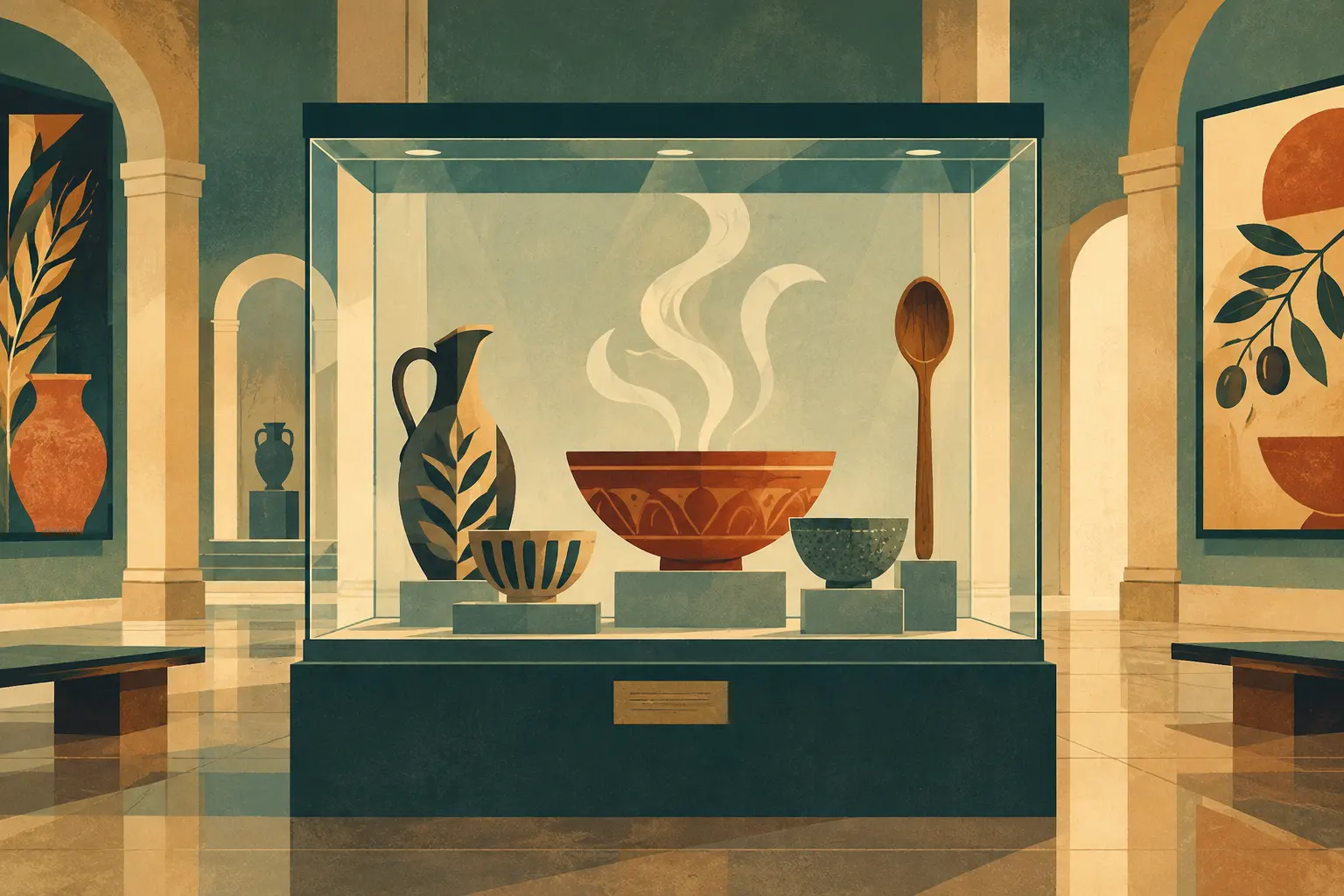
The preservation of food heritage poses a unique challenge for cultural institutions. Unlike a sculpture or a painting, food is a biological, sensory, emotional, social, and cultural phenomenon that is consumed and disappears. Ethnographic museums face the difficulty of transmitting the entirety of this experience in a static space. This article examines the strategies and limitations of documenting gastronomy as a cultural fact, beyond the mere display of packaging or utensils.
The tension between object and practice
The core of the problem lies in the distinction between the physical object and the intangible practice. A tin can or a kitchen knife are tangible artifacts that can be preserved using standard preventive techniques. However, flavor, aroma, and the ritual of the table are ephemeral experiences that escape traditional conservation. Studies in Food Studies and anthropology point out that gastronomy is a complex cultural expression, full of ancient reminiscences and social connections that are not reduced to their ingredients.
The role of ethnographic museums
Ethnographic museums attempt to document not only the products but the context that distinguishes commercial promotion from domestic practice. This involves integrating sources that separate advertising from real habits. The design of packaging and recipe books are used as living documents that offer clues about the eating habits of a time. The evidence suggests that conservation must go beyond the object to include local practices and collective memory.
The memory of flavor
Capturing the memory of flavor is one of the most difficult challenges for the archive and the museum. Flavor is a subjective experience that varies according to the individual and the context. Often, the memory of flavor is linked to nostalgia and social relationships. Museums seek ways to evoke these experiences without resorting to artificial simulation. Oral documentation and ethnography are key tools for this purpose.
Historical and cultural context
The history of food is intrinsically linked to the history of societies. The conquest and the exchange of food between different cultures have left a deep mark on gastronomic traditions. For example, Peruvian gastronomy is considered a cultural heritage of humanity, full of exquisite flavors and ancient reminiscences. This historical context is essential to understand the cultural relevance of food.
Limitations of verification
Although museums make significant efforts, there are limits to what can be verified and preserved. The ephemeral nature of food makes it difficult to document exhaustively. In addition, the interpretation of sources may be subject to cultural and personal biases. It is important to recognize these limitations and be transparent about the methods used in documentation.
Legacy and contemporary relevance
Food heritage is a consensus and a tension simultaneously in contemporary culture. On the one hand, there is a general agreement on the importance of preserving culinary traditions. On the other, there are tensions related to globalization, the industrialization of food, and the loss of biodiversity. Museums play a crucial role in mediating these tensions and in promoting awareness of the cultural value of food.
Conclusion
The conservation of food heritage requires a comprehensive approach that combines the preservation of physical objects with the documentation of intangible practices. Ethnographic museums are in a unique position to address this challenge, thanks to their ability to integrate diverse sources and perspectives. The future of food documentation will depend on the ability of institutions to innovate in their methods and to recognize the complexity of the gastronomic experience.
- Decade
- Contemporary
- Region
- Global
- Level
- Introduction
- Entities
- Museum, Museos etnográficos
Sources and references
- Food Studies en español: Investigación actual en ...digital.sandiego.edu · 2026-10-22
- El patrimonio alimentario en los museos etnográficos. 2019www.academia.edu · 2026-10-22
- GASTRONOMÍA PERUANA PATRIMONIO CULTURAL DE LA ...catedraunesco.usmp.edu.pe · 2026-10-22
- Conquista y comidadn720004.ca.archive.org · 2026-10-22
- Patrimonios alimentarios : entre consensos y tensioneshorizon.documentation.ird.fr · 2026-10-22
- Explorando la comida a través de la historia y la cultura ( ...translate.google.com · 2026-10-22
- LA CONSERVACION PREVENTIVA EN LOS MUSEOSwww.museosdetenerife.org · 2026-10-22
- Lo inmaterial en el museo. Museos y patrimonio alimentarioriunet.upv.es · 2026-10-22