More than a machine in a display case
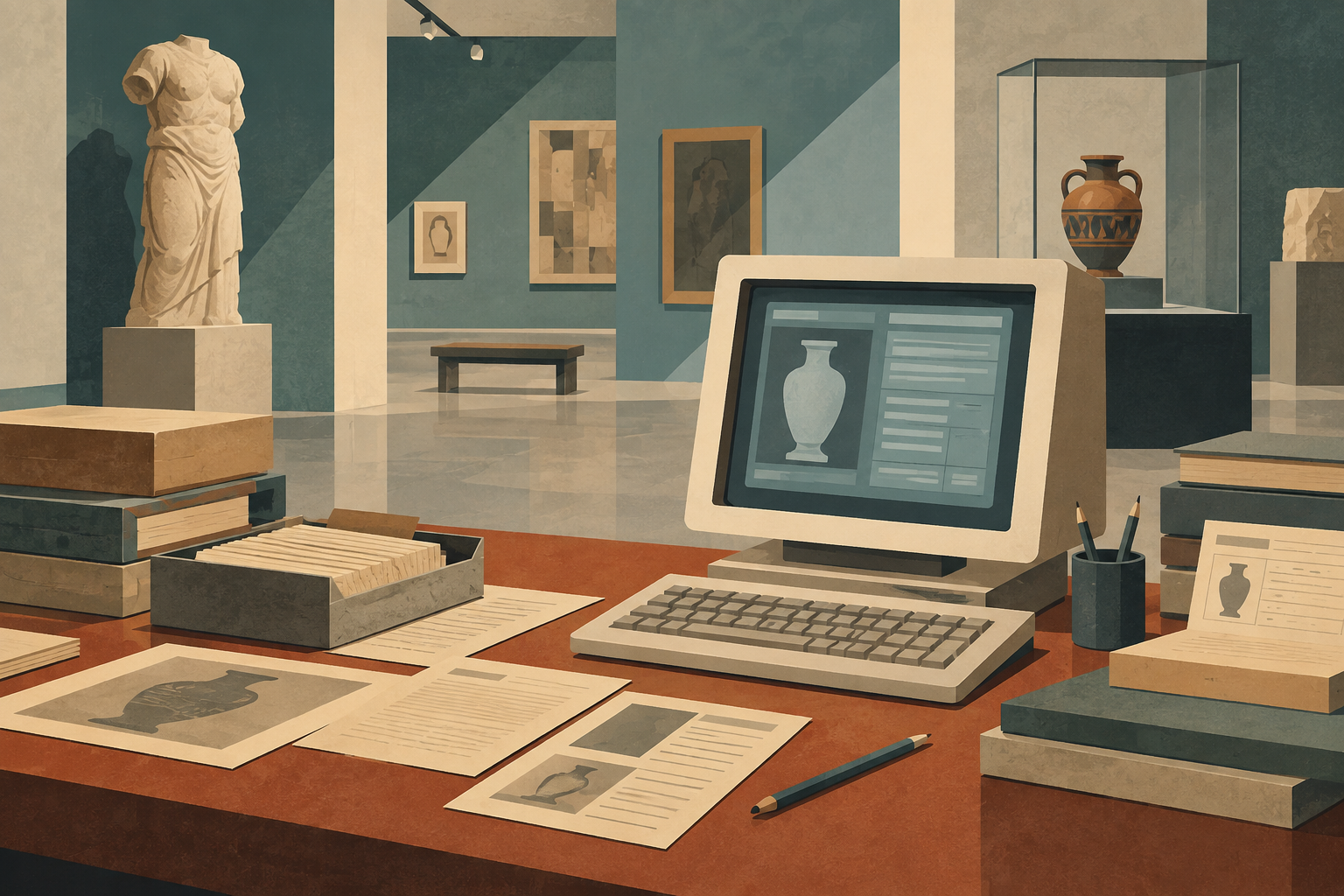
In a museum, a computer can occupy two different conceptual roles. It can be a tool for documenting and managing collections, or it can be a collection object whose history depends on being preserved. The distinction sounds simple, but it requires separating the machine’s present use from the significance it may acquire as evidence. A computer used in institutional work does not automatically become a heritage object; and a preserved object cannot, by itself, explain what role it played, who used it or what practices surrounded it.
The starting point here is limited and specific: a RetroPause article explicitly raises this dual role, while CER.es describes a digital network of Spanish museum collections. Those sources make it possible to consider the questions raised by computers in museums without attributing policies, inventories or histories to particular institutions that the available evidence does not document.
The tool has a context too
A computer used for work belongs to an institutional activity. Treating it only as technical equipment leaves that context out: what it was used for, how it fitted into tasks and how it related to the documents or collections it helped manage. These are research questions, not answers that can be inferred from the mere presence of a machine.
Archival documentation offers a general clue for asking them. A source on the transformation of historical archives notes that, for electronic documents, context is established through metadata. This concerns documents and does not, by itself, show what metadata a museum keeps about its computers. It does suggest a useful distinction: recording an object and recording the relationships that explain its use are different tasks. A record identifying a piece of equipment may be a start; reconstructing its function would require contextual documentation that the evidence available here does not describe.
From management to collection
The other side of the issue is the computer as a heritage object. The RetroPause article specifically identifies the possibility that computers may be objects whose history depends on preservation. “Preservation” should not be read here as an intervention recipe. The evidence gives no models, components, technical methods or restoration procedures, so it cannot support recommendations for work on particular machines.
It does support an editorial point: a museum can tell the story of computing through objects, but also through the practices and records associated with them. Equipment without visible context risks appearing as an isolated form. Conversely, an account based only on documents could leave out the materiality of computers. The relationship between object and documentation is more informative than either approach alone, although the supplied sources do not show how particular museums handle it.
Making what is preserved visible
CER.es describes a digital network of Spanish museum collections, providing a framework for thinking about public access to catalogued objects. A collections portal can make an object findable beyond the physical gallery; it does not, however, prove that every computer is included, or that an online description preserves an object’s full context by itself.
The distinction matters. Cataloguing helps identify and locate; interpretation explains why an object matters and what relationships can be documented. For a computer, a clear description would distinguish what is observed from what is inferred: what information is associated with the object and which aspects of its use remain unknown. The sources available here support the relevance of that question, but provide no specific catalogue records whose level of detail could be assessed.
Preserving information without promising that nothing changes
The source consulted defines digital preservation as a set of methods, standards and techniques intended to allow digital information to remain and continue to be used despite technological change or other causes. It also lists qualities such as integrity, authenticity, reliability, readability and functionality. This is a general description of digital preservation, not a computer-museum-specific protocol or a guarantee that a system will remain fully operational.
That caution helps avoid a common confusion: preserving a physical computer and preserving related digital information are not necessarily the same task. The machine, electronic documents and records about its context raise different questions. The supplied evidence does not specify how to deal with particular systems, media or programs, so it cannot provide technical instructions or assure readers that preserving the hardware automatically preserves its contents.
A history made of objects and records
Treating the computer as both a tool and a possible heritage object moves beyond a history focused exclusively on the machine. It also directs attention to the activities, documents and cataloguing decisions that make its presence intelligible. Here, that reading is an editorial interpretation based on the sources, not an account of a particular museum or collection.
The limits are as important as the idea: the available evidence is brief and general. It does not document models, acquisition dates, user experiences, institutional policies or conservation case studies. The conclusion, then, is not that every computer should enter a collection. Rather, when computers appear in a museum, it is worth asking both what they are and what function they served, and what documentation supports that account. The tool may change; the context that makes it understandable also needs to be recorded.
- Decade
- Contemporary
- Region
- Spain
- Level
- Enthusiast
- Entities
- Museum
Sources and references
- Archivo histórico - | Ministerio de Culturawww.man.es · 2026-09-29
- El ordenador en el museo: herramienta de documentación y ...www.retropause.com · 2026-09-29
- CER.es Colecciones en Red - Ministerio de Culturaceres.mcu.es · 2026-09-29
- La necesaria transformación de los archivos históricos | gttwww.gtt.es · 2026-09-29
- Preservación digitales.wikipedia.org · 2026-09-29