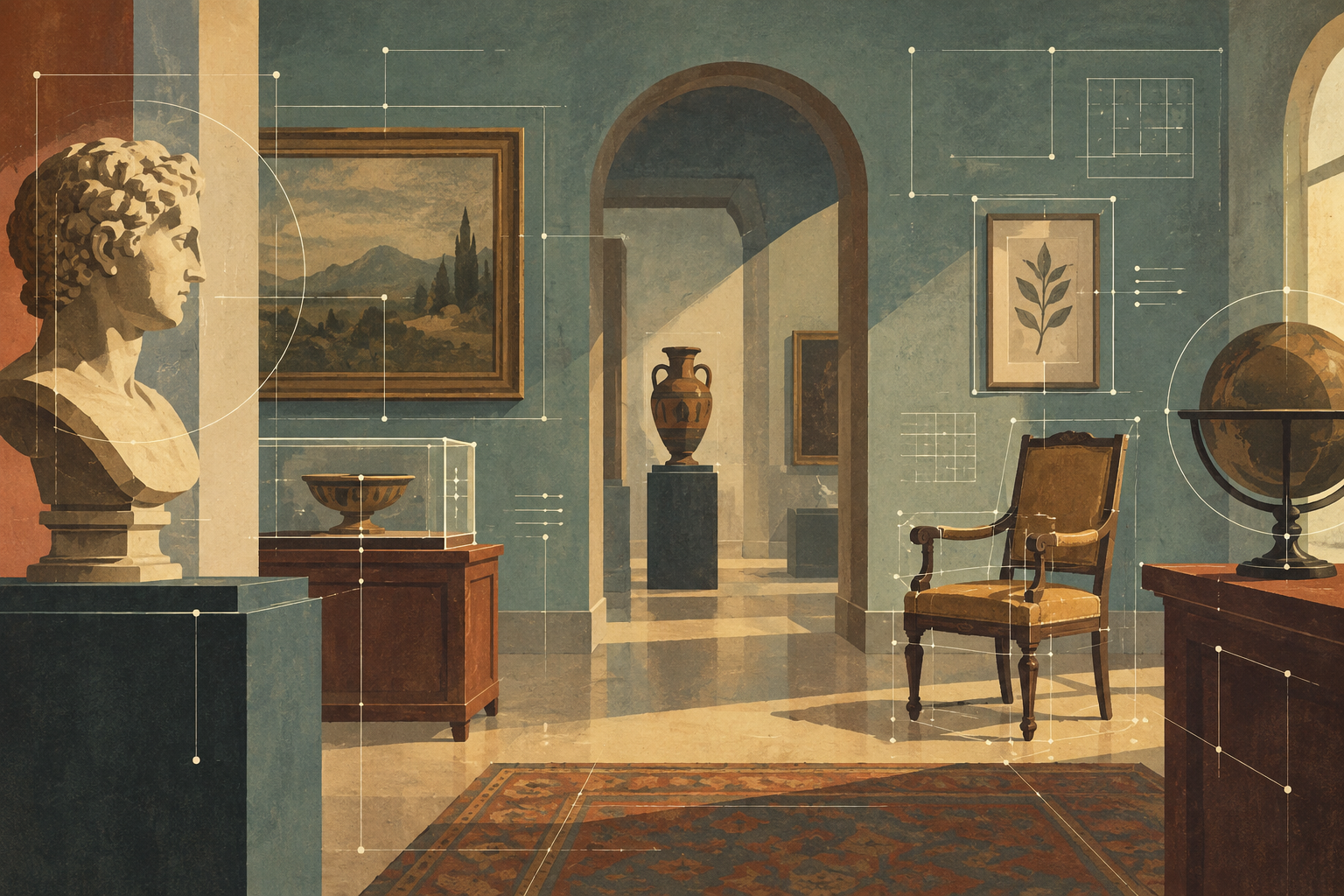
The practice of documenting interiors in museums goes beyond the mere cataloging of isolated objects. Its fundamental objective is to preserve the cultural context surrounding the pieces, understanding the inhabited space not as a neutral background, but as a document in itself. This methodological perspective, supported by preventive conservation manuals developed by cultural institutions, underscores the need to record detailed descriptions, precise measurements, and reasoned classifications. The goal is for each element to be clearly identified within its original environment, allowing for a comprehensive reading of the era in which it was born.
Documentation as an analytical foundation
Heritage management manuals establish that documentation is the first step for any intervention. It involves an exhaustive analysis of the cultural asset and the context that may influence its conservation state. It is not just about listing what is in a room, but understanding the relationships between objects and their location. This process generates a database that allows conservators to make informed decisions, ensuring that the identity of the space remains intact against environmental changes or the passage of time.
The role of reasoned classifications
One of the most specific guidelines in conservation plans, such as that of the Sephardic Museum, is the special attention to reasoned classifications. This means that labeling an object by its material or function is not enough; its categorization must be justified within a cultural and aesthetic framework. By doing so, museums facilitate the understanding of how aesthetics and practical needs coexisted in homes of different eras. This depth in registration allows researchers and the general public to access a richer narrative about everyday life, connecting design with the social practices of the time.
Risk analysis and environmental factors
The integrity of these documented spaces depends largely on the identification of threats. The risk management guide for museum heritage highlights the importance of detecting factors that can deteriorate materials, such as pollution, mold growth, or the dissociation of elements. In the case of interiors, these risks do not only affect individual objects but the cohesion of the whole. Therefore, risk analysis is a fundamental step that complements initial documentation, allowing for the design of preventive strategies that safeguard both the matter and the meaning of the space.
The intersection of design and heritage
Design has shaped the world we live in, and its relationship with cultural heritage is increasingly recognized. Studies on design and conservation point out that ensuring the preservation of designed spaces requires a deep understanding of their original intention. By treating the interior as a document, museums offer a more complete view of everyday life, where space organization and object selection reveal much about the identity and customs of their users. This methodology is particularly relevant for decoration sections, where curation must balance accessibility with historical fidelity.
Interdisciplinary collaboration
Keeping this material memory alive requires collaboration between various professionals. Conservators, designers, and historians must work together to interpret the documented data. Conservators provide technical knowledge about material stability, designers understand spatial and functional logic, and historians contextualize the findings within the cultural current. This synergy is key to avoiding misinterpretations and ensuring that the museum presentation is rigorous and respectful of the available evidence.
Limits of verification
Although documentation is a powerful tool, it has its limits. Evidence texts are unreliable data in themselves and require cross-verification. It is not always possible to reconstruct with total certainty the original layout of an interior if records are incomplete or contradictory. Moreover, the interpretation of aesthetics and function may vary depending on the researcher's perspective. Therefore, it is crucial to maintain a critical and transparent stance on what can be safely asserted and what remains in the realm of interpretive hypothesis.
Conclusion
The treatment of the interior as a document in museum conservation represents a significant advance in the understanding of heritage. By integrating detailed documentation, risk analysis, and interdisciplinary collaboration, museums manage to preserve not only objects but contexts. This approach allows the public to connect with history through spatial experience, offering a window into the everyday life of other eras. Rigor in registration and interpretation is, therefore, the guarantee that this material memory remains relevant and accessible for future generations.
- Decade
- Contemporary
- Region
- Global
- Level
- Introduction
- Entities
- Museum, Museo Sefardí
Sources and references
- Guía para la Elaboración e Implantación de Planes de ...www.ibermuseos.org · 2026-10-19
- PLAN CONSERVACIÓN PREVENTIVA MUSEO SEFARDÍwww.cultura.gob.es · 2026-10-19
- Manual de Documentación - de Colecciones Patrimonialeswww.cdbp.gob.cl · 2026-10-19
- Guía de Gestión de Riesgos para el Patrimonio Museológicowww.iccrom.org · 2026-10-19
- Diseño y patrimonio cultural: cómo asegurar la conservación ...turia.uv.es · 2026-10-19
- La Conservación: el porvenir del pasadounesdoc.unesco.org · 2026-10-19