Comics do not have just one publishing form
When people talk about comics, they often think of characters and pages, but the object that brings them together matters too. An article by Rubén Varillas in CuCo, Cuadernos de cómic addresses the question of formats and names magazines, fanzines, minicomic booklets, albums and graphic novels. That list alone points to a useful distinction: “comic” does not necessarily mean one kind of publication or one material way of reading.
We should not infer from the list how each format was printed, distributed or read in a particular period. The available source identifies categories; it does not provide a detailed account here of their print runs, audiences or techniques. It does, however, allow an editorial question: what changes when a comic appears in a magazine, an independent publication or an album?
The medium shapes the experience
Format is not merely a wrapper. As a framework for reading, it can shape the relationship between a story and the other material around it. A periodical, a fanzine and an album suggest different units of consultation; that is a reasonable interpretation of their names, not a detailed description documented by the available record. Claims about dimensions, paper, pagination or frequency would require identified copies and specific bibliographic data.
This caution does not make format unimportant. On the contrary, it encourages us to examine it without turning a visual intuition into a historical fact. Varillas’s classification offers a starting point for comparing media, provided each comparison is supported with specific publications and evidence of its own.
From reading object to archival material
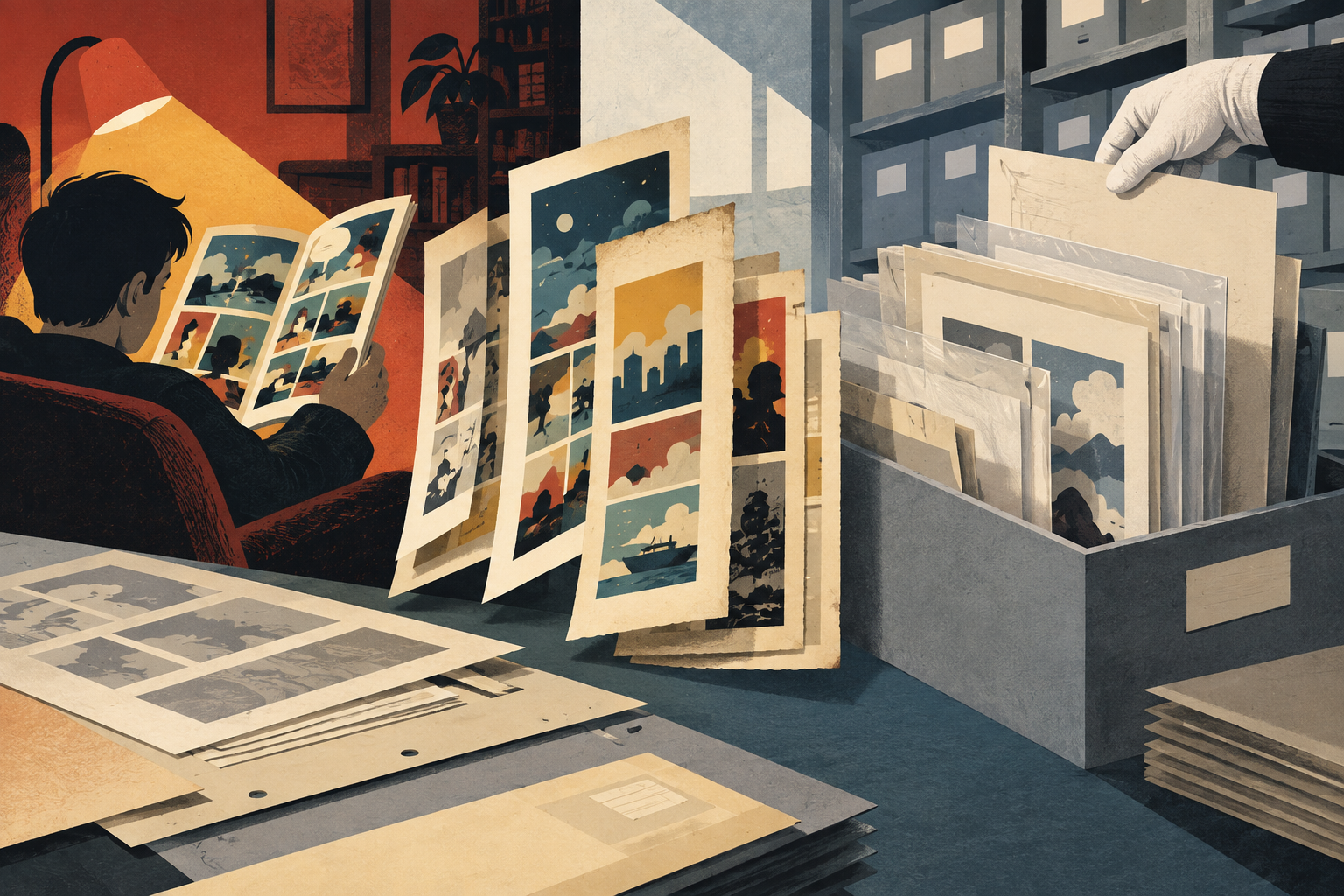
One RetroPause piece among the sources considers the movement of comics and magazines from ephemeral materials into collections, museums and digitization projects. The historical archive of the National Archaeological Museum, meanwhile, describes itself as a research resource for both the museum’s departments and external researchers. These references have different scopes: one explicitly addresses comics and magazines; the other describes the research function of a museum archive without claiming to hold comics.
The comparison helps pose, rather than settle, a question: preserving a publication can expand the possibilities for studying it, but knowing that an archive exists is not enough. Describing a particular collection would require an inventory, provenance information and access policies that these references do not provide.
What an archive can and cannot tell us
Spain’s Ministry of Culture describes state museum archives as holding documentation about objects in their care from the moment they are deposited. This supports the idea that documentation is another layer of research: information accompanying an object may matter alongside the object itself. It does not show that all museums document in the same way or that documentation about a comic is available in every case.
The literature on museum archives included in the sources reflects on their new spaces for communication. The blog of the archive at El Museo Canario also reports on an exhibition devoted to written culture in the Canary Islands. Neither reference is, by itself, a catalogue of comics. Both serve as reminders that archives, exhibitions and public access are related but distinct questions.
Read with context, preserve with care
The strongest lesson is methodological. Understanding a comic involves more than recognizing its plot or style: it is worth recording the publication in which it appears, its format and the information that identifies it. We should then distinguish what a copy shows, what an archival record documents and what a researcher interprets.
The available sources do not make it possible to reconstruct a general chronology of magazines, fanzines or albums, or to describe specific conservation policies for comic-book paper. They do support the case that format deserves attention and that institutional preservation can make material once treated as ephemeral available for research. The next editorial step would be to test that proposition against identified issues and collections. In that way, format becomes more than a label: it becomes a verifiable historical question.
- Decade
- Contemporary
- Region
- Spain
- Level
- Introduction
- Entities
- Museum, Museo Arqueológico Nacional
Sources and references
- El cómic, una cuestión de formatos (2): revistas de cómics, fanzines, mini-cómics, álbumes y novelas gráficasdoi.org · 2026-09-29
- Archivo histórico - | Ministerio de Culturawww.man.es · 2026-09-29
- Cuando una revista pasa a ser archivo: el cómic entre colecciónwww.retropause.com · 2026-09-29
- ARCHIVOS DE LOS MUSEOS ESTATALESwww.cultura.gob.es · 2026-09-29
- Archivos de museos. Una oportunidad para liderar el ...edicionsedic.es · 2026-09-29
- Blog del archivo de El Museo Canario | “…muchos ...blogarchivoelmuseocanario.wordpress.com · 2026-09-29