The publication object has a history
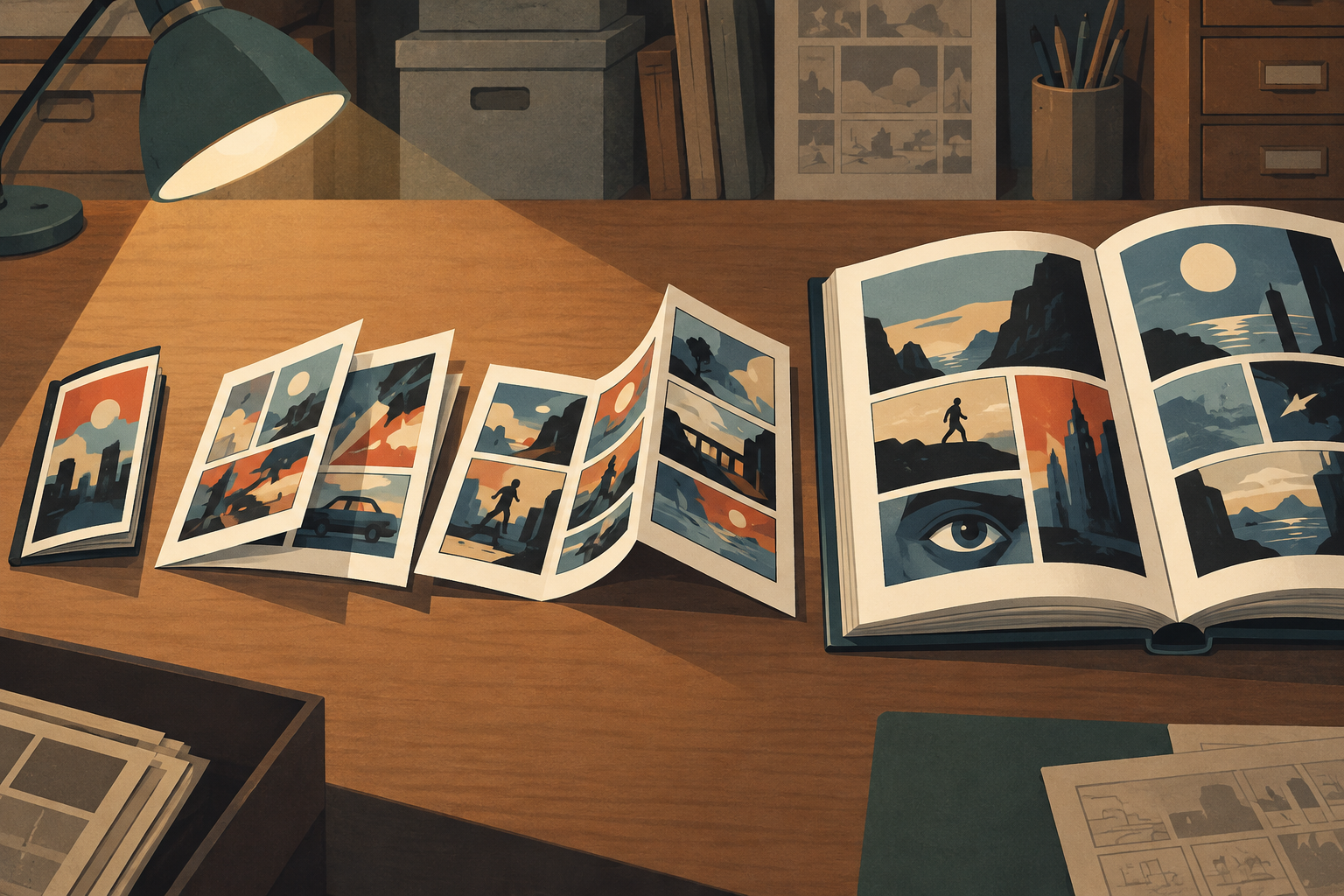
A comic does not reach its readers in the abstract. It may appear in a magazine, circulate as a fanzine, take the scale of a minicomic, or be presented as an album or graphic novel. These categories describe different ways of publishing and distributing drawn narratives. They do not, by themselves, tell us how each work is read. Establishing that would require specific copies and attention to their material and editorial conditions.
The question of format is useful because it keeps comics connected to circulation rather than treating them as sequences of images detached from their publication history. Publications have a form, a context of appearance and a later life. Considering all three can connect reading to editorial history and preservation, without turning a research possibility into a universal rule.
A classification that opens questions
Rubén Varillas brings together comic magazines, fanzines, minicomic books, albums and graphic novels in “El cómic, una cuestión de formatos (2),” published in CuCo, Cuadernos de cómic. The reference confirms that format is a subject of analysis and supplies a map of categories. The available evidence does not, however, provide a comparison of specific issues or editions. It therefore cannot assign a particular pace, sequence or interpretation to each category.
The distinction between a periodical, a short edition and a volume can guide an inquiry into how a narrative is published. But a format’s name does not reveal a page’s dimensions, publication frequency, installment order or the editorial decisions behind a particular work. Those details must be checked against relevant objects and records, not inferred from a label.
From circulation to reading
Format offers a starting point for asking how a comic reaches readers and in what context it appears. A magazine belongs to a periodical; a fanzine is identified here as a distinct editorial category; a minicomic, an album and a graphic novel name other forms of presentation. The list alone cannot reconstruct the audience for any particular object or the reading practices associated with it.
It is also important to separate two levels of inquiry. The first is material and verifiable: dimensions, pagination, sequence and publication context, where copies or records document them. The second concerns experience: perceived pace, attention or interpretation. It is reasonable to ask whether material conditions matter to those experiences, but the supplied sources do not establish a fixed effect. Comparing editions of the same work, if they can be located, would offer a way to investigate without assuming the result.
Ephemeral publications and what survives
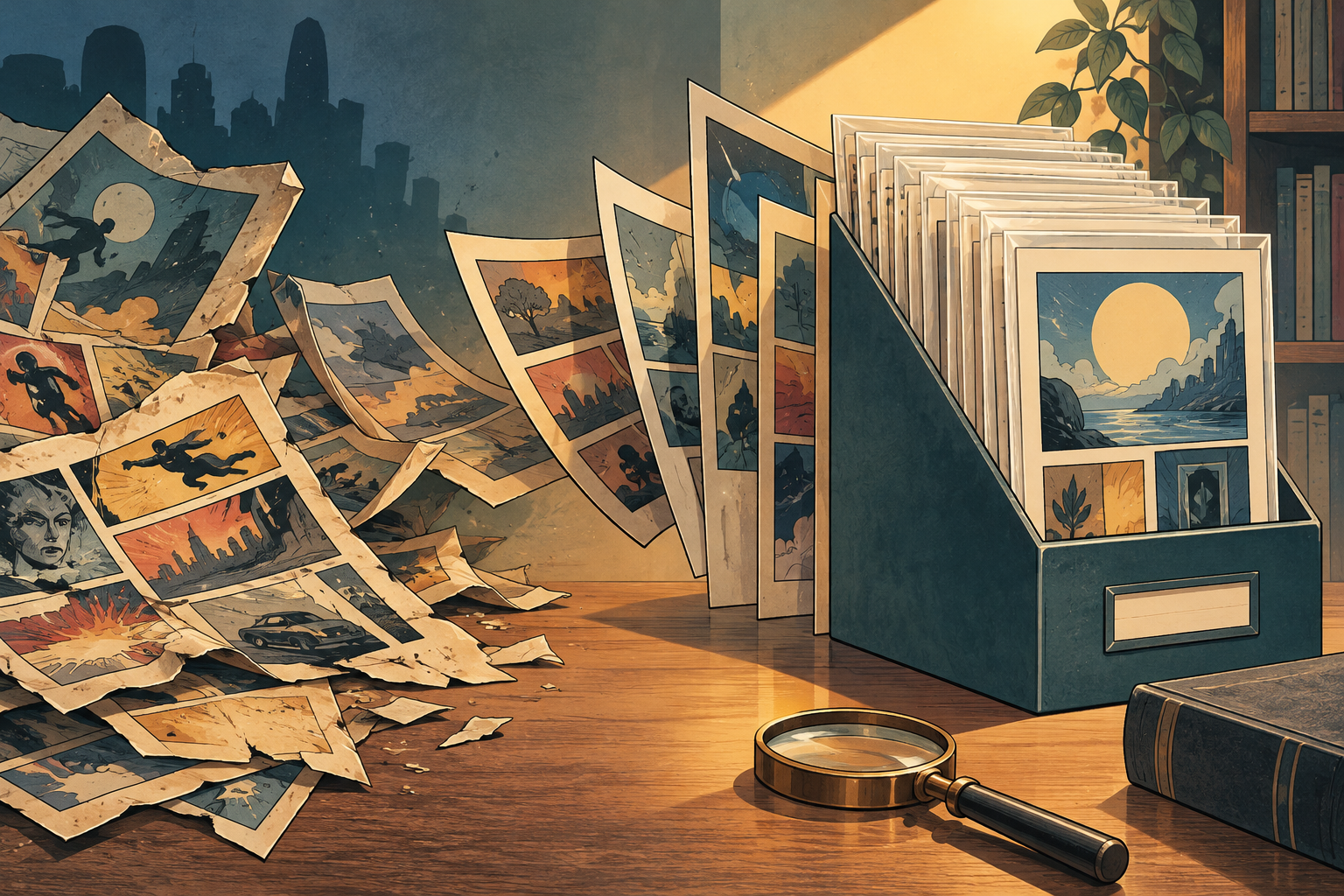
Publication history leads to another tension: some comics were originally conceived as ephemeral, meant to be read and discarded. That initial status contrasts with the treatment of comics as cultural and artistic heritage whose preservation matters, a point emphasized in discussions of comic collections. As an object moves from circulation into preservation, the framework of study changes. The question is not only what it tells, but which copy survived and what material information it retains.
The relationship between format and archive should not be oversimplified. The evidence identifies the intended ephemerality of some publications and the value of preserving collections, but it gives no specific titles, survival rates or archival policies here. It makes the problem visible without measuring its scope. An assessment would require catalogues, located copies and documentation of provenance and condition.
Comparing without assuming an effect
A sound study would begin with identifiable objects. It could record dimensions, pagination, page organization, sequence and publication details, then distinguish those findings from hypotheses about reading. If multiple versions of a comic were available, comparing them could show whether the editorial presentation changed and exactly where. Without such material, claims that a format speeds up the pace or alters meaning would exceed what can be verified.
That limit does not make the question unimportant. It helps define it precisely. Format is one dimension of comic history and a route into the study of circulation, publishing and preservation. It is not an automatic explanation of content or reader response. Given the available evidence, the concrete conclusion is methodological: comparing formats requires comparing documented publications and keeping verifiable features separate from interpretations of the reading experience.
A history that is also kept
Magazines, fanzines, minicomic books, albums and graphic novels provide a way to organize discussion of the different forms in which comics circulate. Varillas’s article supplies an explicit framework for that classification; references to collections and ephemeral publications add the question of what is preserved. Together, these clues justify studying comics as both editorial works and cultural objects, but they do not suffice to reconstruct changes in reading in particular cases.
Reading is shaped by multiple conditions, and no universal transformation can be attributed to format without examining the works. What can be said is that the publication object belongs in the analysis: documenting it helps establish how a comic was published and what remains of it. The next step is not to generalize, but to compare specific copies and archives.
- Decade
- 2000s
- Region
- Global
- Level
- Enthusiast
- Entities
- CuCo, Cuadernos de cómic, Rubén Varillas, Revistas de cómics, fanzines, mini-cómics, álbumes y novelas gráficas
Sources and references
- El cómic, una cuestión de formatos (2): revistas de cómics, fanzines, mini-cómics, álbumes y novelas gráficasdoi.org · 2026-10-16
- Del archivo al lector: el valor de las colecciones de cómiclaregenta.org · 2026-10-16
- (PDF) Las exposiciones de cómics. Historia y contexto globalwww.researchgate.net · 2026-10-16
- Los desafíos del museo en el cómicwww.zubiaurcarreno.com · 2026-10-16
- coleccionismo y conservación del cómic en estados unidos ...riull.ull.es · 2026-10-16