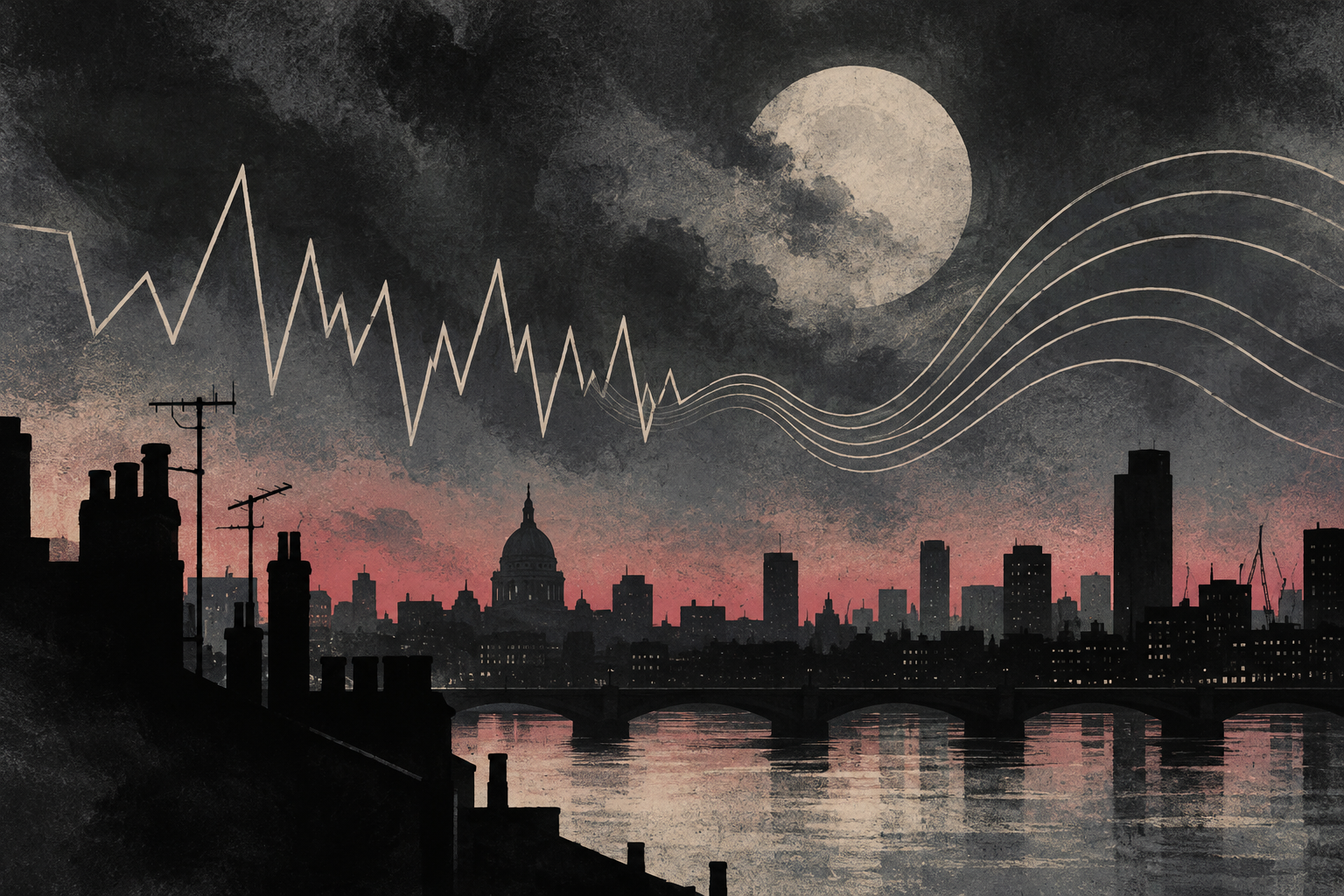
The Cure emerged in Crawley, England, in 1978, around Robert Smith and at a moment when punk still had a strong presence in the British scene. Yet describing their early years simply as a passage toward gothic rock obscures a less linear story: the band developed a sound that moved away from punk conventions and is now understood as part of post-punk. Released in April 1980, “A Forest” offers a particularly clear point of entry. Its hypnotic bass and enveloping guitars create an atmosphere distinct from punk’s familiar urgency, though the available evidence does not support reducing the group’s entire development to a single song.
A beginning connected to punk, but not defined by it
The Cure appeared in a British context where punk remained prominent. That connection helps situate the band, but it is not enough to describe its musical identity. The group’s early trajectory, according to the available information, did not yet match either the sound later associated with the band or the gothic label. The change is better understood as a search for new melodic structures and darker textures shared with other groups of the period, rather than as a sudden break.
“A Forest” as a threshold
Released in April 1980, “A Forest” brings into focus features that would become central to The Cure’s sonic image: a persistent bass line and guitars that create an enveloping atmosphere. The song is often described as a decisive moment, but that claim has limits. It can serve as a milestone in an account of the band’s development; on its own, it does not establish how it was recorded, which specific technical decisions were made, or that the whole later aesthetic was already fixed within it.
Post-punk as a space of transformation
Here, post-punk is not a label that erases the band’s connection to punk, but a field in which that inheritance changed form. The available evidence places The Cure within a wider movement of bands exploring new melodic shapes and darker atmospheres. This perspective avoids presenting the shift as an isolated metamorphosis and makes it possible to understand it as part of a scene. It also reminds us that musical categories are tools for organizing history: they cannot replace listening or fully describe the differences between groups.
How the gothic reading took shape
The press and critics began grouping The Cure with Siouxsie and the Banshees and Joy Division under the gothic rock label. The classification consolidated in the early 1980s, alongside the opening of venues such as the Batcave club. This evidence supports discussing a critical and cultural association, but not claiming that the three bands shared an identical identity or that The Cure adopted a stable label from the beginning. The category developed amid scenes, audiences and modes of reception that extended beyond any one group.
Production, media and reception: what can be established
The Cure’s trajectory invites consideration of how composition, production and physical media shape the experience of music. Recordings of the period circulated in material formats and reached audiences in a particular historical setting; that context is part of their reception. But the information provided identifies no specific formats, studio techniques, equipment, production personnel or audible changes attributable to a particular medium. The role of the medium can therefore be raised as a relevant question, not presented as a demonstrated technical conclusion.
An influence that calls for caution
The music of The Cure and other bands associated with post-punk is linked in the evidence to later genres such as trip hop. That relationship points to a possible cultural continuity: earlier sounds and references may be taken up beyond their original context. However, no artists, songs or specific mechanisms of influence attributable to The Cure are detailed here. What can be verified is more limited than a complete genealogy: the band’s work became part of a sound world whose resonance extended beyond the early 1980s.
A history that resists a single label
The Cure’s transformation can be traced from Crawley in 1978, through the prominence of “A Forest” in 1980, to the band’s later association with gothic rock. That journey does not make the group a closed genre story. Rather, it shows how a band that emerged in punk’s orbit participated in the expansion of post-punk and became inscribed in a gothic culture still taking shape. What can be said concretely is that listening to The Cure acquired new meanings as sounds, critical categories and the spaces through which the music circulated changed.
- Decade
- 1980s
- Region
- Europe
- Level
- Enthusiast
- Entities
- The Cure, Sounds
Sources and references
- The Cure y la Canción que Casi Nunca Existió #thecure # ...www.instagram.com · 2026-10-15
- ✨ The Cure: “A Forest” (1980) 🌌🎶 🎹 El origenwww.instagram.com · 2026-10-15
- The Cure | Análisis críticas | discosjesusgran.wixsite.com · 2026-10-15
- LA HISTORIA DE UNA SUBCULTURA: POST PUNKtranslate.google.com · 2026-10-15
- Trip hopes.wikipedia.org · 2026-10-15
- Rock góticoes.wikipedia.org · 2026-10-15