Format is not a neutral wrapper
A comic can appear in a magazine, a fanzine, a mini-comic, an album or a graphic novel. These categories are brought together in the title of Rubén Varillas’s study of comic formats. Even that list invites us to look beyond the drawn page: the material form of publication is also a way of organizing reading and presenting a work. It does not, however, establish that each format always has a fixed audience, lifespan or function. Such claims would require specific evidence about publications, readers and contexts that is not available here.
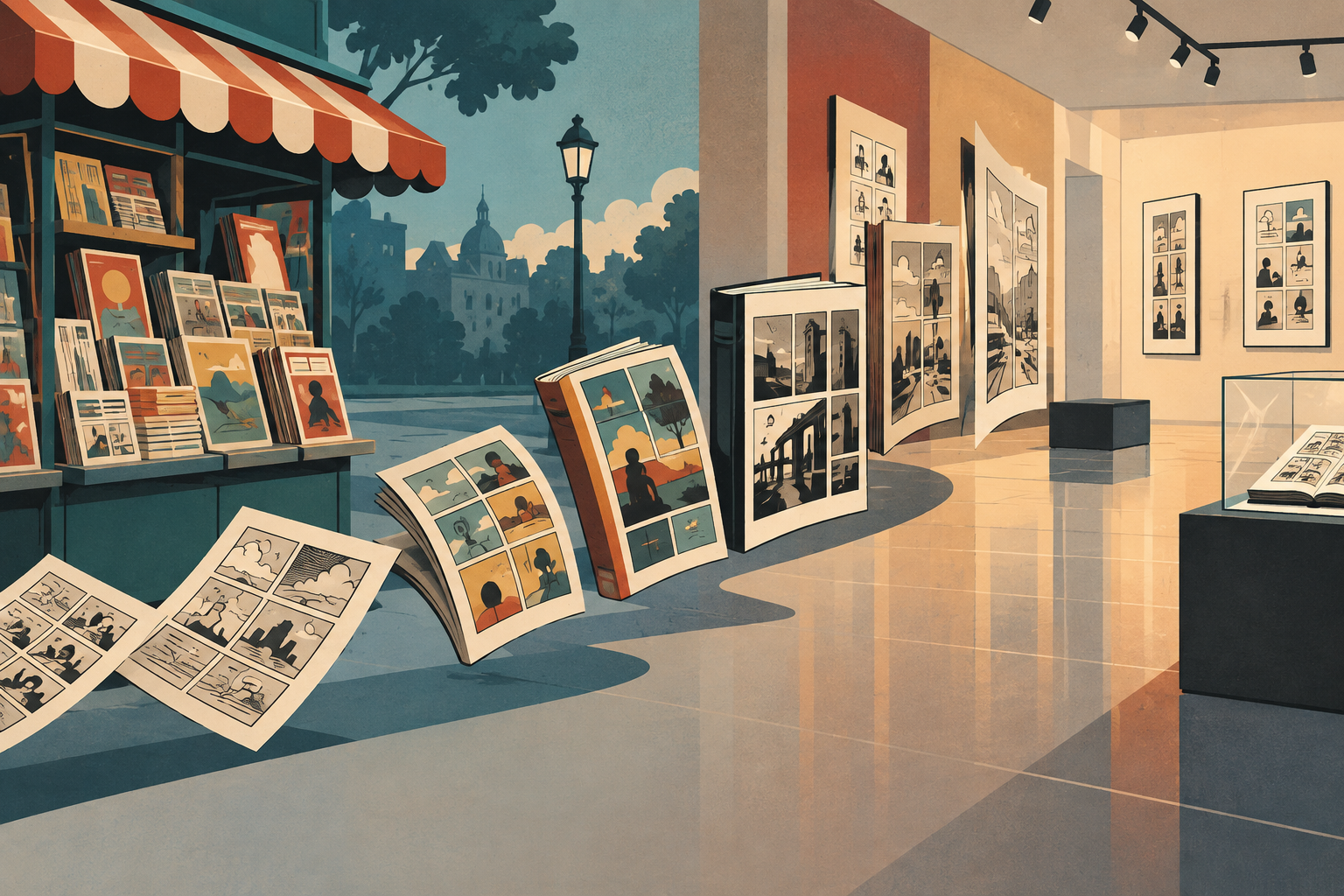
The useful question is narrower: what changes when a comic is encountered as a magazine at a newsstand, as part of an exhibition or as a preserved object? The supplied evidence points to these shifts, though it does not describe each experience in detail.
From magazine to newsstand
A RetroPause study of Spanish magazines from the 1970s and 1980s frames the move “from newsstand to museum” as a transformation in the places from which comics are seen, read and remembered. This framing matters because it presents the magazine not merely as a printed support, but as part of a situation of circulation and encounter.
The newsstand and the museum should not be treated as interchangeable settings. The source presents the former as a starting point for reflecting on magazines, and the latter as a place of memory and exhibition. The supplied material does not provide enough data to describe print runs, distribution, reading habits or particular cases. It would therefore go beyond the evidence to claim a linear evolution—for instance, from popular reading to institutional recognition.
A family of formats
Varillas’s study lists comic magazines, fanzines, mini-comics, albums and graphic novels. That list serves as a map of categories and shows that “comics” does not refer to a single kind of publishing object. But the bibliographic title alone does not explain the physical properties of each format or how they related historically. We should distinguish what the record confirms—the subject and range of formats—from what would require reading the full article.
The classification is useful as a method: it allows comparisons without assuming that all formats work alike. A magazine and an album can be studied as different objects, but claims about specific differences in periodicity, cost, content or readership require dedicated sources. Format opens a line of inquiry; it is not an automatic answer.
Exhibiting comics has a history too
María Pilar Méndez’s academic article on the history and global context of comic exhibitions challenges the idea that exhibiting comics is a recent practice. The available summary says that exhibitions have been common since the medium’s beginnings and names “Bande Dessinée et Figuration Narrative” as an example. The evidence supports the claim that exhibition history belongs within the history of comics; it is not enough to establish a full chronology here or to explain the cited case in detail.
This perspective complements the question of format. A work in an exhibition is presented under different conditions from a magazine available for reading: exhibition turns comics into objects of observation, and the cited article places this practice within a broader history. Further details—gallery design, page selection and audience response—are not described in the supplied material and must remain open questions.
What a history of format can and cannot tell us
Another reference in the evidence studies Spanish comics from 1951 to 1970. There is also an Instituto Cervantes event in Utrecht associated with the exhibition “20 años de cómic Injuve,” in which Gerardo—identified in the result’s title—leads a journey through Spanish comic history. These are indications that research and cultural mediation approach comics from different angles: periodization, exhibition and historical overview.
On their own, they do not prove a causal relationship between magazines and museums, nor do they allow comparisons between countries or audiences. They also do not justify a complete timeline from 1970 to 2009. Their value here is more modest: they show that magazines can be studied alongside other objects and spaces, and that exhibition has its own history worthy of attention.
A provisional conclusion
Looking at format broadens the history of comics. Varillas’s categories provide a starting vocabulary; the RetroPause study places Spanish magazines between newsstand and museum; and Méndez’s research reminds us that exhibitions are not necessarily a recent phenomenon. Together, these clues support a cultural interpretation: comics change context when the object that contains them or the space in which they are encountered changes.
This conclusion is deliberately limited. The available sources do not establish details here about circulation, readers, sales, licences or the material properties of specific publications. Further work would require full texts, catalogues and identified copies. What can already be said is enough for one idea: comic history is not exhausted by its drawings; it also passes through the formats and places that make it possible to see, read and preserve them.
- Decade
- 1970s
- Region
- Spain
- Level
- Introduction
- Entities
- Museum
Sources and references
- El cómic, una cuestión de formatos (2): revistas de cómics, fanzines, mini-cómics, álbumes y novelas gráficasdoi.org · 2026-09-30
- Del quiosco al museo: qué cambió para las revistas de cómic ...www.retropause.com · 2026-09-30
- El cómic español: un recorrido por su historia por Gerardo ...www.youtube.com · 2026-09-30
- Las exposiciones de cómics. Historia y contexto globalerevistas.publicaciones.uah.es · 2026-09-30
- En las décadas de 1970 y 1980, diversas autoras españolas ...www.facebook.com · 2026-09-30
- Vista de La historieta española de 1951 a 1970arbor.revistas.csic.es · 2026-09-30