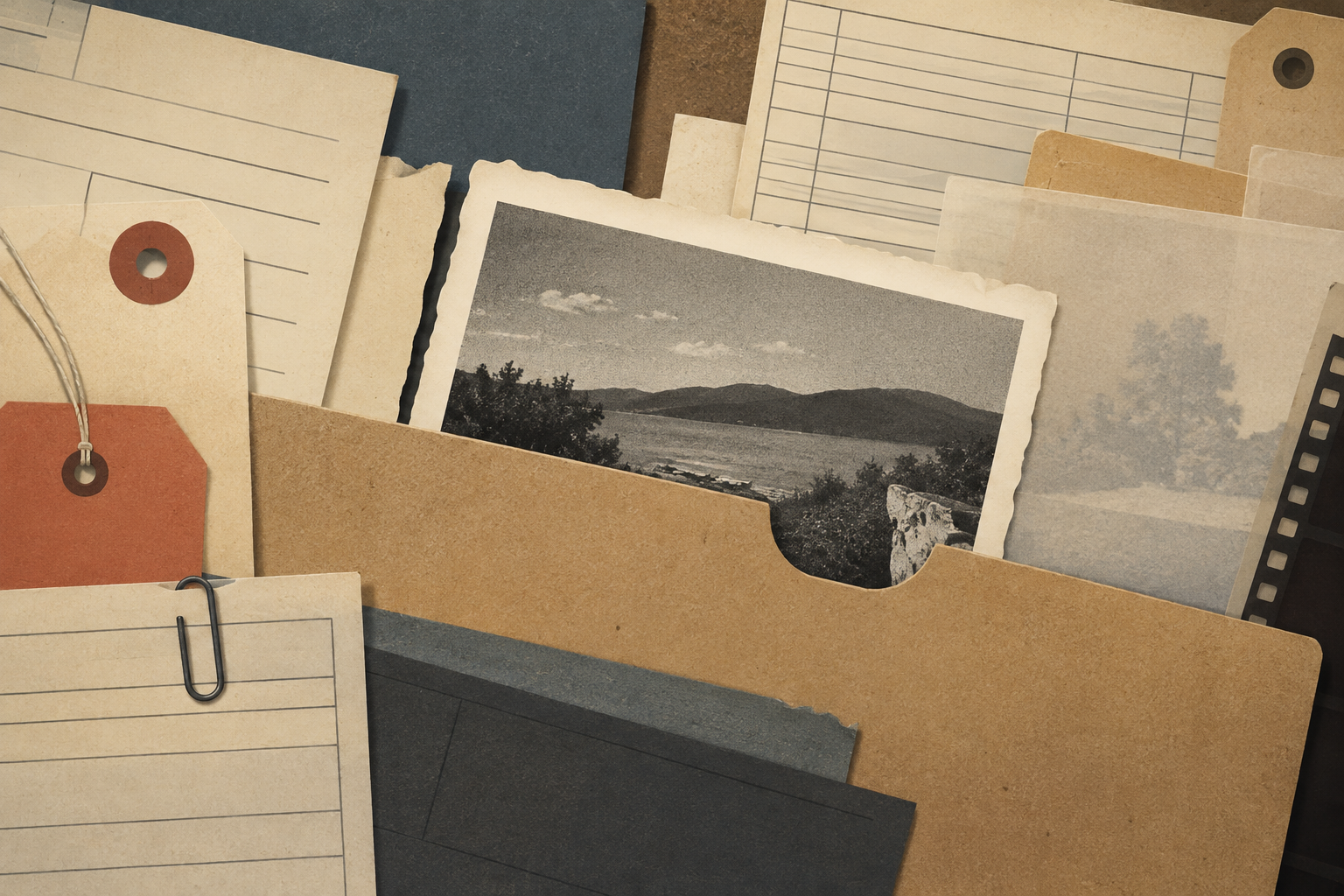
A photograph can show a scene and still leave unanswered who made it, when, by what process, or why it was preserved. An archive does not automatically resolve those questions, but it helps determine what information stays with an image and how that image can be consulted. This is the central contribution of viewing photography through its documentary life: historical meaning lies not only in what is depicted, but also in the conditions that allow an image to be identified, contextualized and connected to others.
The photographic-conservation documentation gathered by Memoria Chilena emphasizes the importance of “perfectly documented” photographs and mentions advice provided to an institutional department forming a photographic archive. Isabel Argerich’s academic article “Photography and Archive,” in turn, makes the archive a subject of reflection on photography. The supplied evidence does not give the article’s full argument or detail the conservation procedures mentioned. It does, however, provide a basis for examining how support, description and organization shape an image’s use as a document.
The frame does not contain the whole story
A frame is a selection: it makes some elements visible and leaves others out. Yet even what appears in the image does not explain itself. A person, building or activity may be visually recognizable without revealing identity, location or purpose. This is not a flaw unique to photography. It is a limit of visual evidence when separated from information that helps interpret it.
Describing an image, therefore, is not the same as narrating everything that happened in front of the camera. A description can record what is observable while distinguishing it from a confirmed identification or a hypothesis. An archive, understood as a body of images and associated records, can keep that distinction in view. When information is unavailable, uncertainty belongs in a rigorous account; it should not be filled with conjecture.
The support is part of the document
Photography has a material as well as a visual dimension. The support and production process may matter to understanding the object that is preserved and the attention it requires. The evidence provided here, however, identifies no specific processes, materials in particular photographs or instances of damage. It therefore cannot support claims about the technique or condition of an individual image.
That caution does not diminish the importance of materiality; it prevents a general consideration from becoming a diagnosis without evidence. It also separates two questions: what a reproduction shows, and what can be said about the photographic object from which it derives. Answering the second may require examining the object and its records, information not included here.
Cataloguing makes relationships explicit
The Memoria Chilena reference connects documentation with the possibility of bringing photographs together in an institutional archive. In cultural terms, recording identifying and contextual information can prevent an image from circulating as an anonymous fragment. Its connection to a collection, provenance or group may be retained, provided those details are actually documented.
Cataloguing is not neutral in the sense that every system chooses categories and makes some relationships more visible than others. But the available sources describe no particular classification system and do not allow its criteria to be assessed. The narrower point that can be supported is that the quality and scope of information accompanying photographs affect what researchers and members of the public can find and claim about them.
From memory to public consultation
A news item about a donation to a museum describes a project intended to digitize old photographs and recover individual and collective memories. This expresses a familiar cultural ambition for image archives: to make materials accessible that may contribute to shared accounts. The description alone does not establish which photographs are in the collection, how they are documented or what the project achieved.
Public access can expand an image’s uses, from family remembrance to research, exhibition or local history. Each use, however, depends on the information available and how the image is presented. A photograph may provide evidence about what it shows without representing an entire community on its own. Avoiding that equivalence matters when images enter collective narratives.
Digitization is not complete preservation
A digital copy can make consultation easier and, in some circumstances, reduce the need to handle an original. The supplied evidence specifies no digitization practices, standards or outcomes, however, and does not support the claim that a copy fully replaces the physical object. A digital image records a representation; it does not automatically carry all the material, historical or administrative information associated with the original.
It is therefore useful to distinguish access from preservation. Digitization may form part of a documentary strategy, but it does not by itself prove that the original support is preserved or that its context has been transmitted in full. The conservation guidance mentioned by Memoria Chilena points to documentation as an important component; the available material does not provide a comprehensive protocol for explaining how this is done in each case.
A reading that respects its limits
The references support a specific conclusion: studying a photograph as a document requires attention both to the image and to the conditions of identification, description and consultation around it. They do not allow us to reconstruct the history of particular collections, confirm photographic processes or assess individual objects. Those conclusions would require examining the photographs and their records, as well as consulting the full text of the cited research.
An archive, then, does not turn every photograph into transparent proof or erase its silences. It makes more precise questions possible and helps show which parts of an interpretation rest on evidence. The practical conclusion is simple: an image documents more fully when preserved with verifiable context, and a responsible reading states clearly what remains unknown.
- Decade
- 2000s
- Region
- Global
- Level
- Enthusiast
- Entities
- Museum
Sources and references
- Fotografía y archivodoi.org · 2026-10-17
- Fondos de fotografía antigua sobre el arte aragonés en la Biblioteca Nacional y unas notas sobre el Museo del Prado y el Archivo Histórico Nacionaldoi.org · 2026-10-17
- Una mirada documental de la fotografía underground a través del fanzine Rockocó. Análisis del Archivo Miguel Trillo en el Museo Nacional Centro de Arte Reina Sofía (MNCARS)doi.org · 2026-10-17
- 📸✨ Un nuevo fondo digital llega al Museo de los ...www.facebook.com · 2026-10-17
- 00-CONSERVACION FOTOGRAFIAwww.memoriachilena.gob.cl · 2026-10-17