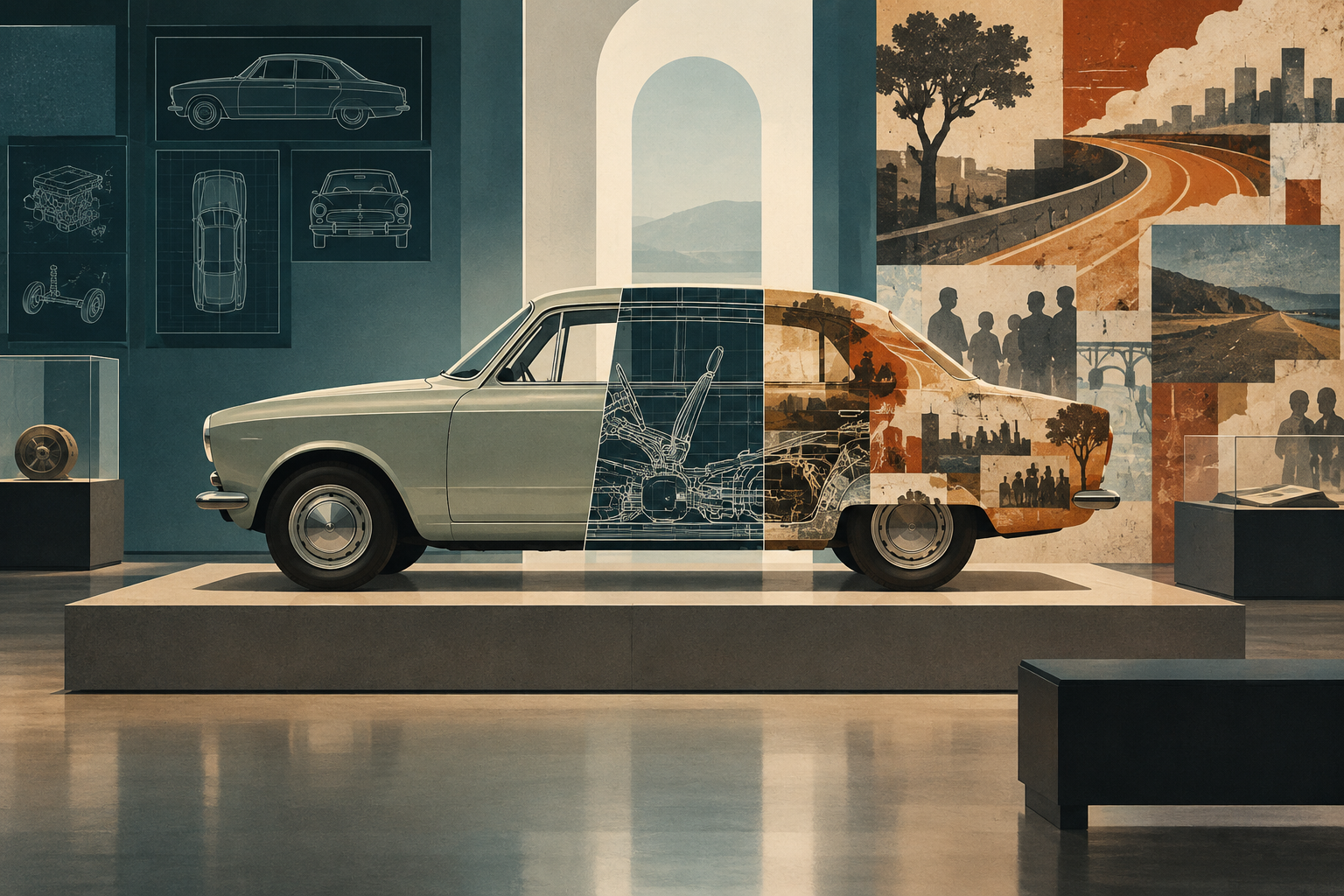
A car in a museum is more than a machine taken out of circulation. It can also help examine technical choices, patterns of consumption, and ideas about mobility. The central contribution of the available sources is this double reading: the vehicle as a material object and as a social document. The evidence supplied, however, is brief and does not identify specific displays or restorations. It is therefore important to distinguish what the sources support from the questions they raise.
From everyday object to subject of study
The automobile occupies a distinctive place in technical heritage: it was made to be used, not to remain motionless behind glass. A study titled El automóvil como objeto expositivo y su potencial didáctico describes it as one of the consumer objects that has had the greatest influence on society from the twentieth century to the present. This places the car within a history larger than that of its components. Its social presence can be studied through the object, although the available summary does not specify which groups, practices, or changes the research addresses.
A change of setting changes how the vehicle is read. On the road, it takes part in journeys and routines; in a museum, its form and technology become subjects for interpretation. Its status as a consumer good does not disappear, but its function is no longer the only explanation. An exhibition can prompt questions about access to mobility, technical choices, and the values attached to cars. These are analytical questions, not conclusions answered by the cited sources on their own.
Technology needs context
A vehicle preserves material evidence of its design and manufacture, but interpreting that evidence requires documentation. The supplied article argues for using manuals and catalogues to contextualize technology and to distinguish inherited reputation from verifiable characteristics. That distinction matters: a model’s or brand’s fame is not evidence of how it worked, how people received it, or what impact it had.
Manuals and catalogues can help reconstruct how a vehicle was described and what technical information circulated about it. By themselves, they cannot explain everyday use or cultural meaning. Those interpretations would require further sources, such as historical records or focused research; the material provided does not establish what a particular institution used. Curatorial rigour also means making the difference between technical description and social interpretation visible.
The transport museum as a framework
An academic publication on the case of the National Transport Museum outlines conceptual principles for creating a state museum devoted to transport and public works. The available summary confirms the study’s general purpose but does not present its detailed proposals or justify attributing a particular curatorial programme to it. Even so, the subject helps place the automobile within a network of infrastructure and transport modes rather than treating it as an isolated object.
That framework changes the story a museum might tell. A car can be considered alongside other vehicles and the material conditions that make transport possible. The evidence supplied does not describe a particular exhibition or explain how any specific collection is arranged. Claims about an institution beyond the study’s stated subject would therefore exceed what can be verified. What can be said is that establishing a transport museum involves conceptual decisions about what to collect and how to interpret it.
The cultural meaning of mobility
The automobile has also featured in public narratives that extend beyond engineering. The UNESCO record titled El mito del automóvil includes, according to the supplied excerpt, sections such as “The car enters history” and “The rolling museum,” as well as a reference to teenagers going to meeting places in cars or on motorcycles. This fragment indicates that vehicles can function as elements of sociability and cultural imagery. It is not enough, however, to reconstruct the publication’s full argument.
This dimension matters because museums do not present only technical solutions; they also choose which cultural associations to make visible. Mobility can be connected to everyday life, consumption, or social gatherings, but more specific claims require sources absent from the evidence provided. The car’s value as a document does not come from speaking for itself. It comes from enabling questions that must be checked against other records.
Conservation without erasing material history
Conserving a vehicle involves a tension between maintaining its physical integrity and making it understandable to the public. The supplied article notes that a restoration workshop can become a space for historical research. This takes restoration beyond cosmetic improvement: decisions about what to repair, preserve, or leave visible can shape how an object is read.
The sources do not provide details about techniques, intervention policies, or examples of restoration. It is not possible to describe a specific method or claim that museums balance these aims in the same way. Caution matters: a restored object should not automatically be treated as an untouched representation of its past. Documentation of the process and decisions would be needed to assess what was preserved and what was changed.
What the evidence can support
The available material supports three broad points: the automobile had a notable social influence; it can be approached as an object for exhibition and teaching; and designing transport museums involves conceptual choices. It also offers hints of a cultural reading of the vehicle, though only in fragments. It does not provide enough information to attribute particular practices to a museum, quantify the automobile’s social impact, or reconstruct a complete institutional history.
That limit does not weaken the documentary approach; it defines it. Treating a car as a document means approaching it as material evidence that needs context, comparison, and explanation—not as self-sufficient proof. In a museum, mechanics and bodywork are the starting point. The concrete conclusion is that a vehicle’s historical value becomes clearer when an exhibition distinguishes verifiable features, curatorial interpretation, and questions that still require research.
- Decade
- 1990s
- Region
- Global
- Level
- Enthusiast
- Entities
- Museum
Sources and references
- Museos de ciencia y tecnología en Europa - Whichmuseumwhichmuseum.com · 2026-10-17
- el caso del Museo Nacional del Transporte Mikel Asensio ...core.ac.uk · 2026-10-17
- El automóvil como objeto expositivo y su potencial didácticowww.tdx.cat · 2026-10-17
- El Mito del automóvilunesdoc.unesco.org · 2026-10-17
- Redes de Museos en Iberoaméricawww.ibermuseos.org · 2026-10-17