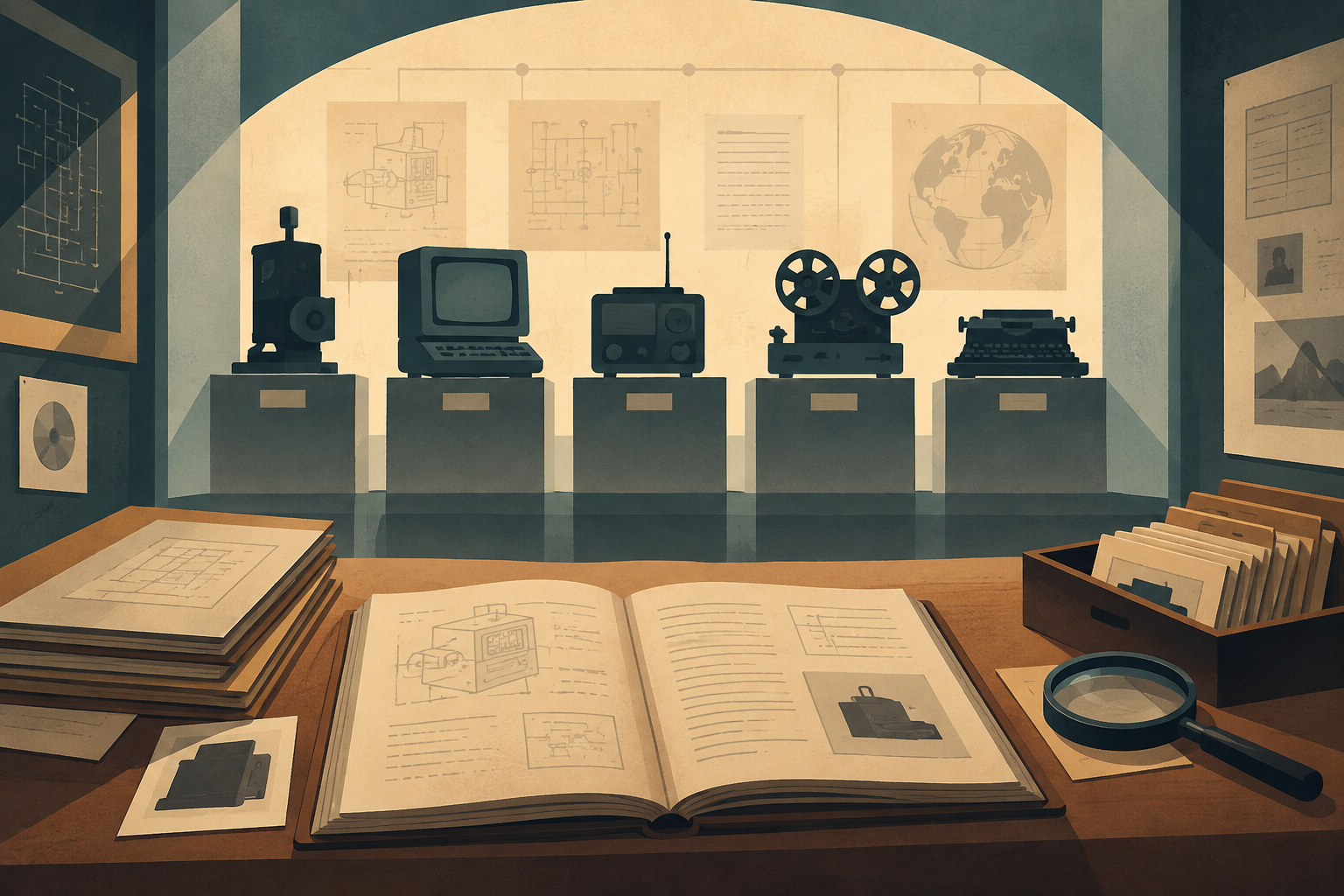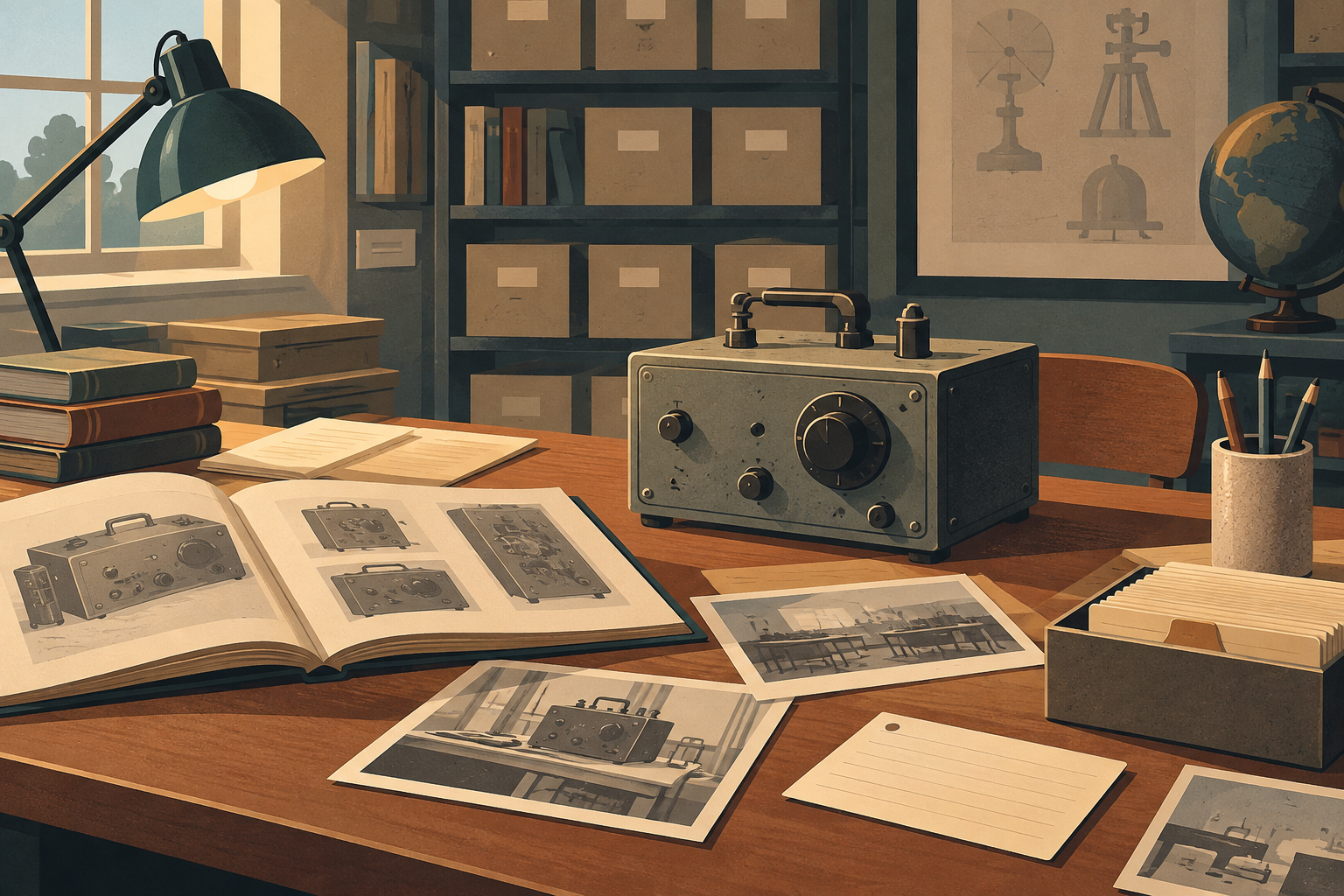
A device preserved in a museum can show its shape, materials and some of its design choices. On its own, however, it cannot explain what its maker expected of it, how it was presented to the public, or how it was used beyond the display case. To approach those questions, the object has to be read alongside the documents around it. Archives in science and technology museums offer a concrete starting point for that research—not a guarantee that every use is known, but a way to establish what is documented and what remains open.
The archive is part of the object’s research context
MUNCYT describes its archive as responsible for organising, processing and storing historical and administrative documentation. The National Archaeological Museum, in turn, presents its historical archive as a public-access resource that provides finding aids. These institutional descriptions do not identify specific records for every device, but they do locate the archive within museum work: it is not merely a storehouse for papers, but a structure for organising documentation and making it consultable.
Research can begin with the device and continue through registers, contextual records or materials that help establish how it was described. That relationship must not be assumed: the information available here does not tell us which specific documents accompany any particular object. The editorial proposition is more cautious. When documents can be linked to an object, they should be studied alongside it; when none have been located, their absence is not a licence to fill in the story with an imagined scene.
Promises, descriptions and use are different things
A manual or advertisement may help reconstruct what a device was said to do, how people were advised to use it, or what limitations were communicated. But a sales claim or instruction does not by itself prove that people followed it. The text records an intention, recommendation or presentation; it does not automatically provide a record of every day-to-day practice.
This distinction matters when asking which real uses set a device apart. The supplied evidence describes no specific device and offers no user testimony, so it would be unjustified to assign it a particular everyday function. What the evidence does support is a method: separate claims made by manufacturers or institutions from editorial inference, and seek records of use before turning a possibility into a fact. If all that is available is an institutional description or a prescriptive document, the conclusion must stop there.
Museum documents and incomplete histories
The Tábula article on archives in science and technology museums places preservation and dissemination among the functions of those archives. Records matter, then, both because they are preserved and because they may be consulted. The available summary, however, does not identify archival series or explain what kinds of use can be reconstructed from them. It is a reference for opening the question, not detailed evidence about a particular object.
Other works in the supplied material raise related issues in different fields. An article on immaterialities addresses the preservation of new-media art; another studies the history, technology and conservation of Brendel botanical models at the Complutense University of Madrid. A publication on the conservation and restoration of cultural heritage on paper is also listed. These titles show that preserving technology, media and documents raises conservation questions, but they do not allow their specific conclusions to be applied to every device or archive.
What a record can and cannot prove
An inventory may help identify an object; an administrative document may provide information about its management; a manual may show instructions. These are examples of questions an investigation can put to documentary sources, not claims about the specific holdings cited here. Each document has a scope. An object’s appearance in a register does not, by itself, prove that it was used in a particular way. A manual describing a procedure does not prove that the procedure was followed routinely.
Care also requires distinguishing an absence of evidence from evidence of absence. If the documents consulted do not mention a particular use, that does not establish that nobody ever used the device that way. Further progress would require additional sources connected to the same object and context. Research should state what it consulted, what it found and what remains unverified; that way, a limit is not disguised as certainty.
A story assembled from evidence, not assumptions
Archive documents can restore context to devices that, displayed on their own, seem to speak for themselves. In reality, the story comes from the relationship between objects, records and documents, and from a reading that keeps their differences visible. The institutions cited confirm the existence of archives and conservation work related to museums, science, technology, new media and documentary heritage. The supplied evidence does not let us reconstruct a specific experience of use or identify a device whose history can be narrated without speculation.
That limit does not make the question useless. It makes it more precise: which document supports each claim about a device, and what kind of claim does that document allow? A device preserves material traces; an archive organises sources that may put it in context. Neither replaces research into the other. Read together—and with what we still do not know kept in view—they make it possible to tell a history of technology less centred on isolated promises and more attentive to the evidence available.
- Decade
- Contemporary
- Region
- Spain
- Level
- Enthusiast
- Entities
- Museum, Museo Arqueológico Nacional
Sources and references
- Conservación y Restauración del Patrimonio Cultural en soporte Papel - Museo Jesuítico Nacional de Jesús Maríadoi.org · 2026-10-01
- Inmaterialidades. Problemas de conservación del arte de los nuevos mediosopenalex.org · 2026-10-01
- Flora Artefacta. Historia, Tecnología y Conservación de la Colección de Modelos Botánicos Brendel en la Universidad Complutense de Madridopenalex.org · 2026-10-01
- El archivo en los museos de ciencias y tecnologías | Tábulapublicaciones.acal.es · 2026-10-01
- Archivo histórico - | Ministerio de Culturawww.man.es · 2026-10-01
- Archivomuncyt.es · 2026-10-01
- Del papel a la nube: el impacto tecnológico en ...www.integratecnologia.es · 2026-10-01