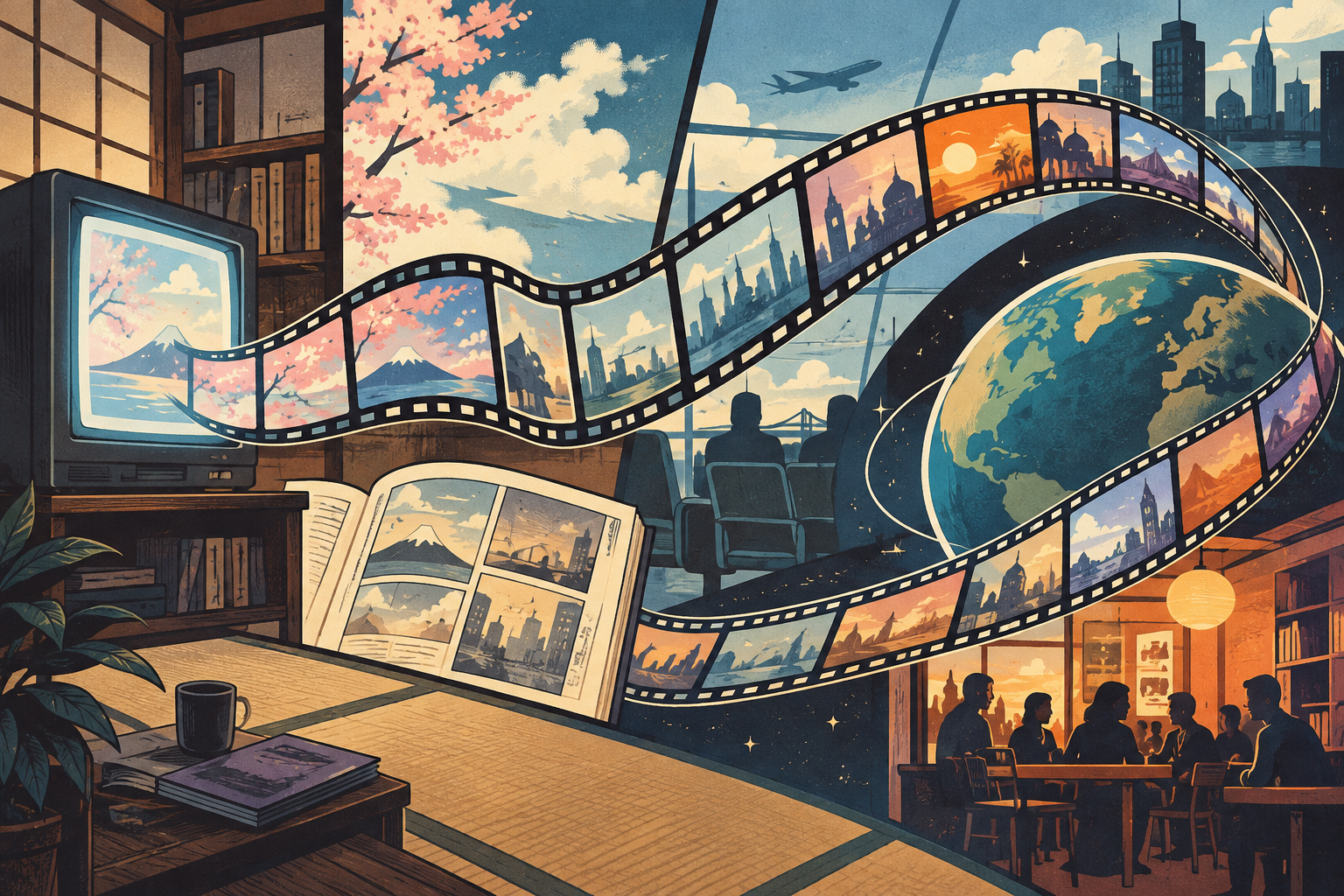
Anime is often presented as an obvious category: Japanese animation, recognisable by its origin and a set of visual conventions. Yet the available sources point to a less simple history. Debate over its origins, studies of its storytelling and research into its reception in Spain show that “anime” is also a category that is constructed, contested and used in different ways. To follow its circulation, we need to look both at the works and at the frameworks used to describe them.
A history with disputed boundaries
A study published in Con A de animación places controversy over anime’s origins at the centre of its subject. Its title alone is a reminder not to turn a brief chronology into a definitive answer. Another source in the search results offers a broad historical overview, but its description does not let us verify every date or work mentioned. Caution is not an obstacle: it helps distinguish a general account that is useful for orientation from a detailed, verified historical claim.
That care also prevents us from treating anime as though it appeared fully defined all at once. The supplied sources do not support a complete account of its early decades. They do show that academic discussion exists about how to establish its origins and boundaries. That disagreement is part of the medium’s history, not a detail to be hidden.
Language shapes the experience too
“Anime” and “Japanese animation” may be used as synonyms in some contexts, but deciding what belongs in the category requires explicit criteria. A label may refer to origin, style, industry, format or reception. If these aspects are conflated, a history of anime risks presenting a classification convention as a universal fact.
This distinction matters particularly when comparing works’ circulation between countries. A series arriving on foreign television, being distributed on video and being recognised as part of popular culture are not the same phenomenon. The supplied audiovisual overview mentions anime’s arrival on television, but provides no concrete data about channels, dates or territories. Those gaps cannot be filled with an invented chronology.
From the story to the way it is told
Antonio Loriguillo López’s research on narrative ambiguity in Japanese commercial animation offers a different route: rather than asking only where anime comes from, ask how it tells stories. The title Anime Complejo. La ambigüedad narrativa en la animación japonesa signals that immediate clarity is not the only measure by which a narrative can be judged. The available record identifies it as an academic book, but does not supply its full argument; it would therefore be wrong to attribute specific conclusions not present in the evidence.
An article by Antonio Horno López addresses the art of limited animation in contemporary anime series. Its existence suggests another productive question: which decisions about movement and visual economy merit analysis in serial production? But the supplied reference gives only the title and basic bibliographic information. It does not, by itself, prove that a particular technique is universal or defines all anime.
Reception is not a single story
The thesis listed in idUS examines anime’s impact on Spanish society. Its subject shows that research has been devoted to studying reception in a national context. The available excerpt is not enough to establish its conclusions, the periods it covers or the audiences it analyses. Even so, its focus helps separate two questions that are often confused: what circulated, and what that circulation meant to those who encountered it.
The encyclopaedia entry on otaku culture included among the sources describes the growth of fandom, its international presence and its connection with anime and manga. It also gathers claims about market research and social change. As a secondary source represented here by an excerpt, it is best used as a guide, not as a substitute for the original reports or proof that all fans shared the same practices. “Otaku” should not be used as a neutral label for every viewer either.
What the sources leave open
This collection brings together academic perspectives, a thesis, an audiovisual overview and an encyclopaedia entry. It is not an exhaustive investigation: television schedules, company records, period journalism and attributable testimony are missing. It therefore cannot establish a definitive list of international milestones, audience figures or individual viewers’ trajectories.
It does support a more careful conclusion. Anime travelled as animation and as a cultural category, but those two dimensions did not necessarily move at the same pace. Debate about its origins shows that classification is not automatic; research on narrative and technique reminds us that works can be studied formally; and the study of Spain indicates that reception deserves context-specific analysis. Anime’s global history is clearer when these questions remain together, without making a broad label do all the explanatory work.
- Decade
- 1990s
- Region
- Global
- Level
- Enthusiast
- Entities
- Televisión, Anime
Sources and references
- Anime Complejo. La ambigüedad narrativa en la animación japonesadoi.org · 2026-09-29
- La narración compleja en el anime postclásico: La ambigüedad narrativa en la animación comercial japonesadoi.org · 2026-09-29
- El arte de la animación selectiva en las series de anime contemporáneasdoi.org · 2026-09-29
- ANIME: history of the audiovisual genre that conquered the worldwww.youtube.com · 2026-09-29
- la repercusión del anime en la sociedad española - idUSidus.us.es · 2026-09-29
- Otakues.wikipedia.org · 2026-09-29