The Commodore Amiga is often remembered for its graphics, sound and games. But a home computer did not end at the case: keyboard, mouse, floppy disks, monitor and expansions were all part of the experience. They shaped how programs were loaded, how people worked with the system and how far a particular setup could go.
Two ways to have an Amiga at home
Commodore introduced the first Amiga in 1985. Later known as the Amiga 1000, it combined a Motorola 68000 with custom chips for graphics, sound and memory access. Its architecture assigned tasks to dedicated components, providing a foundation for its audiovisual capabilities. Everyday use, however, also depended on the connected devices and the software in use.
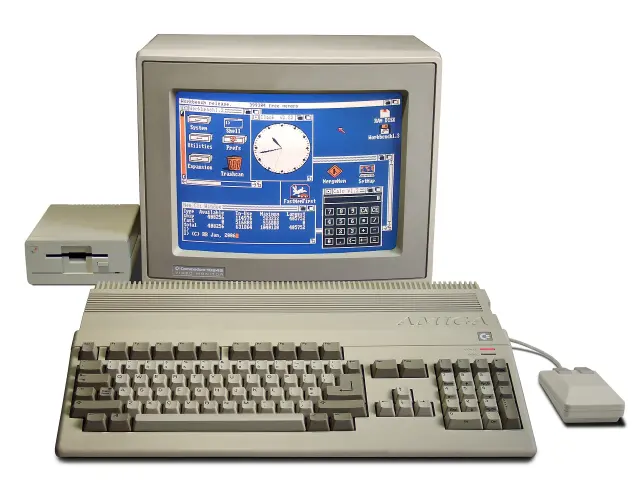
The family soon offered different formats. Introduced in 1987, the Amiga 500 integrated the keyboard and computer into a compact unit and became the best-selling model. The Amiga 2000, also released in 1987, was a desktop system with expansion slots. The distinction was not simply about performance: the A500 offered a straightforward way to set up a computer at home, while the A2000 made it easier to add hardware for more specialized uses.
Floppy disks, Workbench and the command line
The 3.5-inch floppy disk was a common medium for loading programs and saving files. External drives expanded the options for working with disks. In everyday use, a mouse connected to a control port enabled users to work with Workbench, the system’s graphical environment, while the keyboard remained useful for typing and using the command line. The graphical interface and shell offered complementary ways to interact with the computer.
The display and video equipment also affected what the system could do. The Amiga could synchronize its output to an external source using genlock, making it possible to combine computer-generated graphics with incoming video. This function was used in audiovisual production and specialized home setups; putting it to work required more than the computer alone.
Expansions that changed the machine’s reach
The ecosystem included memory expansions, SCSI controllers, accelerators, sound cards, samplers, video digitizers and network cards. Not every user needed these accessories, and not every model supported the same kinds of expansion. Desktop systems in particular offered options for adapting the machine to specific tasks.
NewTek’s Video Toaster, introduced in 1990, is one example of that combination. The expansion card supplied video-production and effects tools that, alongside the Amiga’s graphics hardware and signal synchronization, formed a setup for audiovisual work. The case shows how a home computer could enter semiprofessional environments when the right components were brought together.
Sound, too, had both an integrated foundation and room for additions. The Paula chip provided four PCM audio channels and could play samples stored in memory using direct memory access. Sampling accessories allowed external sounds to be brought in, while third-party cards extended the system. It is worth distinguishing what the computer offered as standard from what required extra hardware: not every setup had the same capabilities.
A computer shaped by its connections
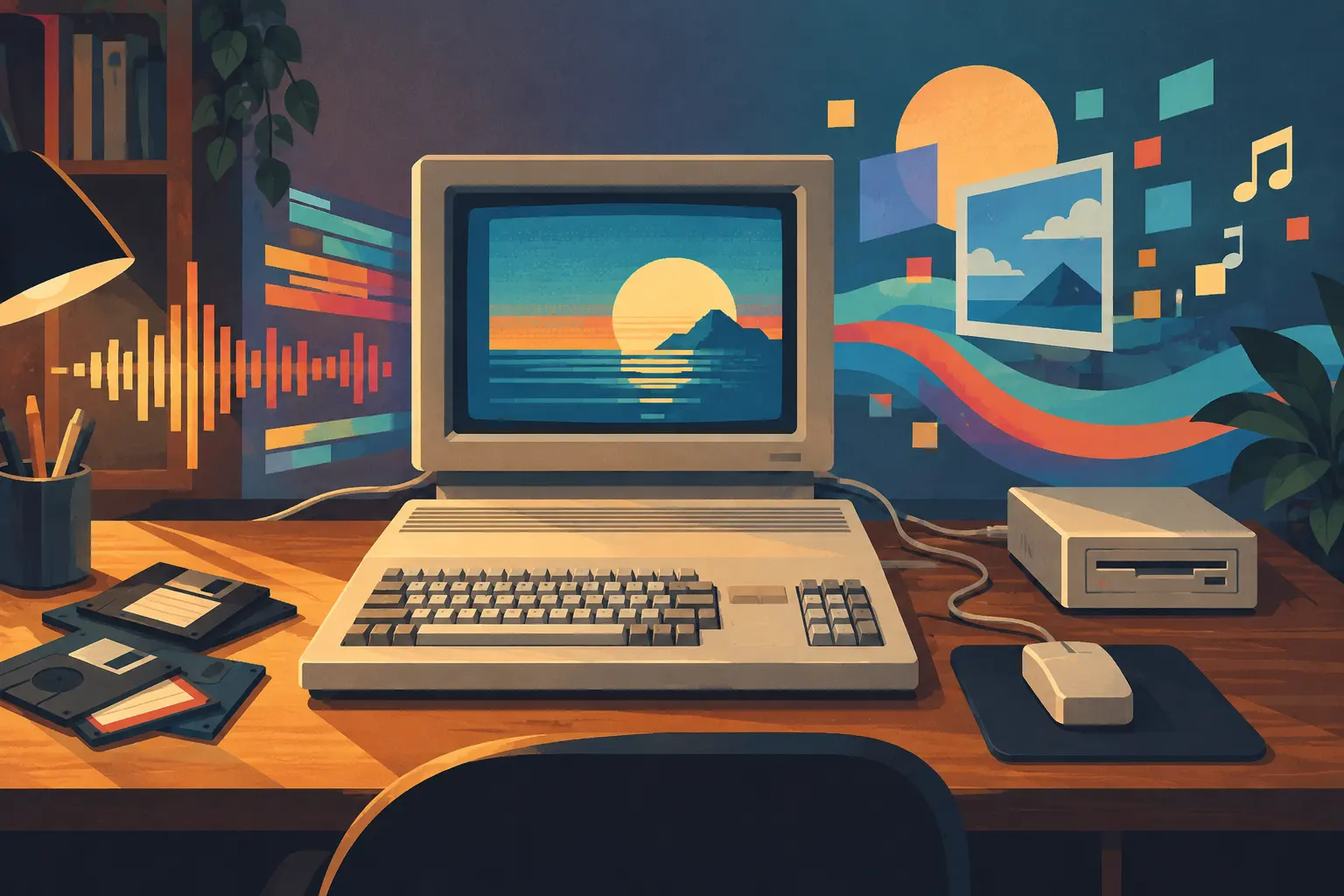
Looking at the Amiga alongside its peripherals helps explain the variety of ways it was used. The compact A500 made it easier to bring into homes as a computer for games and creative software; the A2000’s expansion options supported more specialized setups. Floppy disks, mouse, monitor and audio or video accessories were not abstract add-ons: they shaped the practical work of loading, saving, connecting and making things.
The Amiga can therefore be understood not only as a list of specifications or a games platform, but as a system that households could arrange in different ways. Depending on the equipment available, it could be used for entertainment, for exploring music or graphics tools, or as the centre of a small audiovisual setup. Its range of uses grew from the meeting of the computer’s architecture, its connections and the needs of the people using it.
- Decade
- 1980s
- Region
- Global
- Level
- Enthusiast
- Entities
- Sounds, Disquete, Cuatro, Commodore Amiga
Sources and references 5
- Amigatranslate.google.com · 2026-11-12
- Jay Glenn Miner el Padre de la Computadora Amigaretrocomputingmx.com · 2026-11-12
- Commodore Amiga - Wikipedia, la enciclopedia librees.wikipedia.org · 2026-11-12
- Descubriendo el Poder del Amiga Shellamigatronics.com · 2026-11-12
- Música de videojuegoses.wikipedia.org · 2026-11-12