The Commodore Amiga was not a single machine but a platform whose capabilities changed with its models and hardware generations. Its history combines custom-chip design, a culture of audiovisual creativity and a community that still uses, adapts and documents these computers. Understanding that legacy means looking at both what the machines shared and where they differed.
A project that began before Commodore
Amiga Corporation’s team, including Jay Miner, developed the project before Commodore acquired the company in 1984. The Amiga 1000 appeared in 1985. Its significance lies in bringing colour graphics, sampled digital sound and a multitasking operating system together in a personal computer—not in claiming an absolute first in every field.
An architecture built around shared work
The Motorola 68000 did not do everything alone. It worked alongside chips designed for specific tasks: Agnus managed memory access and functions such as the Copper and Blitter; Denise handled parts of graphics generation and sprites; and Paula managed audio and some input and output. Through DMA, these chips could access memory and take certain operations off the processor’s hands.
The audio hardware offered four eight-bit digital channels routed between the left and right channels of a stereo output. Visual capabilities depended on the chosen screen mode: resolution, palette and the number of simultaneous colours were linked, and could not all be maximised at once. The Copper could change registers during a screen refresh, while the Blitter accelerated graphics operations and data movement. This division of labour between the processor and custom chips helps explain both the Amiga’s capabilities and the way software was written for it.
Exec, the system’s core, supported pre-emptive multitasking, but did not provide the memory isolation associated with modern systems. Many games also accessed hardware directly and took control of the computer, so they could not always run alongside desktop applications like ordinary system programs.
A family of machines, not a uniform ladder
The range did not evolve as a simple sequence in which every model improved on its predecessor in every respect.
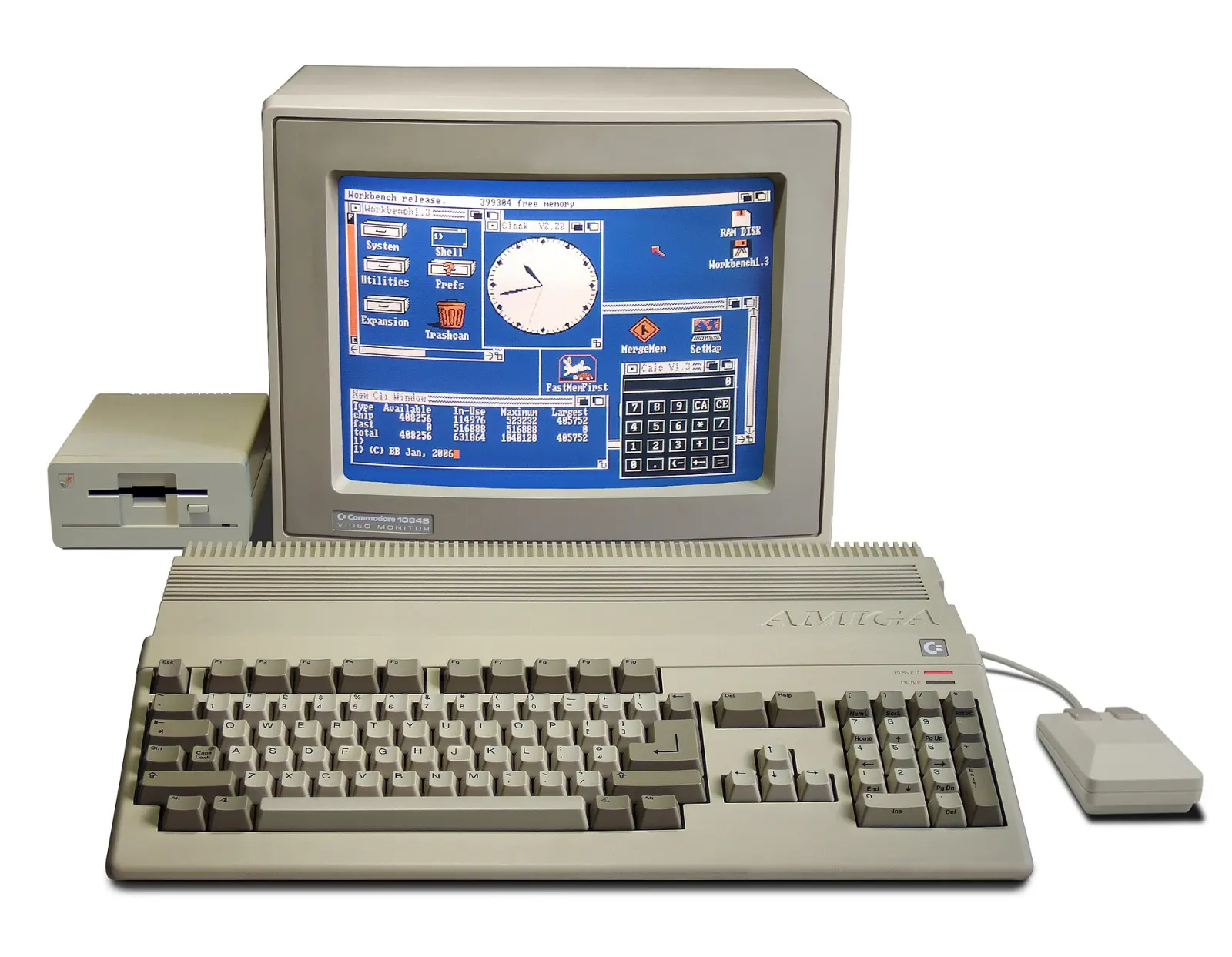
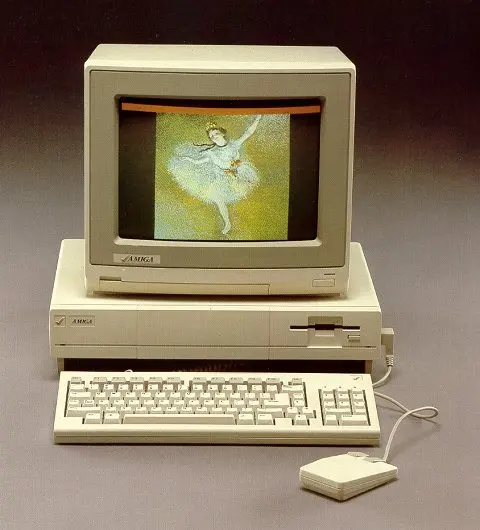
The A500 (1987) brought the 68000 and OCS chipset into a compact keyboard case. The later A500 Plus used ECS. Also released in 1987, the
A2000 was designed for expansion, with Zorro II and video slots; configurations varied.
The A3000 (1990) combined a 68030 processor with ECS, SCSI and Zorro III slots. In 1992, different kinds of machines appeared.
The A600 reduced the form factor, removed the numeric keypad and added IDE and PCMCIA, but retained the 68000: being newer did not make it faster than the A500.
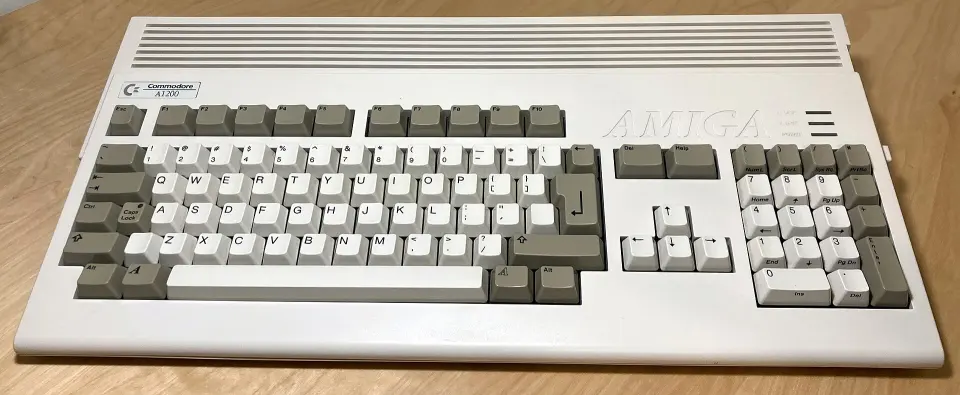
The A1200 introduced a 68EC020, the AGA graphics chipset and 2 MB of Chip RAM, as well as IDE and PCMCIA.
The A4000 offered AGA and Zorro III expansion; early versions shipped with a 68040, followed by 68030 variants. The desktop used IDE, unlike the A3000’s SCSI.
The CD32 (1993) adapted AGA and a 68EC020 for a CD-ROM console.
OCS, ECS and AGA refer to hardware generations, not desktop-software releases. Their differences could affect screen modes and software compatibility. Memory, processor, expansions and system version mattered too. Saying that a program “runs on Amiga” is not always enough to identify the machine or configuration it needs.
AmigaOS, Workbench and Kickstart
The system’s names are often confused. AmigaOS refers to the operating system as a whole; Workbench is its graphical environment of icons, windows and menus. AmigaDOS provides file-management and command-line facilities. Kickstart contains essential components for booting and running the system.
On the A1000, Kickstart was loaded from a floppy disk into special memory. On most later models it was usually provided in ROM. Differences between versions and machines could determine whether an application started or recognised particular hardware; the family name alone did not remove those requirements.
Games, music and audiovisual production
The Amiga is associated with video games, but its culture also included the demoscene, where groups explored graphics, animation, timing and sound in audiovisual programs. Trackers such as Soundtracker and ProTracker let musicians arrange notes and samples in patterns. The MOD format helped those compositions circulate and be played on different machines and software.
The platform was also used for video. Introduced in 1990, NewTek’s Video Toaster combined expansion cards and software for production and editing, and found a prominent place in A2000-based setups and NTSC video environments. It was not built into every Amiga: it required additional hardware and software.
Corporate break and later continuities
Commodore’s liquidation in 1994 ended the platform’s original industrial continuity. Escom acquired Commodore assets in 1995 and established Amiga Technologies; Escom entered insolvency proceedings in 1996, and Gateway acquired related assets in 1997. What followed was not one linear upgrade path: classic hardware, emulation, PowerPC AmigaOS, MorphOS and AROS developed along distinct lines.
Continuity also lives in everyday use and community archives. Aminet hosts software and documentation, but terms of use depend on each package. WHDLoad makes it easier to install many games and demos on a hard drive, including programs that take over the system; the tool does not grant rights to that content or to Kickstart images some programs require. Emulation enables people to study and run older configurations, though compatibility depends on the emulated system and the files used.
68k accelerators, FPGA designs and ARM solutions that emulate 68k processors—such as Emu68—extend the ways the platform can be used, without making different configurations universally interchangeable. User groups, including Amiga North Thames, continue to hold meetings, demonstrations and gaming sessions and to offer technical support: a cultural legacy that does not depend on everyone owning the same machine.
Preserving the computers and their media
A machine that has been stored for years should be checked before being powered up. Identify its model, board revision and expansions. Surface-mount electrolytic capacitors in A600, A1200, A4000 and CD32 systems can leak without visible bulging. Clock batteries on some boards—including certain A2000, A3000, A4000 and A500 Plus versions—and on some expansions can also cause corrosion. The original A500 did not have a clock battery on its motherboard. Where leakage or damage is present, inspection and repair belong with an experienced technician; power supplies and CRT monitors should not be opened without appropriate training.
Floppy disks need their own care: stable, dry and clean storage, write-protecting originals and making copies with a healthy drive all help reduce risk. Do not put mouldy disks into a drive. An ADF image can preserve many disks, but does not necessarily record every copy-protection scheme or physical detail; some preservation work requires magnetic-flux captures. Manuals, labels and provenance also help make sense of recovered software.
The Amiga’s legacy is more than a list of models. It lies in an architecture that shared work between the processor and specialised chips, in the creative work the platform enabled, and in the continuing efforts of people who keep its machines, software and knowledge in circulation.
Documentary gallery
- Decade
- 1980s
- Region
- Global
- Level
- Enthusiast
- Entities
- Disquete, Cuatro
Sources and references
- AmigaOS documentation · programming, Exec and memory protectionwiki.amigaos.net · 2026-11-11
- Amiga Hardware Database · model a1000amiga.resource.cx · 2026-11-11
- Amiga Hardware Database · model a500amiga.resource.cx · 2026-11-11
- Amiga Hardware Database · model a2000amiga.resource.cx · 2026-11-11
- Amiga Hardware Database · model a3000amiga.resource.cx · 2026-11-11
- Amiga Hardware Database · model a600amiga.resource.cx · 2026-11-11
- Amiga Hardware Database · model a1200amiga.resource.cx · 2026-11-11
- Amiga Hardware Database · model a4000amiga.resource.cx · 2026-11-11
- Amiga Hardware Database · model cd32amiga.resource.cx · 2026-11-11
- Commodore hardware manual · CPU and custom chipsamigadev.elowar.com · 2026-11-11
- AmigaOS manual · Workbenchwiki.amigaos.net · 2026-11-11
- Computer History Museum · 1990 Video Toasterwww.computerhistory.org · 2026-11-11
- HomeComputerMuseum · Escomwww.homecomputermuseum.nl · 2026-11-11
- WHDLoad · purposewww.whdload.de · 2026-11-11
- WHDLoad · requirementswww.whdload.de · 2026-11-11
- Aminetaminet.net · 2026-11-11
- ProTracker 2 clone · project documentationraw.githubusercontent.com · 2026-11-11
- Emu68 · project documentationraw.githubusercontent.com · 2026-11-11
- Amiga Wiki · conservation of capacitors and batterieswww.amigawiki.org · 2026-11-11
- Amiga North Thames · activitieswww.amiganorththames.co.uk · 2026-11-11
- Amiga Documents · early yearssites.google.com · 2026-11-11