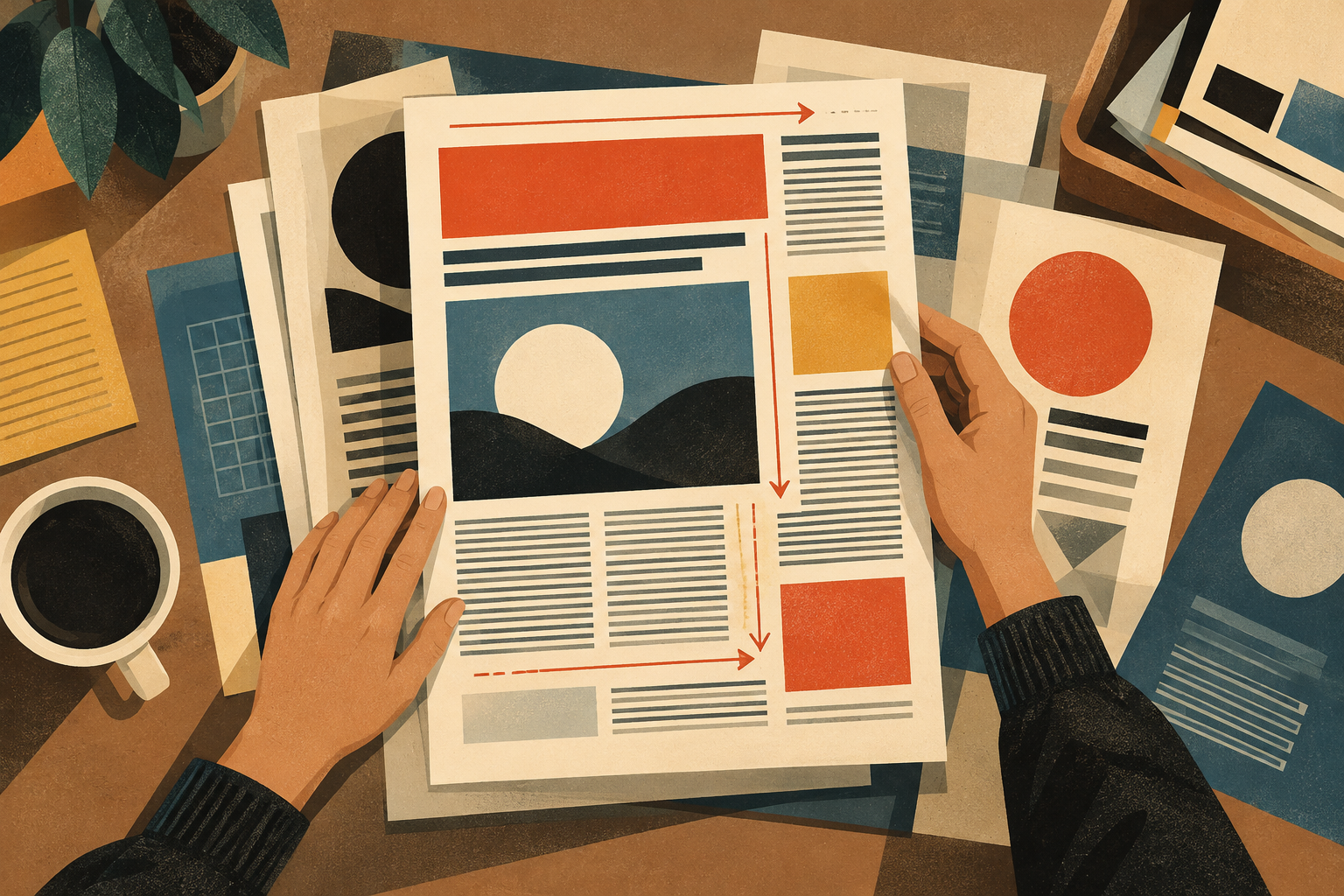
An advertisement can attract attention before we read a single word. The size of a headline, the position of an image and the space left empty already organize the viewer’s gaze. These are not details added after the message: they help make it. But observing that structure does not, by itself, tell us who commissioned it, which audience saw it or whether it persuaded anyone. A rigorous discussion of design keeps two questions in view: what formal choices are visible, and what evidence do we have about their purpose and use?
Form does a job
Graphic design can be understood as a visual communication practice combining text, images and composition to convey messages. The reference entry on graphic design emphasizes this function and its application, among other areas, to advertising and branding. This supports a functional reading: hierarchy helps determine what appears first; composition relates elements; typography gives words a visual as well as verbal presence.
That reading is an analytical tool, not an automatic account of original intent. A piece may make one element stand out, but without further documentation we may not know whether that was the specific reason for the choice, who made it or which alternatives were rejected. “Form follows function” is useful as a question, not a guaranteed answer: what function does this form seem to support, and what evidence confirms that hypothesis?
Advertising: communicating and persuading
Advertising adds a persuasive purpose to this discussion. The supplied reference on criticism of advertising describes it as communication intended to persuade an audience, and records objections concerning saturation, psychological pressure and privacy. These arguments remind us that advertising design is not neutral in its possible effects: it organizes attention within a commercial or ideological relationship.
Even so, we should not infer specific effects from appearance alone. An advertisement may make a promise or direct the viewer’s gaze; that does not prove that an audience believed it, that the message worked or that it caused a particular action. Moving from visual analysis to claims about reception would require sources documenting circulation, audiences or responses. Without them, an interpretation can describe visible devices and identify possible functions, while leaving the outcome open.
What an archive adds
MUVAP is described as a virtual museum documenting the history of Spanish advertising and graphic design in Spain. The Centro de Documentación Publicitaria, in turn, presents its project as a historical advertising archive. These descriptions support an important point: preserving pieces allows them to be studied as documents, not only as attractive images.
An archive also shapes what we can know. Selection, description and grouping affect which connections become visible. An isolated piece offers different information from a series; a catalogue record may foreground authorship, date or medium, but the supplied summary does not establish which specific fields these collections contain. RetroPause’s article on design and advertising in the museum explicitly frames documentation and the archive as layers that contribute to the historical account. It invites us to ask not only what an institution preserves, but how it presents it and what remains undocumented.
A publication as a reading exercise
Lucía Céspedes’s study of the Argentine magazine Ciencia Nueva identifies its contents, graphic resources, advertising and audiences as areas of analysis, and places the magazine between 1970 and 1974. The supplied record gives no detailed findings and describes no specific advertisements or design decisions. The case therefore serves as a methodological prompt, not as grounds for attributing particular visual features to the magazine.
Its approach points to a productive way of researching: study graphic resources and advertising together without treating them as the same thing. In a magazine, an advertisement belongs to an editorial object that also organizes other content. Explaining how these parts relate would require examining the issues and their documentation. From the information supplied, we can say only that the study includes them in its analysis, not what compositions they used or how readers responded.
From print to the internet, without invented leaps
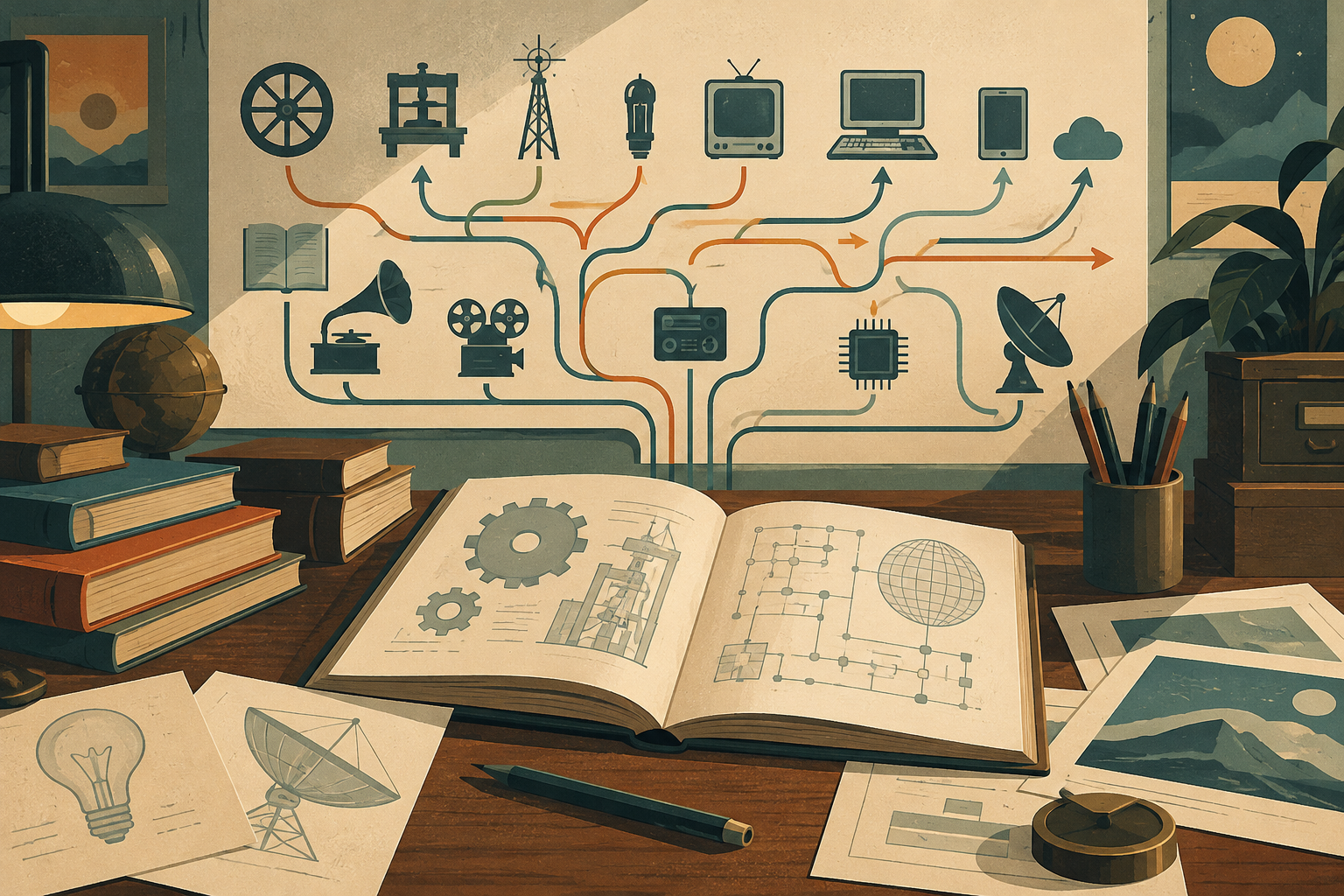
The registered chapters “Advertising before the printing press” and “Advertising in the internet era” indicate that advertising can be studied across very different contexts. Their titles alone are not enough to reconstruct a detailed transition between techniques, media or styles. They do, however, suggest a caution: do not present digital media as a simple replacement for print, or assign a uniform aesthetic to each period without consulting the relevant sources.
When comparing pieces, begin with what can be observed: how information is arranged, which element carries the greatest weight, what relationships the composition establishes and what function that organization might serve. Then distinguish observation from interpretation, and both from evidence about production, circulation and reception. This separation prevents an aesthetic label—“modern,” “retro” or “minimalist”—from standing in for analysis.
Reading the piece and recognizing the limit
Design organizes information and proposes ways of using visual objects: reading, identifying, comparing or pausing. Advertising uses that capacity to present persuasive messages, although actual effects require evidence distinct from the image itself. Archives and specialist studies can supply context, but their available descriptions must be read as carefully as the pieces they describe.
The answer to which functional decisions explain a design therefore begins with verifiable questions, not a style assigned in advance. We can describe visible hierarchies and relationships; we can ask what work they seem to do. To explain who made a decision, for what purpose and with what result, we need additional documents. Keeping that boundary clear does not impoverish interpretation: it helps us understand what a piece shows and what we still do not know.
- Decade
- 1970s
- Region
- Global
- Level
- Enthusiast
- Entities
- Museum, MUVAP, Internet
Sources and references
- La publicidad antes de la imprentadoi.org · 2026-10-08
- La publicidad en la era de internetdoi.org · 2026-10-08
- LA REVISTA ARGENTINA CIENCIA NUEVA (1970-1974): ANÁLISIS DE CONTENIDOS, RECURSOS GRÁFICOS, PUBLICIDAD Y PÚBLICOSopenalex.org · 2026-10-08
- MUVAP (2001- 2016): museo virtual que documenta la ...revistas.ucm.es · 2026-10-08
- Diseño y publicidad en el museo: cuando el archivo también ...www.retropause.com · 2026-10-08
- Centro de Documentación Publicitariawww.lahistoriadelapublicidad.com · 2026-10-08
- Diseño gráficoes.wikipedia.org · 2026-10-08