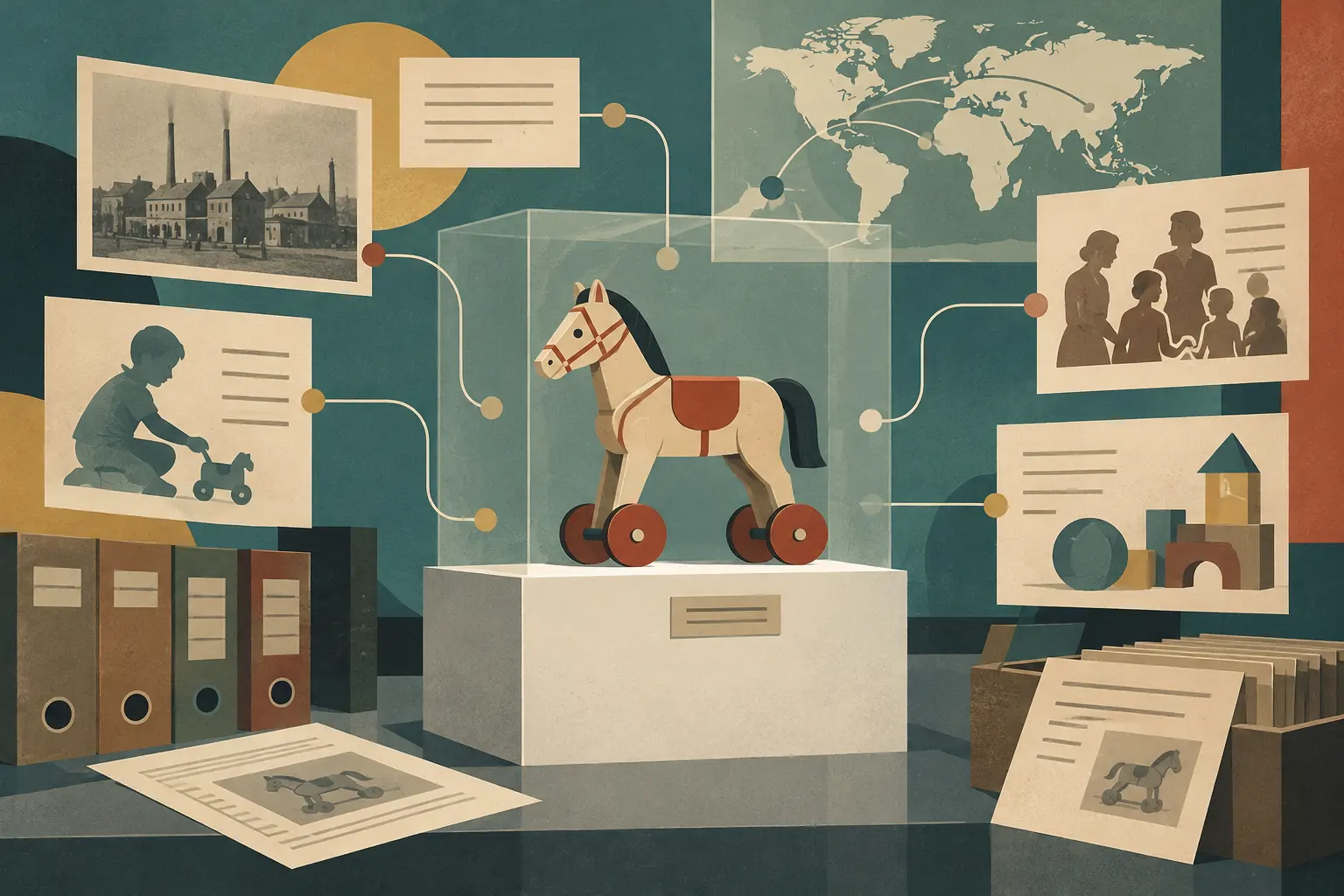
The preservation of a play object transcends the mere custody of its materiality. In contemporary museology, the toy ceases to be a simple static relic and becomes a cultural document that requires rigorous documentation of its use. This conceptual shift implies that the history of who handled the object and under what circumstances is as valuable as its physical state. Archives and pedagogical museums have developed methodologies to capture this social dimension, allowing the toy to function as a primary source for understanding the dynamics of everyday life in different eras.
The toy as a living document
Available evidence suggests that a stored toy retains a form, but it is the annotation of its use that allows part of its history to be preserved. Institutions such as the Colombian Pedagogical Museum have adopted this approach, positioning the toy not only as an artifact but as a living document. This perspective aligns with studies on ethnographic heritage that emphasize the need to record the context of manufacture and use. By doing so, museums reconstruct a social biography that goes beyond the exhibition label, integrating collective memory into the curatorial narrative.
Historical contextualization and production
To understand the value of a toy, it is essential to analyze its production context. The case of Playmates dolls, produced in the second half of the 20th century, illustrates how the manufacture of these objects is intrinsically linked to the social dynamics of the time. Documenting these pieces does not limit itself to describing their physical characteristics but explores the market conditions, design trends, and social expectations that surrounded them. This contextual approach allows researchers and the general public to understand how toys reflect and, in turn, shape the cultural norms of their time.
Heritage registration methodologies
Manuals for the documentation of heritage collections, such as that produced by the Chilean CDBP, provide the technical foundations for this work. These documents emphasize preventive conservation as a set of actions aimed at protecting and ensuring the material life of cultural assets. However, documentation does not stop at physical protection; it includes the capture of metadata regarding use, provenance, and modifications suffered by the object. This duality between physical conservation and historical recording is fundamental to ensuring that the toy maintains its cultural relevance in the long term.
The boundary between fact and interpretation
One of the main challenges in the museography of play is distinguishing between documented facts and curatorial interpretation. While preventive conservation protects the matter, active research seeks meaning. Museums must be transparent about which aspects of the toy's history are supported by primary evidence and which are interpretive constructions. This distinction is crucial to maintaining the academic integrity of exhibitions and avoiding the projection of anachronistic narratives onto historical objects.
The role of ethnographic museums
Ethnographic toy and game museums play a key role in preserving the living history of traditional games. These spaces do not only exhibit objects but facilitate the continuous renewal of cultural memory. By documenting the use of toys in specific contexts, these museums contribute to the preservation of the intangible heritage associated with play. This work is particularly relevant in communities where traditional toys have deep ritual or social significance, and whose documentation requires a sensitive and rigorous approach.
Limitations of available evidence
Although the available sources provide a clear view of general methodologies, there are limitations in the specificity of documented cases. The provided evidence does not detail specific technical procedures for digital recording or protocols for accessing private archives. Furthermore, information on the practical implementation of these methodologies in different geographical regions is limited. Therefore, it is important to recognize that the application of these practices may vary significantly depending on the resources and institutional approach of each museum.
Conclusion
The documentation of toy use in museums represents a significant advance in the understanding of cultural heritage. By treating toys as living documents, institutions preserve not only objects but memories and social contexts. This approach enriches the visitor experience and provides valuable tools for academic research. The key lies in maintaining a balance between the physical protection of the object and the depth of its historical recording, ensuring that the social biography of the toy is accessible and rigorous.
- Decade
- 1970s
- Region
- Global
- Level
- Enthusiast
- Entities
- Museum, Museos etnográficos, Muñecas Playmates, Playmates, Museo Pedagógico Colombiano
Sources and references
- Patrimonio Cultural - MUSEO PEDAGÓGICO COLOMBIANOmuseopedagogico.pedagogica.edu.co · 2026-10-22
- Un juguete guardado conserva una formawww.facebook.com · 2026-10-22
- La Conservación de material etnográficounesdoc.unesco.org · 2026-10-22
- La importancia del museo de juegos y juguetes ...museodeljugueteetnico.com.ar · 2026-10-22
- Manual de Documentación - de Colecciones Patrimonialeswww.cdbp.gob.cl · 2026-10-22