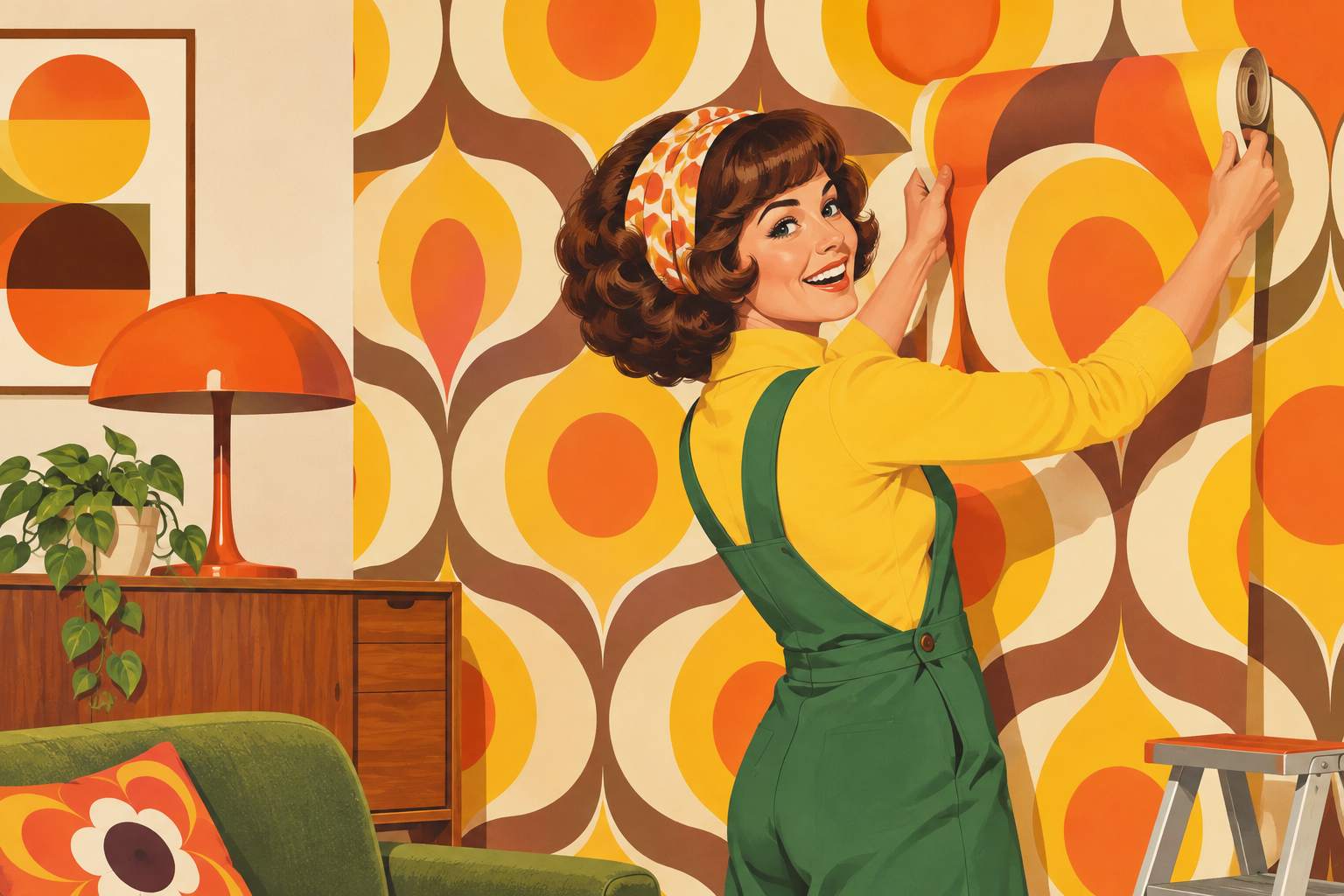
Advertising a domestic material does more than describe it: it also suggests how it might look at home. A text on the history of wallpaper design reports that, from 1970, the German trade association Deutsche Tapeten-Gemeinschaft began placing advertisements in magazines including Stern and Schöner Wohnen. The effort sought to counter what was described as a dull trend by promoting modern, pop-inspired designs through colourful and humorous imagery. This is a concrete clue to how interior design and commercial communication could meet on the printed page. It is not enough, however, to tell the story of a particular campaign.
A material in search of a new image
The source describes a sector-wide effort to challenge an image perceived as monotonous. That description should be understood as the account given by the text, not as an independent measure of consumer taste. What it does establish is that the advertising offered an alternative: modern wallpapers associated there with pop style and a more eye-catching visual presentation.
The shift was not only about the product itself. Showing a wall covering through surprising or humorous imagery could help turn a functional decision—what to put on a wall—into an aesthetic choice. This is an interpretation of the approach described; the supplied sources do not explain the specific arguments in each advertisement or how audiences responded.
The magazine page as a shop window
The mention of Stern and Schöner Wohnen places the advertisements in two identifiable print titles. The evidence gives no publication dates for individual items, circulation figures, formats, credits, or page locations. Nor does it provide reproductions that would allow analysis of typography, layout, photography, or illustration. It is therefore not possible to describe individual advertisements rigorously or to assign them a precise aesthetic beyond the general traits recorded: colour, humour, and a modern outlook.
Even within these limits, the media matter. A magazine provides a different editorial context from a wallpaper sample or product catalogue. An advertisement might have reached readers interested in interiors or current affairs, but that possibility does not establish who saw the pieces or what effect they had. Separating the documented publication context from the audience response we do not know prevents a plausible hypothesis from being presented as fact.
Design and advertising, a porous boundary
Histories of graphic design often describe the discipline as a way of organising text and images to communicate, and recognise its links with advertising and brand identity. That general definition helps place this case, but it does not document the design decisions behind these specific advertisements. Studying them would require the original issues, credits and, if they survive, records held by the association or agencies involved.
It also matters that the advertising came from a trade association, according to the available source. This supports describing the material as communication promoted from within the German wallpaper sector, but not attributing the pieces to a particular company, designer, or brand. The distinction is important: the institutional context is identified; the creative contributors and specific campaigns are not.
What the archive can show—and what is missing
A study of MUVAP, a virtual museum documenting the history of advertising and graphic design in Spain, points to difficulties in preserving the documentary heritage generated by advertising agencies and argues for involving documentation professionals. That work concerns Spain, not direct research into the German advertisements discussed here. It offers a methodological warning: advertising history depends on preserving and cataloguing materials, but it does not prove that this particular case has suffered a documentary loss.
Further research would require dated copies of Stern or Schöner Wohnen, identification of individual advertisements, and production details. Without them, it would be unwise to supply names, slogans, or supposed audience reactions. The gap does not invalidate the clue, but it defines its scope: we have evidence of an approach and some publication outlets, not a catalogue of pieces.
A lead, not a reconstructed campaign
What can be verified is precise but limited: from 1970, Deutsche Tapeten-Gemeinschaft advertised in certain German magazines; the text consulted links those advertisements to modern, pop-inspired designs and colourful, humorous imagery. That combination offers a way to observe how an industry might try to renew the public presentation of a domestic product.
The available evidence does not support a detailed chronology, named authorship, commercial impact, or lasting influence. For now, the editorial value of the case lies in pointing towards a line of inquiry: reading interior-design advertising not only as the promotion of goods, but as part of everyday visual culture. Turning that lead into design history will require locating and documenting the advertisements one by one.
- Decade
- 1970s
- Region
- Europe
- Level
- Introduction
- Entities
- Museum
Sources and references
- MUVAP (2001- 2016): museo virtual que documenta la historia de la publicidad y el diseño gráfico en Españawww.researchgate.net · 2026-09-28
- Historia del diseño gráfico internacional: Historia del diseño gráfico en la década de los setentahdgiesne.blogspot.com · 2026-09-28
- Viaje por la historia del diseño: La publicidad del papel pintado en los 70 | Rolling Back | Blog | Papeles de los 70www.papelesdelos70.com · 2026-09-28
- Historia del diseño gráfico | Contexto, movimientos y sus artistasbudamarketing.es · 2026-09-28
- LA CULTURA DE LOS OBJETOS: UNA HISTORIA DEL DISEÑO ESPAÑOL DESDE 1960digibuo.uniovi.es · 2026-09-28


