A meeting place around the board
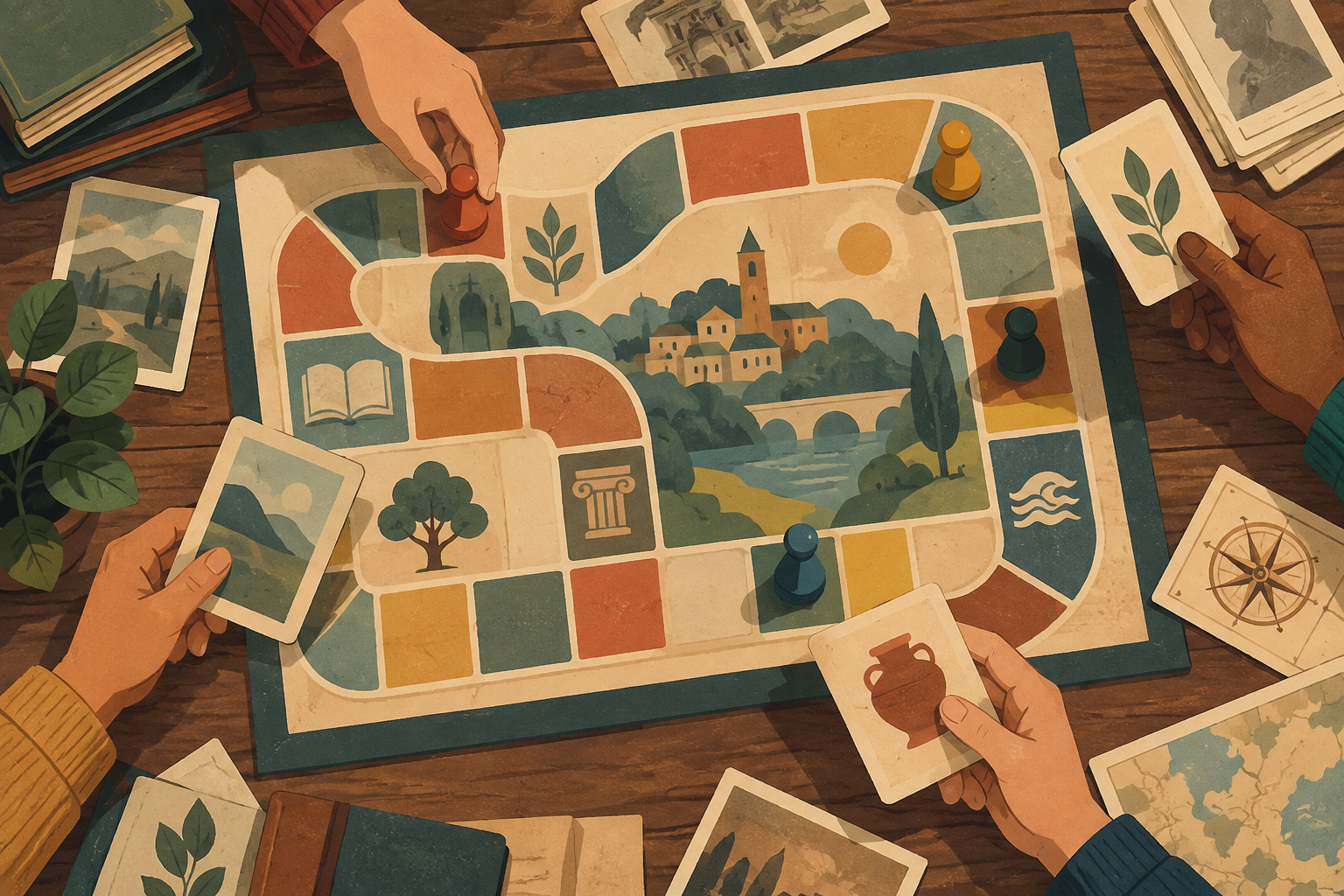
A board game can bring people together around rules, pieces and a shared surface. That situation is enough to raise cultural questions: what knowledge does it pass on, what stories does it circulate, and who decides what is worth remembering? It does not, by itself, prove that a game preserves heritage. Context and documentation are needed to support that claim.
The available sources offer a brief overview, not a complete history of board games. They include educational resources, a collection record, museum initiatives and a contemporary game set in museums. Taken together, they allow us to explore connections between play and heritage without assuming that every game is a history lesson.
Playing to approach history
The National Archaeological Museum presents its resource “Games in History” with a broad premise: play is an activity found since antiquity and can develop skills and support learning. This makes it reasonable to consider games as educational mediators. The description does not, however, identify a single method or prove that any game automatically produces historical learning.
The distinction matters. A resource for learning through play is not the same as an object preserved in a collection. Nor does the available description tell us which specific games the resource includes or how its results are assessed. The most responsible claim is that a museum proposes one way to connect play and history—not that it has demonstrated universal effects.
Objects need context too
The Spanish Ministry of Culture’s CER.es catalogue records an entry titled “Board Games and Society,” associated with the Museo del Traje. The description places it under categories such as “Games and Toys” and “Race Games,” and identifies it as a board game. This is concrete evidence that games appear as catalogued objects in a museum collection.
A record does not tell an object’s whole story. The entry shown is not enough to establish who made it, who played it, how it circulated or what it meant to different communities. Cataloguing helps identify and organise; interpretation requires more information, such as provenance records, testimony or material analysis. The questions raised by an object should not be mistaken for answers the record does not provide.
Heritage becomes a game theme
Chile’s National Historical Museum announced the “First Heritage in Play Meeting,” devoted to education, museums and board games. Its announcement mentions an exhibition of heritage games addressing themes related to Chilean heritage. Here, the game is not only a collected object or teaching tool; it is also a way of representing heritage subjects.
The announcement establishes that the event took place and describes its focus, but the supplied excerpt does not name the games on display, their creators or the audience’s response. That boundary matters. We can say that an institution presented a selection of games on those themes; we cannot claim that the selection represented the full diversity of Chilean heritage or changed how people learn about it.
The museum inside the game
RetroPause describes “Museum,” first published in 2019, as a competition built around collections in museums of the early twentieth century. This offers another kind of connection: a museum can serve as the setting and theme for a contemporary game. In the description, collecting and ordering are part of its premise.
A setting does not automatically make a game a reliable account of museum history. Assessing its representation would require examining the game itself—its rules, images and stated sources. The available description does not provide those details. “Museum” therefore serves here as an example of a work that plays with the idea of collecting, not as proof that it teaches an accurate institutional history.
What the evidence can support
These sources show several possible relationships: games as educational resources, collection objects, heritage themes and settings for contemporary works. These categories are related but not interchangeable. A game may propose learning without being a museum object; a catalogued object may have an unknown social history; and a game set in a museum may draw on the idea of collecting without documenting it exhaustively.
The main limitation is the scope of the evidence: it offers specific examples, not a representative sample of all board games or enough information to measure their impact. Even so, it suggests a useful question for museums and players: beyond asking how a game works, what stories does it contain, and what information can be verified? That approach makes the board a starting point for research, not a replacement for archives or context.
- Decade
- Contemporary
- Region
- Global
- Level
- Introduction
- Entities
- Museum, Museo del Traje, Museo Arqueológico Nacional
Sources and references
- ¿Qué puede hacer un juego por el patrimonio cultural? ...www.facebook.com · 2026-09-29
- Juegos en la Historia - | Ministerio de Culturawww.man.es · 2026-09-29
- Juegos de mesa y sociedad - CER.es - Ministerio de Culturaceres.mcu.es · 2026-09-29
- Museum: coleccionar, ordenar y jugar con la idea de museowww.retropause.com · 2026-09-29
- I Encuentro de Patrimonios en Juego: Educación, museos ...www.mhn.gob.cl · 2026-09-29