Preservation begins by defining what is being preserved
Talking about video game preservation can sound straightforward: keep games from disappearing. But the supplied material points to a broader discussion. A conference titled “The video game: a cultural product to preserve” explicitly brings together video games, libraries, museums and preservation. A 2023 academic article addresses museums and video games, describing initiatives in which museums use games to share their collections. Together, these references invite a distinction between preserving a work and deciding how to make it understandable in a cultural setting.
That distinction matters because the material provided does not detail specific preservation procedures or describe the condition of individual collections. It therefore cannot establish which methods are used, which elements are preserved in each case, or what results have been achieved. It does, however, identify an institutional and editorial concern: video games are treated as objects of preservation and also as media that may take part in communicating heritage.
A work and its explanation are not the same thing
Game culture cannot be reduced to a screen. This section can address rules, presentation and play context, but it must distinguish the work from the stories surrounding it. The preservation conference offers a starting point: its title itself frames the video game as a cultural product. The University of Málaga journal article extends the discussion to museums and the dissemination of their collections.
These references do not, on their own, prove a complete theory of what counts as a preserved video game. More modestly, they support useful questions: are we discussing the work, materials related to it, or its use in an exhibition? What information helps separate a documented feature from a personal recollection? Without sources specific to each game, these questions should remain open rather than becoming claims about particular experiences.
The museum as a place of presentation
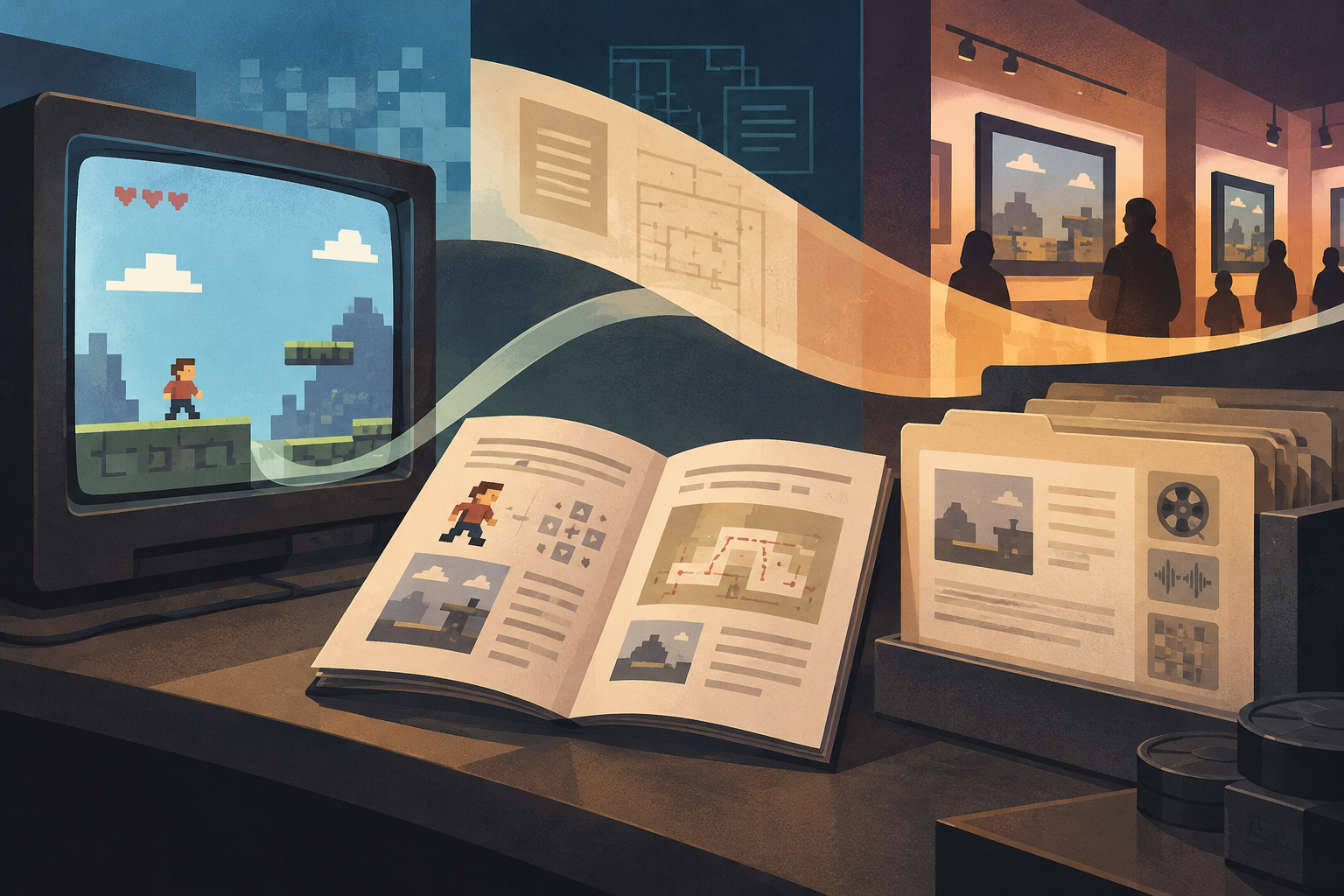
A museum is not simply a place where something is stored. The conference material explicitly connects museums and preservation; the academic article focuses on museum initiatives that use video games to share collections. ICOM, in turn, presents two projects developed in Argentina in which heritage institutions produced video games from their heritage. These are different examples of a possible relationship between games and cultural institutions, not evidence that all museums work in the same way.
The difference between displaying a video game and using one to communicate a collection deserves attention. In the first case, the work may be the object of interest; in the second, the game takes part in a dissemination project. The ICOM source supports the existence of the two projects mentioned, but the supplied excerpt gives no names, dates or design details. It would be wrong to fill those gaps by guesswork.
Document before completing the memory
The Video Game Museum website says that, since 2000, the institution has worked to locate, document and preserve materials related to the history of video games and computing. MUVIC describes itself as a cultural and museum project dedicated to preserving, studying and sharing that history through temporary and travelling exhibitions. These statements describe institutional aims; by themselves, they do not evaluate the scope of a collection or the results of preservation work.
Caution does not diminish the value of these facts. It helps us read them accurately: a stated mission is relevant information about how an institution understands itself, but it is not equivalent to an audit of its holdings. Navigames’ introduction to video game preservation in Spain and Microsiervos’ article on the Embracer Games Archive broaden the available reading, although the supplied excerpts do not provide enough detail to attribute specific conclusions to them.
Preservation also means acknowledging limits
The RetroPause source about video games in museums asks a particularly useful question: is a video game in a museum still something that is played? Its title raises a tension between work, experience and presentation, but the supplied excerpt does not include the article’s discussion. It can serve as a research question, not as proof of an answer.
Nor do the available results allow us to reconstruct the experience of an arcade, an internet café or a bedroom, or to compare different versions of a particular game. That would require specific sources: game documentation, contemporary materials, institutional records or attributable testimony. The evidence assembled here supports a reflection on preservation and cultural mediation, but not a detailed history of play practices.
Preservation needs context
The sources outline a field in which preserving, documenting, studying and sharing are connected, but they are not interchangeable tasks. The cultural conference, academic article, projects cited by ICOM and institutional statements show different ways of relating video games and heritage. They do not establish a single solution or justify generalizations about every collection.
The firmest conclusion is also the most cautious: discussing video games as heritage requires explaining what is preserved and what evidence supports that account. Manuals, magazines, institutional records and attributable testimony can help situate works, provided documented facts are distinguished from later memory. Preservation does not automatically complete the story; it creates better conditions for investigating it.
- Decade
- Contemporary
- Region
- Global
- Level
- Introduction
- Entities
- Museum, Museo del Videojuego, Internet
Sources and references
- Museos & videojuegos: dos proyectos desarrollados en ...icom.museum · 2026-10-10
- Jornada "El videojuego un producto cultural a conservar"www.youtube.com · 2026-10-10
- Vista de Museos y videojuegos. La renovación de los ...revistas.uma.es · 2026-10-10
- Qué hacemos | Museo del Videojuegowww.museodelvideojuego.com · 2026-10-10
- La conservación de la historia de los videojuegos en el ...www.microsiervos.com · 2026-10-10
- MUVIC – Museu del Videojoc de Catalunya | Castellanomuvic.cat · 2026-10-10
- Un videojuego en el museo sigue siendo algo que se juegawww.retropause.com · 2026-10-10
- Introducción a la conservación del videojuego en Españawww.navigames.es · 2026-10-10